
Built structures · Drying kilns and dryers
Barbacuá
The Barbacuá is a fixed batch dryer for yerba mate. Its documented forms use a raised drying surface warmed by wood fire; one excavated example in Misiones preserves a stone flue below ground.
A dryer for the mate crop
Barbacuá names a batch-drying system used for yerba mate, not a general-purpose meat smokehouse. In Argentina’s documented processing sequence, harvested leaves receive a brief zapecado heat treatment, then drying, coarse crushing called canchado, maturation, milling and packing. The national quality protocol lists Barbacuá alongside several other dryer types, so the name does not imply one fixed size or layout.
INTI described the artisanal route in Misiones as a slow wood-fire drying stage lasting around ten to twelve hours. This is a report about that regional practice, not a universal operating time. Barbacuá leaf drying also should not be conflated with zapecado, which is a separate brief heat treatment.
A buried example at Mártires
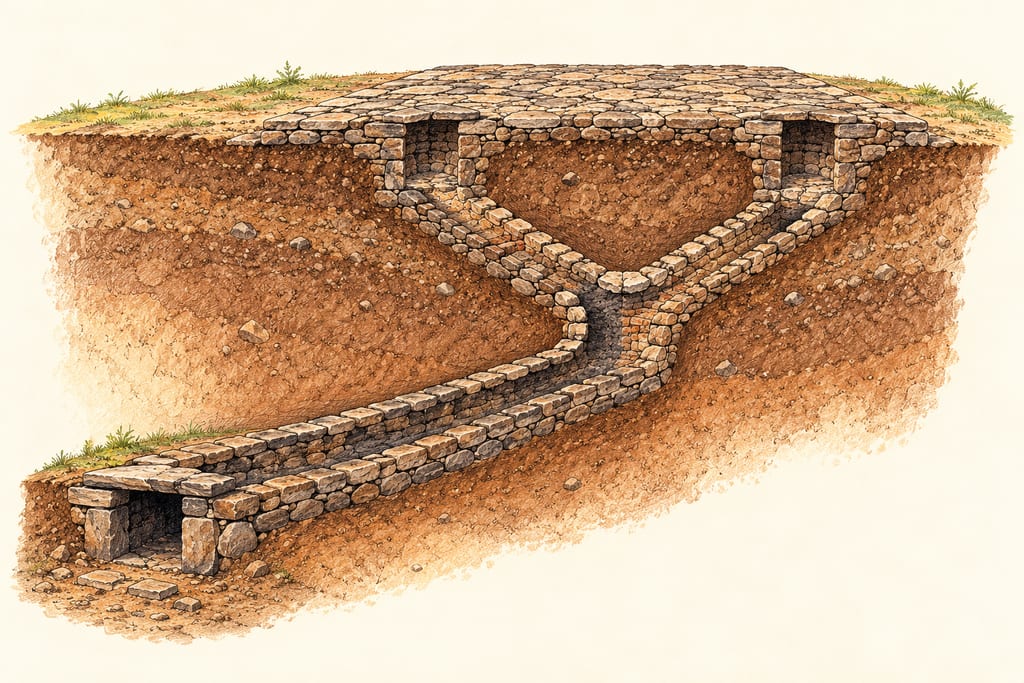
Archaeologists identified the Mártires 1 remains in Misiones as a Barbacuá dryer after combining field survey, excavation, documentary research and local oral knowledge. Its underground work is unusually visible: a straight stone-lined conduit rises from a mouth toward a Y-shaped split below a paved platform, with two separate openings at the surface. The main straight section measures six metres; each branch was measured at 5.20 metres.
The conduit and paving were built mainly from local itacurú stone. The study records brick and cement in altered sections as later repairs or reuse, probably in the twentieth century, rather than evidence for an all-brick original. It reports 36 square metres for the paved surface and later gives overall measurements of 9.70 by 7.07 metres; those figures conflict, and the article does not resolve the discrepancy.
The missing upper structure
The paved platform was probably the base for posts and a drying basket, but those parts have disappeared and the archaeologists found no post impressions. Historical descriptions and local knowledge support the basic relationship between a raised basket and heat conducted from a remote fire through a buried passage; they do not supply a complete measured plan for the Mártires dryer. The cutaway illustration therefore shows the excavated masonry beneath ground level and leaves the missing superstructure out.
A photograph from Campo Ramón shows another working dryer with yerba spread across its bed inside a roofed masonry room. It is a separate, later example and should not be used to reconstruct the missing Mártires supports.
An unresolved history
The archaeological article reports local memories of Barbacuá drying around Mártires into the late twentieth century and notes that INTI still described the artisanal method in 2017. For the excavated structure itself, the authors propose a possible Jesuit-period origin but state that its chronology remains unresolved and allow that later settlers and Guaraní builders may have used inherited masonry skills. Twentieth-century reuse is better supported by industrial bricks, cement and oral accounts.
This example belongs to a broader yerba-mate drying tradition in Misiones, but neither the photographed dryer nor the excavated one establishes a standard design for Argentina or the wider southern South American mate region.
History
The archaeological study identifies the Mártires 1 structure as a yerba-mate Barbacuá dryer, while treating its origin as unresolved. It proposes a Jesuit-period origin but cannot exclude later construction by settlers and Guaraní builders; twentieth-century repairs and reuse are much more securely evidenced.
Site
A build is made where it stands: moving it means building it again.
How it is built
Materials
- Itacurú stone — Cut stone blocks recorded in the Mártires 1 underground conduit and paving; the study gives no total material quantity.
- Brick and cement — Observed in repair and reuse sections, which the archaeologists distinguish from the original stone construction.
- The excavated Mártires layout begins at a mouth and rises through a six-metre straight stone-lined flue to a Y-shaped fork beneath the paved platform.
- The two branches continue beneath the platform and end at separate surface openings; the study measured the branch lengths at 5.20 m each.
- The paved surface sits above the outlets. The original posts and drying basket that likely stood on it are missing, and no post impressions were identified; this evidence does not establish their exact form or assembly.
Places
Argentina
Documented use · Country evidenceThe protocol names Barbacuá among drying systems; this is not a claim that every Argentine dryer has the same construction.
Misiones
Traditional use · Region evidenceThe source documents the regional process, not a universal structure.
Mártires
Historical attestation · Locality evidenceThe site is on private property; no precise coordinates are included.
Campo Ramón
Documented use · Locality evidenceThe source photograph shows yerba mate drying in a dryer at Campo Ramón; this is a separate example from the Mártires excavation.
Community
No community contributions have been published for this entry yet.
Share what you made
Sign in to contribute. Published comments and photos are free to read.
Sources
Relaciones de la Sociedad Argentina de Antropología, 48(1), article 066Archaeology · Construction · History · Geography
Arqueología de la producción yerbatera en Misiones: Primera aproximación a un antiguo secadero barbacuá en la localidad de MártiresIdentifies the excavated Mártires 1 structure as a yerba-mate Barbacuá dryer.
Describes a six-metre rising main flue with a Y branch, two outlets, stone paving and a retaining wall; post impressions and the above-ground basket were not found.
Records itacurú masonry, likely twentieth-century brick/cement repair, an unresolved construction date and competing hypotheses about origins.
Cited in: A buried example at Mártires; The missing upper structure; An unresolved history
Instituto Nacional de Tecnología Industrial (INTI), 27 December 2017Process · Modern use · Geography
Promueven la exportación de yerba mate a partir de un proceso de secado más limpioDescribes artisanal Barbacuá drying as slow dehydration using wood-fire heat for around 10–12 hours.
Locates the study discussed in the article at Dos de Mayo, Misiones; its test methods are distinct from the traditional equipment.
Cited in: A dryer for the mate crop; An unresolved history
Secretaría de Agricultura, Ganadería, Pesca y Alimentos, ArgentinaProcess · Terminology
Resolución 271/2007: Yerba Mate — Protocolo de CalidadSeparates zapecado, drying and coarse crushing (canchado) in yerba-mate processing.
Names Barbacuá among several dryer types; it does not prescribe one universal design.
Cited in: A dryer for the mate crop
Wikimedia CommonsImage reference · Geography
Misiones - Secado de la Yerba Mate.jpgThe photographer describes the subject as yerba-mate drying before canchado at a dryer in Campo Ramón, Misiones.
The file page identifies the photograph as the author's own work and licenses it CC BY-SA 4.0.
Cited in: The missing upper structure