
Built structures · Cabinets and chamber conversions
Beer, cider and wine fermentation fridge
Fermentation fridge
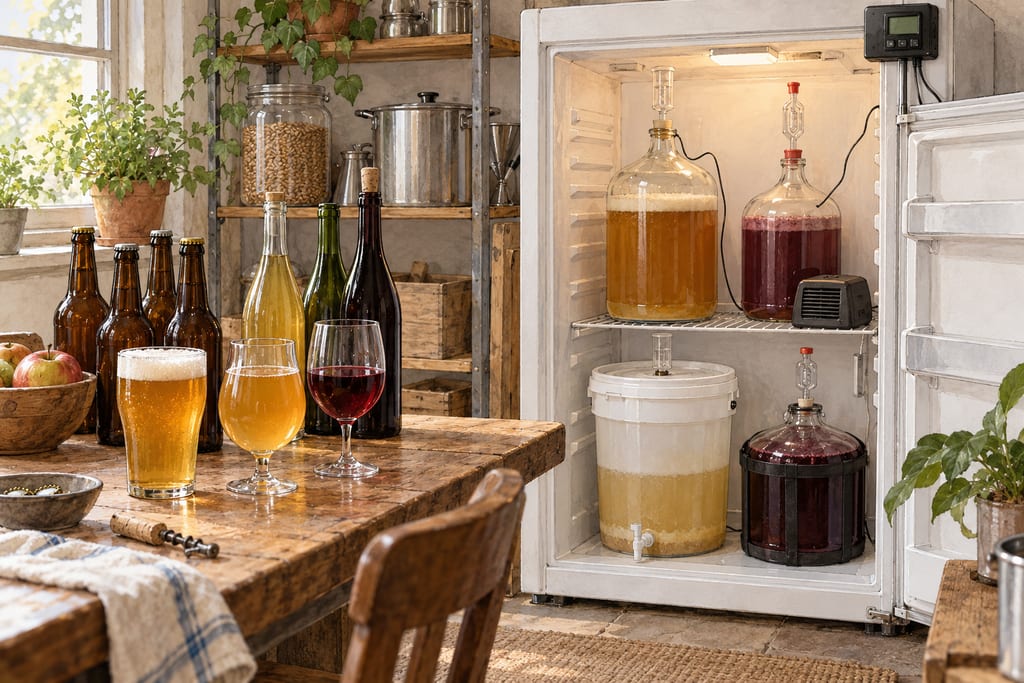
A refrigerator fitted with a heater and a temperature controller, used to hold beer, cider and wine ferments at the range each yeast needs.
Overview
A fermentation fridge keeps a ferment at one steady temperature. The most common home solution is an ordinary refrigerator, often a larder fridge, with a heater and a controller added. The fridge cools, the heater warms, and the controller decides which runs.
The build serves beer, cider and wine together, but the ranges differ for each drink and each yeast.
Ranges by drink
Lager yeasts perform best around 7.2 to 12.8 C (45 to 55 F). Ale yeasts prefer about 15.6 to 21.1 C (60 to 70 F). For white and rosé wine, a guide gives 15 to 20 C (59 to 68 F), and for red wine 22 to 28 C (72 to 82 F). Cider is listed at 12 to 20 C (54 to 68 F), and the warmer the ferment, the drier and less fruity the cider becomes.
Cooler wine ferments generally keep more aromas. Too high a temperature can produce undesirable hydrogen sulphide.
Controlling the liquid temperature
Fermentation generates heat, so the liquid can run warmer than the set point. A homebrew forum thread recommends setting the controller a few degrees below the target and monitoring the beer with a probe in a thermowell rather than the air.
Consumer guides mention a fermentation chamber and a digital thermometer as the simplest controls. A thermowell probe gives the most reliable reading for a sealed vessel.
Sources for this section
Limits and open questions
No single authoritative source covers beer, cider and wine together. The check against the yeast manufacturer's range is required, not optional.
A fridge changes only the air. A brewer's control of ferment temperature still depends on the probe, the controller and the yeast.
Site
A build is made where it stands: moving it means building it again.
How it is built
Risks and precautions
Too high a fermentation temperature can produce undesirable hydrogen sulphide, per one wine guide.
Hazard sourceUse the liquid temperature for control
Control sourceAir temperature is not the same as liquid temperature. A homebrew forum thread advises a probe in a thermowell.
Cider fermented cold at about 40 F with wild or wine yeast finished in one forum report. That is anecdotal and not a recommended method.
Materials
- Refrigerator, preferably a larder fridge — Its thermostat is replaced or bypassed by the controller.
- Heater (heat belt or heat mat) — Raises the cabinet when the room is colder than the ferment needs.
- Temperature controller — Switches the fridge and heater to hold the set point.
- Temperature probe in a thermowell — Sits in the liquid, so the reading is the beer or wine temperature and not the air.
- Fit the heater and controller to the fridge so both can switch independently.
- Place the probe in a thermowell in a test vessel of the same liquid.
- Set the controller a few degrees below the target for the ferment, since fermentation generates heat.
- Choose the range for the yeast in use. Lager, ale, white wine, red wine and cider each have their own range.
- Check the liquid temperature regularly and confirm the controller holds it.
Conditions
Places
Documented for international use, with no single place of origin assigned.
Community
No community contributions have been published for this entry yet.
Share what you made
Sign in to contribute. Published comments and photos are free to read.
Sources
Revolution FermentationMethod
Best temperature for fermentation (practical guide)Wine ranges (white and rosé 15 to 20 C, red 22 to 28 C), cider range 12 to 20 C, and hydrogen sulphide risk at high temperature. Read via search summary.
Cited in: Overview; Ranges by drink; Limits and open questions
Brewers Association (Beer and Brewing)Method
Tip of the week: finding the right temperature for your homemade ciderCider temperature and its effect on dryness. Read via search summary.
Cited in: Overview; Ranges by drink; Limits and open questions
Homebrewers Association forumMethod
Fermentation (Homebrewers Association forum)Advice to set controller below target and probe the beer. Forum post, read via search summary.
Cited in: Controlling the liquid temperature; Limits and open questions
Northern Brewer forumMethod
Fermentation temps (Northern Brewer forum)Anecdotal cold cider fermentation at about 40 F with wild or wine yeast. Forum post, read via search summary.
Cited in: Controlling the liquid temperature; Limits and open questions