
Equipment · Incubators and warm holds
Black garlic ageing cabinet
Black garlic ageing chamber · Black garlic cabinet
A heated, humidity-controlled cabinet for holding whole garlic at high temperature and humidity while it darkens into black garlic. The change is browning chemistry, not live fermentation.
Overview
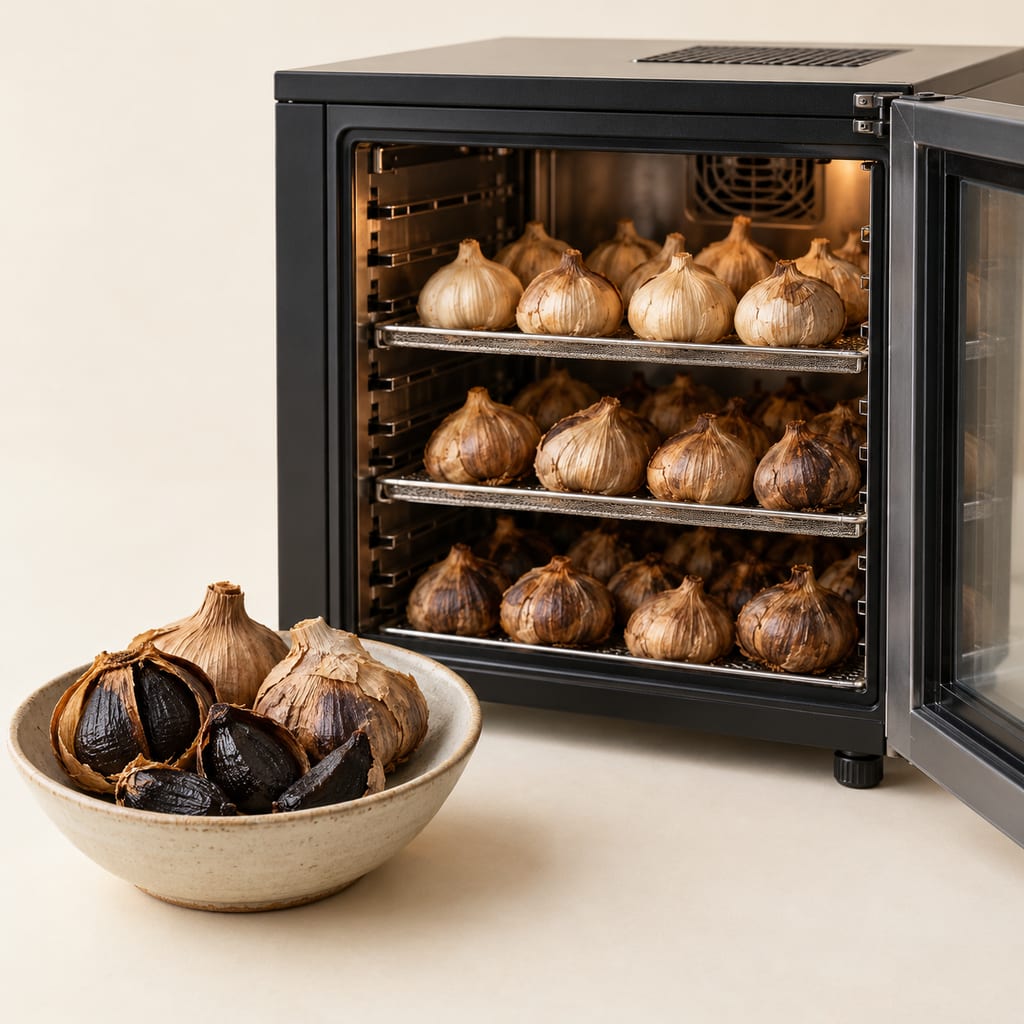
A black garlic ageing cabinet holds whole bulbs at a steady high temperature and high relative humidity for days or weeks. Under those conditions the cloves darken, soften and take on a sweet, mellow flavour.
The change is driven by heat. The browning is attributed to the Maillard reaction between sugars and amino acids, which forms melanoidins. It is not the work of live microbes, so a cabinet built for it should be judged on heat and humidity control rather than on fermentation performance.
Sources for this section
Temperature and humidity
Published production studies use roughly 50 to 90 °C and 70 to 90% relative humidity, for 10 to 60 days, with no additives. Within that band the outcome changes. In one study, 90 °C with 70% humidity gave dry, friable garlic with low water content, while a wetter, cooler regime gave a softer product.
A Korean study lowered the temperature from about day four to protect texture, and reported that 60 °C raised one measured compound while taking longer. An Italian study reported shorter processing times at 70 to 90 °C and 70 to 90% humidity, with a reduction of two to four days. The studies agree that heat and humidity drive browning. They disagree on the best settings, which depend on whether the goal is texture, speed or antioxidant content.
Design requirements
A cabinet for this process needs a heater and humidity source rated for prolonged hot, humid service, an enclosure that tolerates condensation, and independent protection against overheating. Racks must let air move around the bulbs and let condensate drain away.
An ordinary refrigerator conversion is not treated as a default. A fridge is built to remove heat and moisture, which is the opposite of what this process needs, and its seals and insulation are not rated for sustained heat and humidity. A reproducible design should be drawn to a written specification with dimensions measured on the finished unit.
Monitoring and commissioning
Before any food is stored or sold, the cabinet should be mapped for temperature and humidity at several points, with logging over a full run. Outages, door openings and condensation on the lid or walls should be recorded. pH and water activity of the finished garlic should also be measured before any storage claim is made.
Browning that looks complete is not evidence of safe storage. Those measurements are the basis for any claim about shelf life.
Sources for this section
Alternatives
Some household guides use a rice cooker or slow cooker. Those methods give little control over humidity and temperature, so a rated chamber with independent protection and data recording is the safer basis for repeatable results.
A cabinet can also be a converted enclosure or a commercial unit, but each choice carries the same requirements for rating, monitoring and drainage.
Sources for this section
History
No dated source covers a purpose-built black garlic cabinet. The process itself is documented in recent studies, which report the heat and humidity ranges used to make the product.
Equipment details
Risks and precautions
Heaters and wet air can damage insulation, electronics and seals, and can wet the load.
Hazard sourceIndependent over-temperature cut-out and a separate, logged temperature and humidity sensor
Control sourceMeasure thermal uniformity, outages and condensation before storing any food. Smell or colour does not establish that the product is safe.
Limits
Black garlic is produced by prolonged heat and humidity that drives Maillard browning and melanoidin formation. It is not a live fermentation and should not be presented as one.
Source →The cited studies run at roughly 50 to 90 °C and 70 to 90% relative humidity for 10 to 60 days. Those are study conditions, not a validated home schedule.
Source →Higher heat with lower humidity gave dry, friable garlic in one study (90 °C and 70% RH), so temperature and humidity must be set together.
Source →Places
No source in this record establishes a place.
Community
No community contributions have been published for this entry yet.
Share what you made
Sign in to contribute. Published comments and photos are free to read.
Sources
MDPI FoodsProcess · Conditions
Black garlic production study (Foods, 2024)Production at roughly 50 to 90 °C and 70 to 90% humidity for 10 to 60 days without additives.
Cited in: Overview; Design requirements; Monitoring and commissioning
Czech Journal of Food SciencesProcess · Texture
Czech Journal of Food Sciences black garlic study90 °C and 70% RH gave dry, friable garlic with low water content.
Cited in: Temperature and humidity
KoreaScienceProcess · Antioxidants
Korean black garlic temperature studyTemperature was lowered from about day 4 to preserve texture; 60 °C raised one compound but took longer.
Cited in: Temperature and humidity
AIDICProcess · Time
Chemical Engineering Transactions black garlic study70 to 90 °C and 70 to 90% RH; processing time reduced by two to four days.
Cited in: Temperature and humidity; Design requirements; Alternatives
UNESP RepositórioChemistry
Processamento do alho negroBrowning is attributed to the Maillard reaction and melanoidin formation.
Cited in: Overview