
Equipment · Cold stores and coolers
Blast chiller
Powered refrigeration equipment that rapidly cools prepared food with cold, moving air. Batch depth, container arrangement and measured cooling performance still matter.
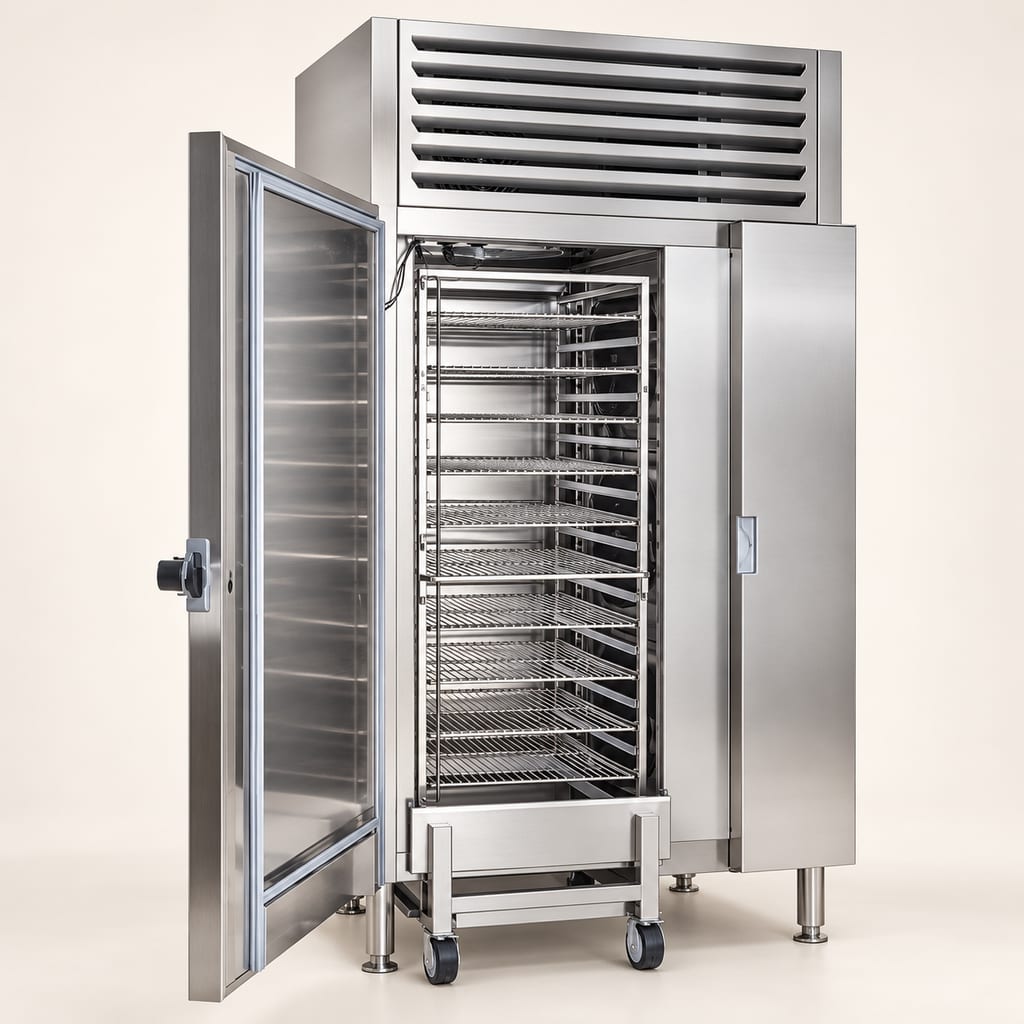
What the cabinet does
A blast chiller is an electric refrigeration appliance for pulling heat out of cooked batches quickly. Commercial designs range from compact reach-in cabinets to roll-in chambers with a wheeled rack; tray formats and capacity belong to the chosen model, not to a single standard. The linked Alto-Shaam photograph shows one large open cabinet with a tall empty rack. Its QC3-100R page describes low-temperature, high-velocity air and gives a 40-pan capacity for that model alone.
Cold air moving around containers promotes heat transfer from their surfaces. The cabinet is therefore part of a cooling system that also includes the food’s depth, container material, spacing and load. The FDA’s 2026 model Food Code lists rapid-cooling equipment as one method among several, alongside shallow pans, smaller portions and ice baths. It separately says containers in cooling equipment should be arranged to maximize heat transfer through their walls.
Sources for this section
Cook–chill and safe cooling
Restaurants and industrial kitchens use rapid chilling to bring cooked batches down through warm temperatures and keep them in a chilled-food chain. The supplied preservation atlas notes that package size and cooling behaviour matter as much as cooking: a deep container of soup or meat in fat may cool slowly even when the room feels cold. Shallow containers, divided portions, ice baths and blast chillers are alternative tools, selected for the batch and workflow.
The 2026 FDA Food Code gives a model criterion for cooked time/temperature-control-for-safety food: from 57°C to 21°C within two hours, then to 5°C or below within six hours total. It also says containers should be loosely covered, or uncovered when protected from overhead contamination, during cooling. The code is a model offered for adoption by jurisdictions; operators must follow the rules that apply where they work and verify actual food temperatures. A cabinet’s name, settings or display are not proof that a large or densely packed batch cooled as required.
Sources for this section
Forms, sourcing and limits
One current commercial example is Alto-Shaam’s QC3-100R roll-in blast chiller. Its manufacturer describes selectable soft-chill, hard-chill, quick-freeze and holding modes, temperature probes and a roll-in rack, with details tied to that specific model. Those features should not be assumed for every blast chiller. The company says its foodservice equipment solutions are made in the United States and supplied to more than 90 countries; that supports the existence of an international commercial market, not a claim that all manufacturers or models share the same origin.
This is contemporary manufactured equipment, not a traditional fermentation vessel, and the inspected sources do not establish an invention date or a single birthplace for the category. Buy and service a unit against its own specification and manual. Rapid chilling lowers food temperature; it does not make a product shelf-stable, replace refrigeration after cooling, or validate a cook–chill process on its own.
Sources for this section
History
The supplied preservation atlas identifies blast chillers as a present-day restaurant and industrial option for rapid cooling, but gives no dated history. The current manufacturer page documents commercial roll-in models without establishing when the category began.
Equipment details
Made of
- Metal cabinet enclosure — Enclosure
The linked manufacturer photograph shows a metal roll-in cabinet; the source does not specify a universal material grade. - Wire rack and shelves — Food support
Shown in the linked roll-in model photograph; rack formats and tray compatibility are model-specific.
Limits
A rapid-cooling cabinet does not by itself establish that a particular batch met a safe cooling process. The FDA Food Code specifies time-temperature criteria and container arrangements; verify the food's cooling performance and applicable local rules.
Source →Places
Unknown
Relationship not established · Place not establishedThe inspected sources do not establish a specific place of origin or a representative place of use for this equipment category. Manufacturer-specific examples do not establish the geography of the broader type.
Community
No community contributions have been published for this entry yet.
Share what you made
Sign in to contribute. Published comments and photos are free to read.
Sources
U.S. Food and Drug AdministrationSafety · Method
FDA Food Code 2026Sections 3-501.14 and 3-501.15 set model cooling time-temperature criteria and list rapid-cooling equipment among acceptable methods.
The code calls for food containers to be arranged for heat transfer and loosely covered or protected while cooling; the Food Code is offered as a model for adoption, not automatically law in every jurisdiction.
Cited in: What the cabinet does; Cook–chill and safe cooling; Forms, sourcing and limits
Alto-ShaamForm · Operation · Capacity · Image
QC3-100R Roll-in Blast Chiller with Remote CondensorA commercial roll-in cabinet example uses low-temperature, high-velocity air to remove heat; the page describes chilling and quick-freeze modes, a roll-in rack and model-specific probe/control features.
The QC3-100R product details list capacity for 40 full-size hotel pans; this is an example model, not a class-wide capacity.
Cited in: What the cabinet does; Forms, sourcing and limits
Alto-ShaamReach
About UsAlto-Shaam says its U.S.-made foodservice equipment solutions reach more than 90 countries; paired with its listed QuickChiller line, this supports international commercial availability by at least one manufacturer, not universal distribution.
Cited in: Forms, sourcing and limits