
Built structures · Cabinets and chamber conversions
Chest freezer converted to a cool chamber
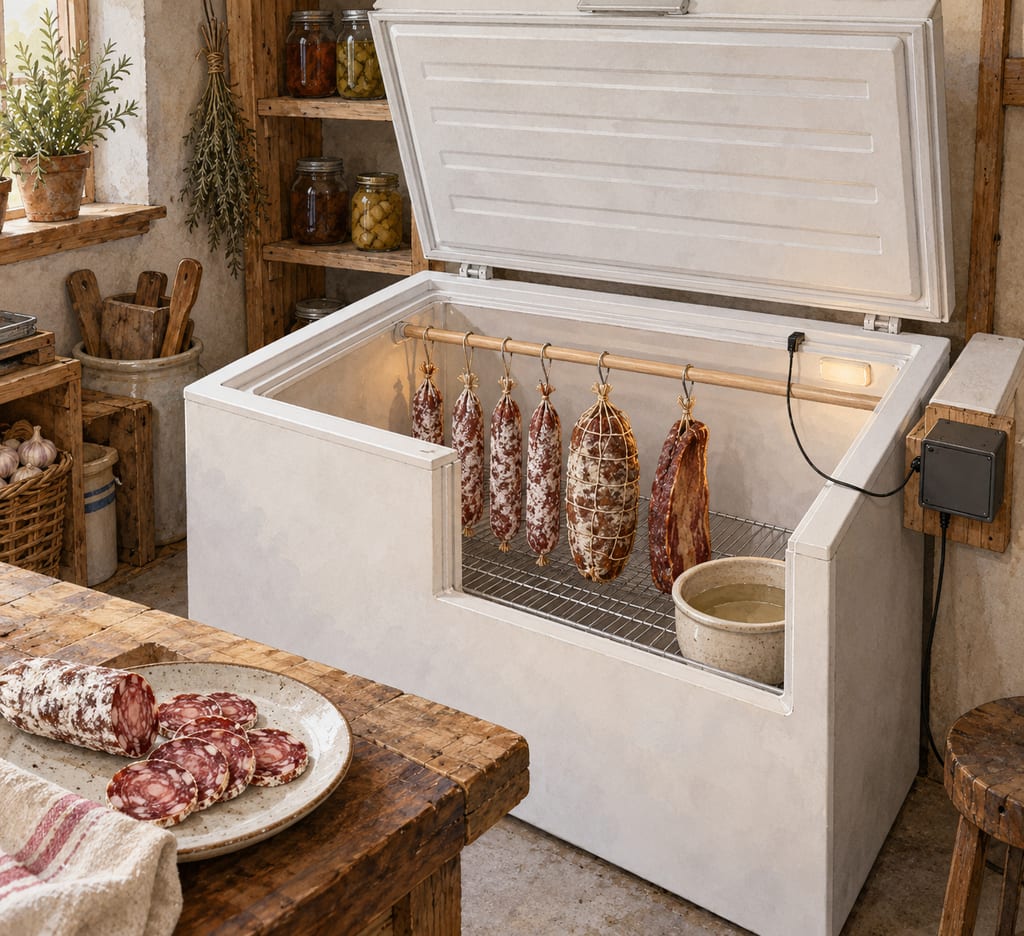
A chest freezer fitted with an external controller, probe and humidity management so that it holds food at cool curing and ageing temperatures instead of freezing.
Overview
A chest freezer converted to a cool chamber is a home build in which a freezer is run warmer than its own thermostat allows, under the control of a separate temperature controller. The aim is to hold a steady cool temperature for curing, ripening or ageing food.
The method comes from homebrewing and charcuterie practice, where it is applied to fermenters and curing boxes. The sources consulted are forum threads and blog guides, not manufacturer documents or tested build reports.
How the control works
The freezer is plugged into the cooling outlet of a dual-stage controller and a heater into the heat outlet. The probe reads the air in the chamber and the controller switches the compressor on above the target and the heater on below it.
The factory thermostat is turned to its coldest setting so that it does not fight the controller. Temperature swings of about 1 to 2 degrees Celsius are described as normal for this arrangement, and a compressor delay of two to three minutes between cycles is recommended to protect the compressor. These figures come from a fridge guide and are not measured for chest freezers.
Sources for this section
Condensation and drainage
Moisture is the commonest problem. External controllers, fermenters, airlocks, blow-off tubes and frequent door openings all add water to the box. Users report rust on the walls and suggest a renewable desiccant, a homemade dehumidifier, or a dehumidifier wired to run with the compressor.
Forum advice generally keeps the factory drain, because it contains spills. A probe can be run through the drain only by cutting the probe line and re-joining it under heat-shrink tubing.
Access and capacity
A chest unit is loaded from the top. Its access is awkward and its vertical clearance for hanging product is limited, which is why racks that the user can reach are recommended. Removable collars that give a service route without drilling the cabinet have been used on other chest builds; their construction and sealing are not covered here and need a separate check.
Capacity is not stated in the consulted sources and must be measured on the unit used.
Sources for this section
Dimensions and capacity
No consulted source gives the internal volume, shelf spacing or clearance of a chest freezer used for this conversion. These are measurements to take on the chosen unit before fitting racks, because chest units limit hanging clearance and access.
Sources for this section
What is not established
No consulted source gives drawings, measured temperature gradients or a tested construction for a particular chest freezer. Whether a given model can hold a warm set point without frost or defrost trouble depends on its own controls, and the manual must be read first.
The next research question is the measured temperature and humidity profile of one converted chest freezer under a known load, with the defrost behaviour recorded.
Sources for this section
Site
A build is made where it stands: moving it means building it again.
How it is built
Risks and precautions
A homebrewer reported rust spots on the box walls after condensation built up; water and carbon dioxide in the box were suggested as the cause.
Hazard sourceCold walls can condense moisture or chill products locally, as the brief for this build records.
Hazard sourceA reader comment on a curing guide says cycling a freezer on and off shortens compressor life.
Hazard sourceThe controller, heater and humidity device share the wiring of the room; the sources give no load figures.
Hazard sourceKeep the factory drain intact or route the probe so that spills are contained.
Control sourceMonitor humidity and temperature with a logged probe after every change.
Control sourceA chest freezer conversion is not a validated food process. The sources do not establish a safe curing or ageing temperature or humidity for any product.
Materials
- 1 unit Chest freezer — Choose a model whose manual allows operation at warmer set points under external control.
- 1 unit Dual-stage plug-in temperature controller — Forum users name the Inkbird ITC-308, which runs the freezer on its cooling outlet and a heater on its heat outlet.
- 1 unit Temperature probe — Taped to the vessel or product, then insulated with foam for accuracy.
- 1 unit Heater — Plugged into the heat outlet of the controller, for use when the unit must run warmer than its set point allows.
- 1 unit Ultrasonic humidifier or dehumidifier — A dehumidifier is cycled with the controller to handle condensation. A renewable desiccant is an alternative.
- Heat-shrink tubing — Used only where a probe wire is cut and re-joined to pass through the drain hole.
- Foam insulation — Wrapped over the probe where it sits on the vessel.
- Check the freezer manual for the warmest set point it accepts and whether its defrost cycle can be disabled. One guide warns that freezer-only chest units may not hold a warm temperature.
- Set the built-in thermostat to its coldest position and leave it there, so that the external controller decides when the compressor runs. This is the practice given for refrigerators; the chest freezer case is inferred from it.
- Plug the freezer into the cooling outlet of the controller. Plug any heater or humidity device into the matching outlet.
- Route the probe through the lid, the compressor hump or the door seal. Avoid drilling the insulated walls, because coolant lines run behind them.
- If a probe must pass through the factory drain, cut the probe line near the controller, feed the wire through the drain hole and re-join it under heat-shrink tubing.
- Keep the factory drain intact where possible. Forum advice favours it because it contains spills from airlocks and blow-off tubes.
- Tape the probe to the vessel or product and insulate it with foam. Check that the probe reads the air the product sits in, not the cold wall.
- Put a dehumidifier or desiccant in the unit if condensation forms, and wire any dehumidifier fan into the controller so that it cycles with the compressor.
- Run the empty unit and log temperature gradients, compressor cycling and recovery after the door is opened. The sources give no figures for these, so the commissioning record must be measured.
- Wipe the interior down regularly. A UK user reports stagnant water pools in chest freezers that go mouldy.
Places
Documented for international use, with no single place of origin assigned.
Community
No community contributions have been published for this entry yet.
Share what you made
Sign in to contribute. Published comments and photos are free to read.
Sources
HomebrewTalk forumMethod
How can I convert this Chest Freezer into a Temp. Controlled Fermentation Chamber?Chest freezer with an external dual-stage controller as the basic conversion method
Cited in: Overview; What is not established
Brewers Friend forumSafety · Method
Condensation in chest freezerCondensation and rust spots reported in a chest freezer fermentation box
Chest units have awkward access
Cited in: Condensation and drainage; Access and capacity; Dimensions and capacity
Homebrew FindsSafety
Fix Fermentation Chamber Condensation with Eva-DryRenewable desiccant and homemade dehumidifier as fixes for condensation
Cited in: Condensation and drainage
HomebrewTalk forumMethod
Running Temp Probe Into Chest Freezer Fermentation ChamberProbe routes through the lid, the compressor hump or the door seal
Probe through the drain by cutting, feeding and re-soldering with heat-shrink
Cited in: Condensation and drainage
Eat Cured MeatMethod · Safety
How to build your DIY Curing ChamberFactory thermostat set to coldest and controller in charge
Probe through the door seal to avoid drilling insulated walls
Compressor delay of 2 to 3 minutes
Clean with vinegar, unplug during cleaning
Cited in: Overview; How the control works
The House of HydroMethod
Meat Curing Chamber Humidity & TemperatureTarget of 70 to 80 percent relative humidity for curing, and the warning against thermoelectric and vaporiser humidifiers in a fridge-based chamber