
Built structures · Cellars, caves and ripening rooms
Controlled root cellar
Controlled vegetable cellar · Basement vegetable room
An insulated, ventilated underground or basement room for storing vegetables at cool temperatures and set humidity, with separate zones for crops that need dry storage and crops that need damp storage.
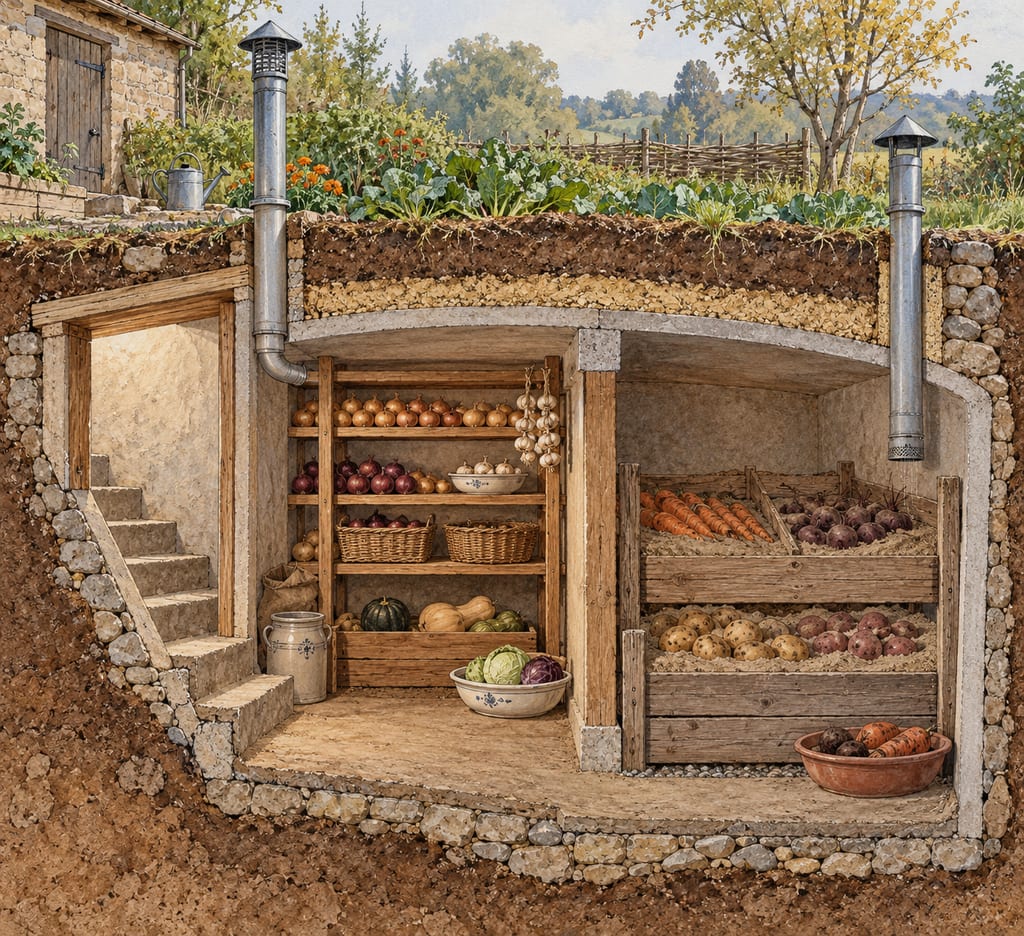
Overview
A controlled root cellar is an insulated room that is kept cool and at a chosen humidity, so that stored vegetables last through the winter. The control is what distinguishes it from an ordinary cellar, which takes whatever the ground gives.
Its value lies in measuring. Extension guidance treats temperature and humidity as the two key factors, and recommends a thermometer and a hygrometer checked daily where possible.
Sources for this section
Target conditions
The University of Missouri Extension lists 0 to 4 °C (32 to 40 °F) with 80 to 90% relative humidity for many produce types. Within that, potatoes are kept at 90 to 95% relative humidity, while onions and garlic are kept drier, at 60 to 70%.
A practical guide describes two zones: a cool, damp zone at 0 to 4 °C with 90 to 95% humidity, and a cool, dry zone at 10 to 16 °C (50 to 60 °F) with 60 to 70% humidity. Dry-storage crops belong in the drier zone. Crops are not all alike, so one room rarely suits everything.
Sources for this section
Ventilation, moisture and crop zones
Ventilation removes heat and moisture without letting in pests or light. A screened intake and exhaust are the basic form. Crates or shelves keep produce off the floor, and a drained floor keeps water from collecting.
High humidity suits some crops and damages others, so the room should be divided rather than set to one humidity. Measuring first, then deciding whether actuators are worth their cost, avoids overbuilding.
Sources for this section
Limits and climate
A root cellar suits cold climates best. The Almanac notes that root cellars may not work in warm southern climates, and a warm, damp basement is not the same as a cold one. A design from one climate should not be assumed to carry over to another without measurement.
A simple basement or an earth-sheltered room can work if temperature and humidity stay steady and light stays minimal, according to practical guidance. Seasonal gradients should be mapped before any design is fixed.
Sources for this section
History
Root cellars and cool storage rooms are long-established ways to hold vegetables over winter. The inspected material describes them as a practical type rather than dating a specific design.
Site
A build is made where it stands: moving it means building it again.
How it is built
Risks and precautions
A closed, damp room can trap moisture, spoil produce and create mould conditions.
Hazard sourceScreened intake and exhaust, and a logged hygrometer
Control sourceElectrical parts for fans and heaters need ratings suited to a damp room. Measure real seasonal conditions before adding actuators.
Materials
- Insulation for walls and ceiling
- Screened intake and exhaust vents
- Shelves or crates
- Drained floor or sand crate
- Thermometer and hygrometer
- Choose a site that stays cool and does not flood. A basement or an earth-sheltered room is the usual base; the programme brief also notes that an earth floor or a sand crate can act as a passive buffer.
- Insulate the walls and ceiling and fit a screened intake and a separate exhaust, so that air can be exchanged without letting in pests or light.
- Install shelves and crates that keep produce off the floor and allow air to pass around it. Build separate zones or rooms for crops that need cool, damp conditions and for crops that need cool, dry conditions.
- Fit a thermometer and a hygrometer at crop height and log them over a full season before deciding whether active cooling or humidification is needed.
- Plan drainage and moisture management before the room is closed. Wet floors and walls raise the humidity that some crops need and damage others.
Places
No source in this record establishes a place.
Community
No community contributions have been published for this entry yet.
Share what you made
Sign in to contribute. Published comments and photos are free to read.
Sources
University of Missouri ExtensionStorage targets
Root cellar and storage guide (MP562)32 to 40 °F with 80 to 90% RH for many produce types; potatoes 90 to 95% RH; onions and garlic 60 to 70% RH.
Cited in: Overview; Target conditions
Practical Self-RelianceStorage zones · Design
Root cellaringCool damp zone 32 to 40 °F with 90 to 95% RH; cool dry zone 50 to 60 °F with 60 to 70% RH.
Cited in: Target conditions; Ventilation, moisture and crop zones; Limits and climate
The Old Farmer's AlmanacMonitoring · Climate limit
Root cellars: types and storage tipsThermometer and hygrometer needed; root cellars may not work in warm southern climates.
Cited in: Overview; Ventilation, moisture and crop zones; Limits and climate