
Built structures · Cabinets and chamber conversions
Fermented vegetable crock and jar cupboard
A home cupboard used as a quiet, room-temperature chamber for crocks and jars of lacto-fermented vegetables such as sauerkraut.
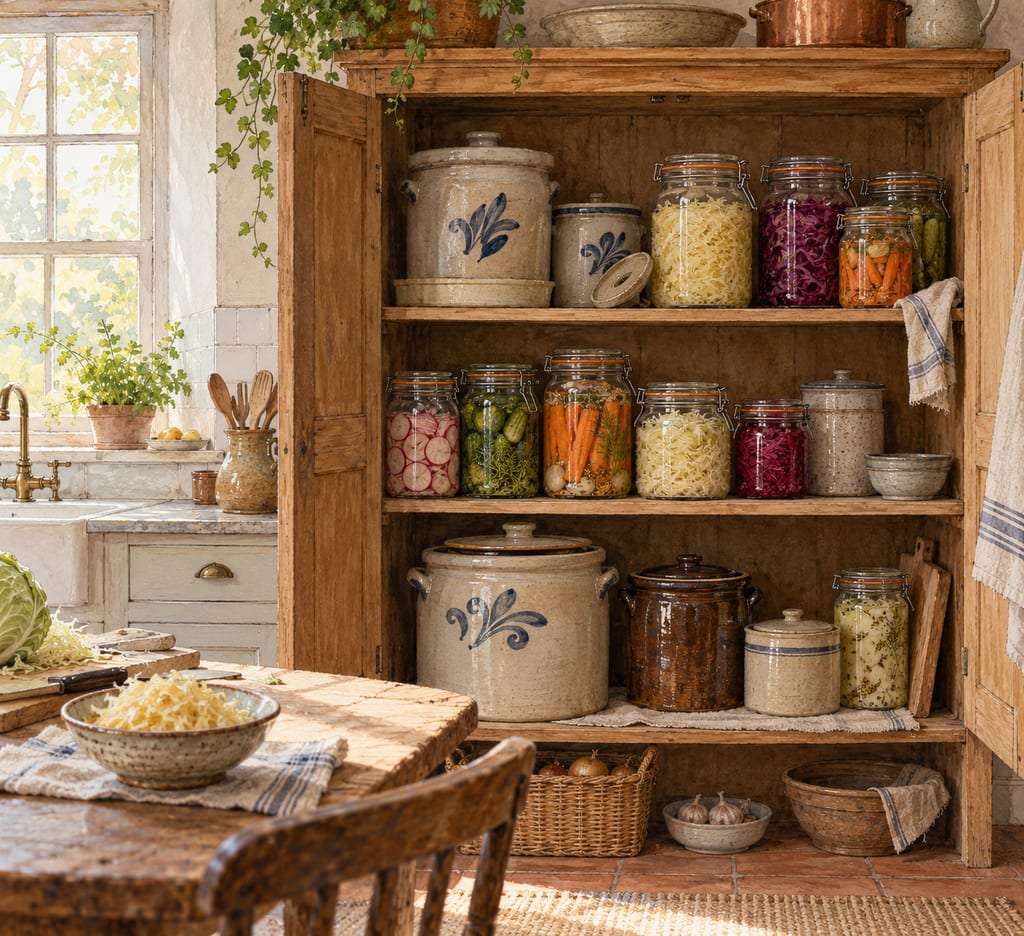
Overview
A fermented vegetable crock needs a stable, moderately warm and dark place more than it needs any special machine. A home cupboard, pantry or utility shelf often provides that. The cupboard protects the vessel from sun, pets and drafts, and it keeps the temperature changing slowly.
The build described here is only the cupboard and its fittings. The crock or jar is a separate piece of equipment, and it is chosen for its material and its ability to hold brine under a weight.
How temperature shapes the result
Extension guidance puts the common sauerkraut target near 70 to 75 F. A cooler room slows the fermentation, so the kraut takes longer. Warmer kraut moves faster and can soften and lose flavour.
The cupboard therefore buys time and steadiness rather than control. The useful records are the food temperature and the final pH, measured with a calibrated meter or strips. A reading from the air tells the cook much less.
Salt, brine and the water seal
Salt sets the rate and the safety margin of the ferment. Extension publications disagree on the exact figure, from about 2.25 to 2.5 percent salt by weight to a volume measure of one and a half tablespoons per quart of water. Ohio State warns that the salt amount is critical and should not be adjusted.
The vegetables must stay under brine. A plate and weight keep them down, and a brine-filled bag or water-seal lid keeps air away from the surface. Spill trays catch the overflow that bubbling produces.
Limits and open questions
The sources reviewed here do not give a validated temperature profile for a cupboard alone. The research programme asks to compare this cupboard with an ambient batch, measuring temperature stability and the time to the endpoint, rather than promising safety from a countdown.
Other vegetables, and fermentations other than sauerkraut, need their own salt, brine and acid targets. Those are not covered here.
Site
A build is made where it stands: moving it means building it again.
How it is built
Risks and precautions
Vegetables above the brine can spoil and grow mould.
Hazard sourceKeep the vegetables covered by brine and use the salt amount in the tested recipe
Control sourceConfirm the finished product has reached the acid level
Control sourceA countdown or a cupboard temperature does not prove the product is safe. Measure food pH and temperature.
A cupboard does not measure food pH, salt or temperature. Those checks are separate.
Warm kraut above 75 F may soften and lose flavour.
Materials
- Stone, glass or food-safe ceramic crock or jar — vessel: Extension guidance advises against copper, iron, galvanized-metal containers and lead-glazed crocks.
- Plate or lid that sits inside the vessel — follower: Presses the shredded vegetables under the brine.
- Weight — weight: Holds the follower down so the vegetables stay covered.
- Brine-filled bag or water-seal lid — water seal: A double plastic bag filled with brine is a common choice. It keeps air off the surface and limits leaks.
- Spill tray — containment: Catches overflow from a bubbling crock inside the cupboard.
- Choose a crock or jar made of food-safe material and clean it. Do not use copper, iron, galvanized or lead-glazed containers.
- Shred the vegetables, mix with salt and pack them in, pressing until brine rises.
- Place the follower and weight so the vegetables sit at least 1 to 2 inches below the brine surface, per extension guidance.
- Set the vessel on a spill tray inside the cupboard, away from direct heat sources, and cover it so dust and insects stay out.
- Leave the crock undisturbed until active bubbling stops. Ohio State guidance says to wait for normal fermentation to finish.
- Check the finished product against a food safety endpoint, not only the elapsed time. Properly fermented kraut reaches pH 4.6 or below.
Conditions
Places
Documented for international use, with no single place of origin assigned.
Community
No community contributions have been published for this entry yet.
Share what you made
Sign in to contribute. Published comments and photos are free to read.
Sources
Penn State Extension / Cornell Cooperative ExtensionMethod · Equipment
Let's Preserve: Sauerkraut (Penn State Extension, via Cornell Cooperative Extension Essex County)Crock capacity guidance (one gallon crock about 5 lb shredded cabbage; five gallon about 25 lb).
Advice against copper, iron, galvanized and lead-glazed containers.
Check of the 70 to 75 F target. Read via search summary; full text not opened.
Cited in: Overview; How temperature shapes the result; Limits and open questions
Ohio State University ExtensionSafety · Method
Ohio State University Extension fact sheet HYG-5364 (sauerkraut)Salt amount is critical for food safety and should not be adjusted.
Ferment until normal fermentation is complete (bubbling stops).
Finished sauerkraut reaches pH 4.6 or below. Read via search summary; full text not opened.
Cited in: Overview; Salt, brine and the water seal; Limits and open questions
Washington State University ExtensionMethod
Sauerkraut Making directions (Washington State University Extension)Brine coverage and weighting routine. Read via search summary; full text not opened.
Cited in: Salt, brine and the water seal