
Equipment · Drying kilns and dryers
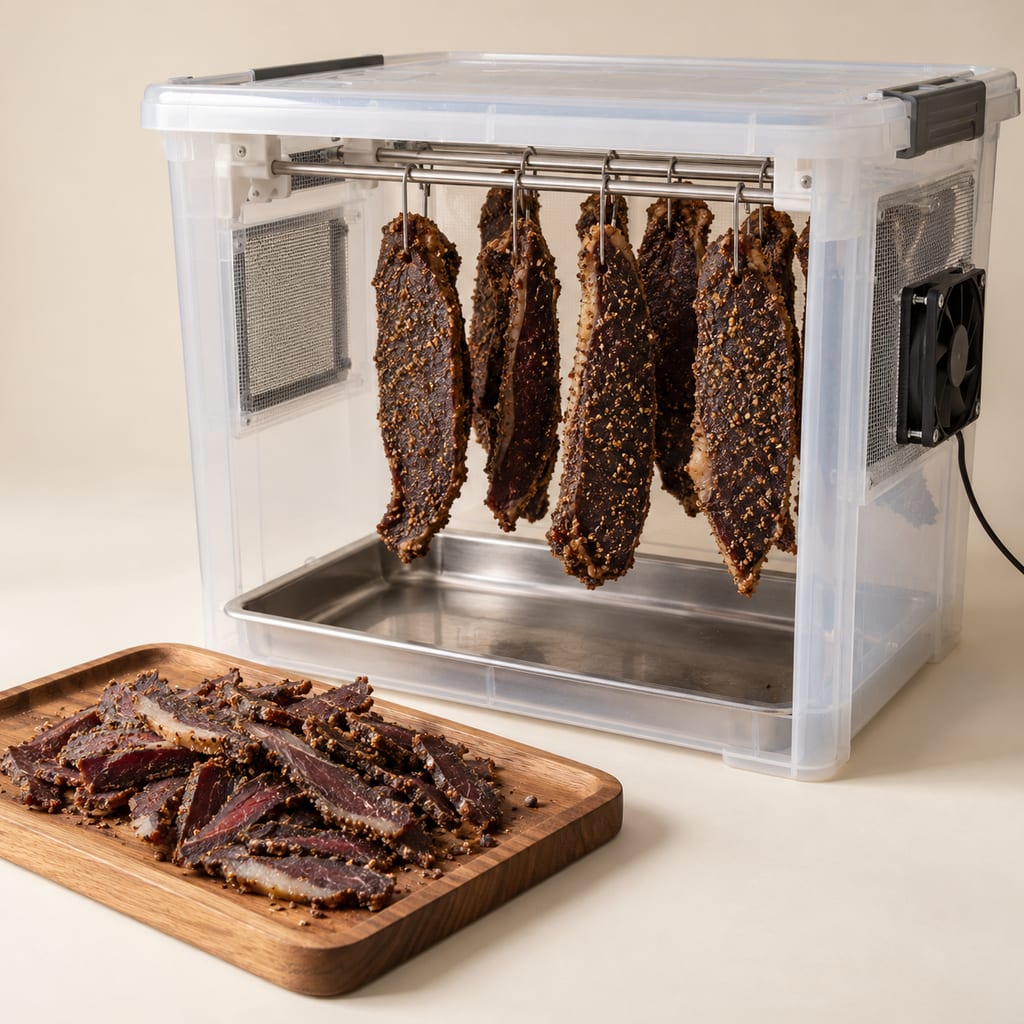
Food-grade tote with low-voltage extraction fan
A washable food-grade tote with removable rails, insect screens, a drip tray and a low-voltage extraction fan, a simple dryer for biltong that avoids rebuilding a refrigerator.
Airflow
Guidance for passive biltong boxes puts the intake low and the exhaust high, with mesh over the vents. A fan running continuously is the main moisture remover in those designs.
The brief asks for the airflow actually delivered through the mesh and guards, not the fan rating.
Sources for this section
Equipment details
Made of
- Food-grade washable tote — Lid replaced by a vented cover
- Removable rails and food-suitable hooks — component
- Insect screens over the inlet and outlet — component
Mesh size not given - Drip tray — component
- Low-voltage extraction fan — Fan direction and speed must be checked against load
Model not given
Limits
An airtight lid with no inlet is not an effective dryer; the box must exchange air.
SourceDelivered airflow after mesh and guards is not measured yet.
SourcePlaces
Documented for international use, with no single place of origin assigned.
Community
No community contributions have been published for this entry yet.
Share what you made
Sign in to contribute. Published comments and photos are free to read.
Sources
Curing ChamberMethod · Materials · Safety
Biltong Box Design and Build GuideTargets of roughly 25-30 C at 40-60% relative humidity; if humidity stays above 60%, add airflow, more bulb heat or a dehumidifier.
Intake vents low, exhaust vents high; mesh over vents keeps insects out.
A 120 mm computer fan is the main moisture remover; a 15-40 W incandescent bulb gives gentle warmth; keep the interior under about 35 C.
Plywood is the author preference; stainless S-hooks or food-safe twine; avoid galvanised hooks touching the meat.
Hang pieces so none touch; run the empty box for an hour and check a digital hygrometer before use.
Cited in: Airflow