
Built structures · Pits and cavities
Huatia (Tiwanaku earth-clod oven)
Huatia o waja · waja · watya · kurpa oven
This Tiwanaku huatia is a temporary oven made from compact earth clods, fired with crop stalks, then collapsed over tubers and insulated with soil.
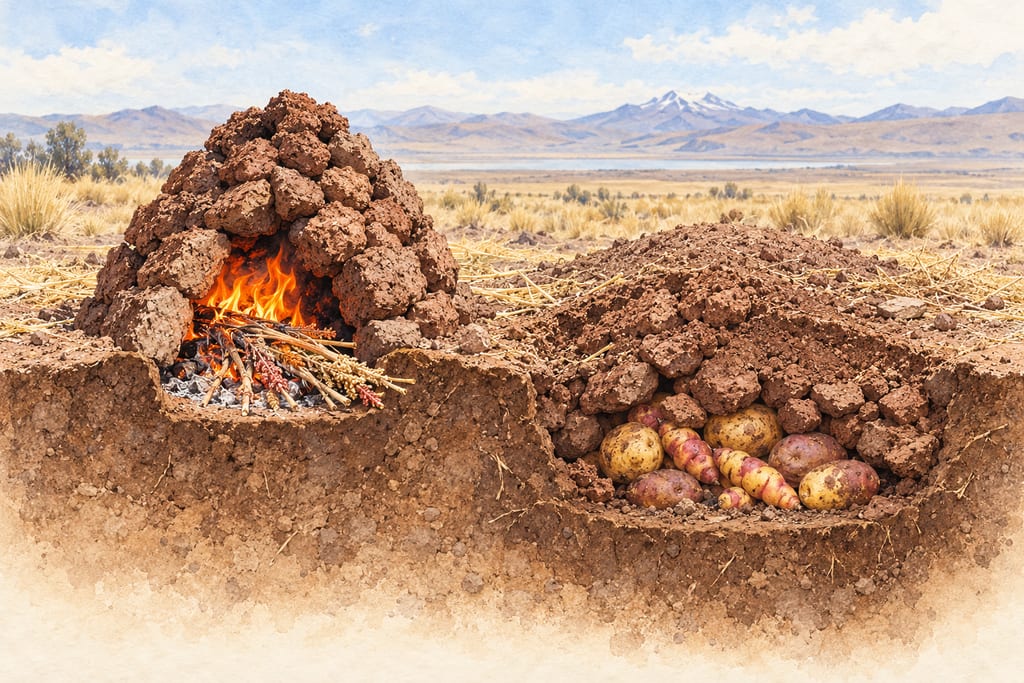
A temporary earth-clod oven
This page describes one specific build: the huatia or waja recorded for Tiwanaku in a 2020 regional food-heritage register. It is assembled from compact, dry earth clods called kurpa in Aymara, over a shallow depression in a dry place. The clods form a small dome with an opening for fuel. It is a temporary oven rather than a permanent masonry chamber, and the heated earth later becomes part of the cooking enclosure.
The register reports a depression about 20 cm deep, with a dome around 30–40 cm high and about 50 cm deep by 40 cm wide. These are measurements from that account, not a standard plan. A 2024 photograph from Chinchero, Peru, shows a separately documented wathia dome built with similar k'urpa clods. It helps compare the material and form, but it is not evidence that the pictured oven is from Tiwanaku.
Fire, collapse and soil cover
In the Tiwanaku account, quinoa or cañihua stalks, or other dry stalks, heat the structure. The register describes the clods becoming red as the loading cue; it supplies no measured oven temperature. Potatoes and ocas are among the foods named, alongside broad beans, meat and cheese. Some foods are wrapped in paper in the source account, but wrapping and ingredients can vary.
After the food is placed inside, the hot clod structure is collapsed over it and the pile is covered with more soil to retain heat. The mass of hot earth surrounds the food, which distinguishes this documented construction from a method where loose heated stones are placed separately in a sealed pit. The register gives roughly 35–40 minutes for its described arrangement and then calls for careful unearthing. That time is not transferable to different quantities, foods or structures.
The name covers more than one local form
Huatia, waja and related spellings are used across Andean foodways, but a name alone does not identify a single construction. A 2026 report from CEPAD documents huatia as living food heritage in the municipality of Tiwanaku/Tiahuanacu and describes a current family practice heated with stones beneath the ground. That account is not the same physical design as the compact clod dome in MIGA's 2020 register.
The two records are best read as evidence of locally documented forms, not as proof that one source is wrong or that either version represents every community. This page focuses on the clod-built oven, keeps its source and date visible, and avoids presenting the generated cutaway as a documentary photograph or a universal Andean design.
Place and historical limits
The clod-oven description belongs to the Tiwanaku food-heritage record in Bolivia. UNESCO locates the archaeological site near the southern shores of Lake Titicaca on the Altiplano, in Ingavi Province, La Paz Department. That geographic information locates Tiwanaku; it does not show that this oven was used at the archaeological monuments or during the ancient Tiwanaku state's peak.
The cited register was published in 2020, and the municipality's later heritage documentation appeared in 2026. Neither source establishes when huatia began or the earliest written attestation. The safe historical description is therefore a contemporary documented practice with an unknown origin date.
History
A 2020 Tiwanaku food heritage register documents a kurpa-clod oven and its sequence. A 2026 account documents a current Tiwanaku huatia practice heated with stones, showing that the same name can describe different local forms. These sources do not establish when the practice began.
Site
A build is made where it stands: moving it means building it again.
How it is built
Risks and precautions
The source describes hot clods, fire and careful excavation; the oven and buried material can retain heat. Do not treat its historical description or reported timing as a validated modern construction or food-safety plan.
Materials
- Compact dry earth clods (kurpa) — Arranged into a small temporary dome over a shallow depression; the source describes compact clods, not a permanent masonry oven.
- Quinoa or cañihua stalks — The Tiwanaku account names these crop stalks, or other dry stalks, as fuel for heating the clod dome.
- Soil — Added over the collapsed hot clods to insulate the cooking pile in the described sequence.
- In the Tiwanaku register's example, prepare a shallow depression in a dry place and arrange compact kurpa clods into a small dome with a low opening. The source's dimensions describe one local arrangement, not a universal construction specification.
- Heat the clod structure with quinoa or cañihua stalks, or other dry stalks, until the clods are hot. The register describes the clods' red colour as its cue for loading; it does not provide measured temperatures.
- Place the selected food inside the heated structure. The register lists potatoes, ocas, broad beans, meat and cheese; it describes some foods as wrapped in paper. Ingredients and local practice can vary.
- Collapse the hot clods over the food and cover the pile with additional soil to retain heat. The register reports about 35–40 minutes for its described arrangement, then says to uncover carefully and retrieve the food. This is not a guaranteed time for other loads or builds.
Places
Tiwanaku (Tiahuanacu municipality)
Documented use · Locality evidenceThe food heritage record is specific to Tiwanaku/Tiahuanacu, Bolivia. UNESCO locates the archaeological site in Ingavi Province, La Paz Department; this row does not claim that the oven was used at the monuments or in antiquity.
Community
No community contributions have been published for this entry yet.
Share what you made
Sign in to contribute. Published comments and photos are free to read.
Sources
Movimiento de Integración Gastronómico Alimentario de Bolivia (MIGA), with the Embassy of France in BoliviaConstruction · Materials · Method · Dimensions · Geography
Registro del patrimonio alimentario regional de Tiwanaku: Hacia un turismo gastronómico con identidadThe 2020 register describes a huatia or waja built from compact kurpa earth clods in a dry place, with a shallow depression and a small dome heated by firewood.
It names quinoa, cañihua or dry stalks as fuels; potatoes, ocas, broad beans, meats and cheeses as possible foods; and collapse followed by soil cover as the cooking sequence.
It reports approximate dimensions and 35–40 minutes for the described arrangement only; those measurements and timing are not standards.
Cited in: A temporary earth-clod oven; Fire, collapse and soil cover; The name covers more than one local form; Place and historical limits
Centro para la Participación y el Desarrollo Humano Sostenible (CEPAD)Geography · Modern use · Scope
Tiwanaku pone en valor su patrimonio alimentario como parte de la Ruta “Caminos del Sol”CEPAD reports in August 2026 that family practitioners in Tiwanaku/Tiahuanacu are sharing huatia practice as living food heritage.
That account describes a current local stone-heated, underground form and names potato, oca, sweet potato, broad beans and corn; it therefore should not be collapsed into the earth-clod design documented in the 2020 register.
Cited in: The name covers more than one local form; Place and historical limits
UNESCO World Heritage CentreGeography
Tiwanaku: Spiritual and Political Centre of the Tiwanaku CultureUNESCO places the Tiwanaku archaeological site near Lake Titicaca on the Altiplano in Ingavi Province, La Paz Department, Bolivia; it does not date the huatia practice.
Cited in: Place and historical limits
Wikimedia Commons; photograph by LAURAMELISSA123Image reference
Horno de k'urpas para wathia.jpgThe 2024 photograph depicts a separately documented Peruvian wathia oven made from k'urpa clods being fired before ingredients are buried; it is a comparative image from Chinchero District, not a Tiwanaku photograph. The file is CC BY-SA 4.0.
Cited in: A temporary earth-clod oven