
Equipment · wort-chiller
Immersion wort chiller
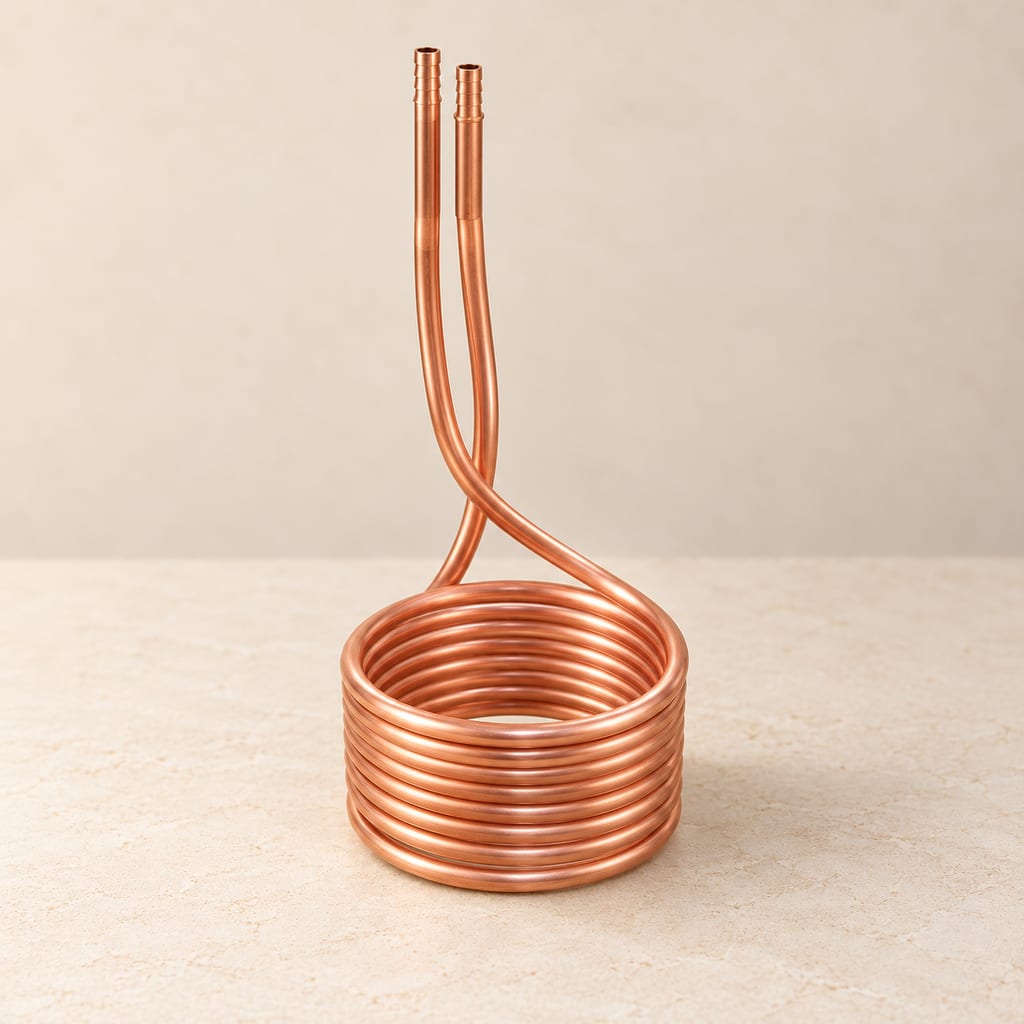
An immersion wort chiller is a manufactured coil heat exchanger placed directly in hot wort; cooling water flows through the coil while the wort stays in its kettle. Cooling depends on the chiller, water supply and wort conditions, so no single time or batch capacity describes the whole type.
What it is
A coil of tubing is placed in the kettle so its surface sits in the hot wort. Cooling water runs through the tubing and carries heat away while the wort remains in the vessel. Copper and stainless steel are both used; the material, coil height, number of turns and hose fittings are model choices, not defining limits of the type.
This differs from a counterflow chiller, where wort itself moves through a separate passage while coolant flows the other way. A plate exchanger is another separate format, with channels divided by plates.
How cooling works
The coil exchanges heat across its wall: hot wort is outside the tube and cooler water is inside it. A larger temperature difference and adequate water flow help transfer heat, but the result also depends on coil surface, kettle geometry, wort volume and whether the wort is moved around the coil. The available sources do not establish one cooling time or volume for all immersion chillers.
The coil is normally lowered into the kettle near the end of the boil according to the manufacturer's instructions. Grainfather's guide describes putting its immersion chiller into boiled wort and running cold water through it before transfer. That sequence is model guidance; follow the actual unit's manual.
Sources for this section
Choosing and using one
Check that the coil fits the kettle with room for the hose connections, that its material and fittings suit the brewer's setup, and that the water source and discharge arrangement are practical. Compare manufacturers' stated dimensions and flow requirements for the exact model rather than treating one coil size as a standard.
The chiller itself is passive, but it needs a water supply and a route for the warming return water. The Grainfather G30 manual calls for checking its hoses, clamps and flow and warns that its coil becomes hot quickly. That warning applies to that product's instructions; do not infer a universal glove specification for every model.
Sources for this section
Limits and evidence
An immersion coil leaves the wort in the kettle during the exchange, so it does not provide the same flow-through arrangement as a counterflow unit. It also consumes cooling water that passes through the coil; the amount depends on source-water temperature, target temperature and the way the brewer operates it. The inspected sources do not give a universal water-use figure.
The recipe source associated with this research mentions a cold-water bath or a wort chiller without identifying a chiller design. It is therefore evidence that wort chilling is an option in that recipe, not evidence that the recipe used an immersion coil.
Equipment details
Made of
- Copper or stainless steel — Heat-transfer coil
Both are documented contemporary materials for immersion chiller coils. - Hose or tubing — Water connections
The supply and return arrangement depends on the model.
Limits
Cooling performance varies with coil geometry, water temperature and flow, wort volume and movement. The inspected sources do not support a class-wide cooling time or batch limit.
Source →Places
Documented for international use, with no single place of origin assigned.
Community
No community contributions have been published for this entry yet.
Share what you made
Sign in to contribute. Published comments and photos are free to read.
Sources
GrainfatherMethod · Comparison
Counterflow Chiller vs Immersion Chiller - what's the difference?An immersion coil is placed in the kettle and cooling water flows through it; comparison language on this vendor page is not treated as neutral evidence of relative performance.
Cited in: What it is; Limits and evidence
GrainfatherMethod
G30 G Series 3 Quick Start GuideThis model's guide describes an immersion coil in boiled wort with cold water run through it before transfer.
Cited in: What it is; How cooling works
GrainfatherCare · Safety · Method
G30 G Series 3 Instruction ManualModel-specific cleaning, hose, clamp, flow and hot-coil instructions.
Cited in: How cooling works; Choosing and using one
ASHRAEContext
ASHRAE Handbook, Chapter 39: BeveragesIndustrial wort cooling discusses heat exchange; industrial arrangements and figures are not generalized to homebrew immersion equipment.
American Homebrewers AssociationContext
Brewing with Extract: German-Style Wheat Beer (Weizen)The recipe mentions a cold-water bath or wort chiller without naming a chiller design.
Cited in: Limits and evidence