
Built structures · Cabinets and chamber conversions
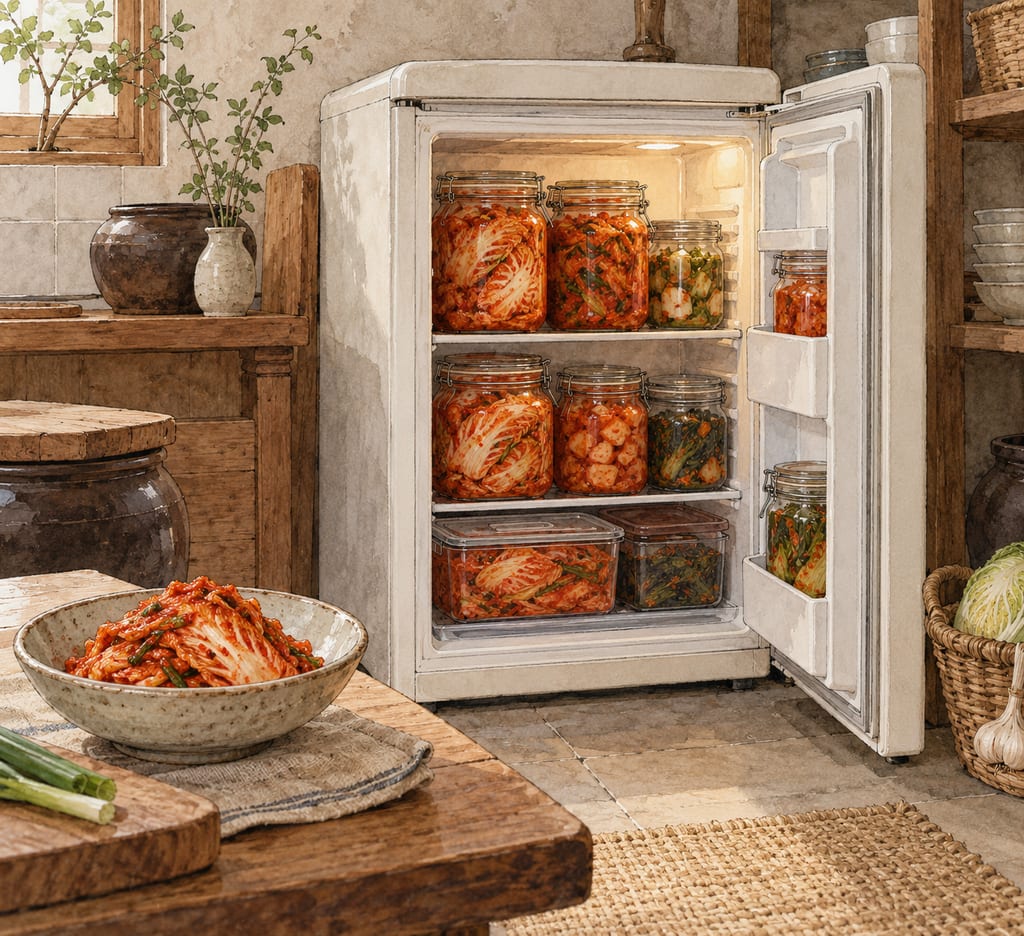
Kimchi fermentation and storage refrigerator
An ordinary refrigerator or cooler set aside for kimchi, used to stage fermentation and then hold the finished kimchi cold.
Overview
A refrigerator gives kimchi two things a warm room does not: a cold holding temperature that slows fermentation, and a closed, washable box that keeps odours and spills contained. Many households use a spare fridge or cooler for this purpose, which is why it appears as a build rather than as an appliance.
The item is distinct from the manufactured kimchi refrigerator, a Korean appliance with its own compartments and bins. The build is the everyday fridge set aside for the job.
Sources for this section
Fresh, normal and long-aged kimchi
Sources separate fresh kimchi from normally fermented and long-aged kimchi. Fresh kimchi is eaten soon after mixing. Normally fermented kimchi is held cold until it reaches the taste the cook wants. Long-aged kimchi keeps longer and grows sourer.
Each style needs its own temperature and time plan. A single preset borrowed from a kimchi appliance does not establish that the plan is safe or suitable for another batch.
Sources for this section
Temperature and acidity
LG guidance gives 0 to 4 C for refrigerated storage, where fermentation slows. A BCIT study, read through its summary, found that acidity fell faster at 25 C than at 4 C, so the holding temperature sets the pace of souring.
A 1994 Korean study on a refrigerator control system for kimchi fermentation and storage is listed among the sources for the control approach. Its details were not reviewed in full here.
Storage time
The sources do not agree on how long kimchi keeps. A Colorado State handout advises refrigerated storage and eating within about one week. Healthline states that kimchi stays fresh for about three to six months in the refrigerator while it keeps fermenting, which makes it sourer.
The lower figure is the conservative one for a home chamber. The longer figure describes a product that is still fermenting slowly and is not a validated shelf life.
Sources for this section
Limits and open questions
The fridge controls temperature only. It does not measure food acidity, salt or pH, and a cold box does not prove a batch is safe.
The open question for this build is a validated profile for each kimchi style: staging temperature, the time to the target acidity, and the holding time in the cold. Those values need a tested recipe and a measured food temperature.
Sources for this section
Site
A build is made where it stands: moving it means building it again.
How it is built
Risks and precautions
A BCIT study found acidity fell faster at 25 C than at 4 C.
Hazard sourceKeep finished kimchi refrigerated
Control sourceStorage limits differ between sources. A Colorado State handout advises eating refrigerated kimchi within about one week; Healthline gives three to six months, with continued fermentation. Use the limit tested for your recipe, not a generic figure.
No Canadian federal guidance on kimchi refrigerator temperatures was found in the search. The BCIT study is the Canadian source reviewed.
Materials
- Refrigerator or cooler with a thermostat — Kept for kimchi, so odour and spills stay in one place.
- Lidded food-safe containers — Rigid containers with lids, so the cabinet stays dry and the kimchi stays covered.
- Spill tray or washable liner — Catches brine and juice from fermenting containers.
- Digital thermometer probe — Set in a jar of water or against the food, so the reading follows the kimchi and not the air.
- Clean the unit and set aside one shelf or compartment for kimchi only.
- Place lidded containers on a spill tray so overflow stays contained.
- Set the thermostat and read the food temperature with a probe, since the air reading lags behind the food.
- Hold the kimchi at the warmer staging temperature the tested recipe uses, then move it to cold storage when the target acidity is reached.
- Store the finished kimchi cold, and check containers for leaks, condensation and off smells at each opening.
Conditions
Places
Documented for international use, with no single place of origin assigned.
Community
No community contributions have been published for this entry yet.
Share what you made
Sign in to contribute. Published comments and photos are free to read.
Sources
British Columbia Institute of Technology (BCIT) repositoryMethod · Safety
Kimchi: determining the rapidity of acidification depending on temperatureAcidity fell faster at 25 C than at 4 C. Read via search summary; full text not opened.
Cited in: Temperature and acidity; Limits and open questions
LG Electronics UKMethod · Safety
What is kimchi and how to store itRefrigerated storage between 0 and 4 C slows fermentation.
Cited in: Fresh, normal and long-aged kimchi; Temperature and acidity
NC State Extension Food Safety, hosting a Colorado State handoutSafety
Kimchi handout (Colorado State University)Kimchi should be refrigerated and is best eaten within one week. Read via search summary.
Cited in: Storage time
HealthlineSafety
Does kimchi go bad?Refrigerated kimchi stays fresh about three to six months and keeps fermenting.
Cited in: Overview; Fresh, normal and long-aged kimchi; Storage time
KoreaScienceMethod
Development of Control System for Kimchi Fermentation and Storage Using RefrigeratorListed as a study of a refrigerator control system for kimchi fermentation and storage. Abstract only; not read in full.
Cited in: Temperature and acidity