
Built structures · Cabinets and chamber conversions
Kombucha and jun warming enclosure
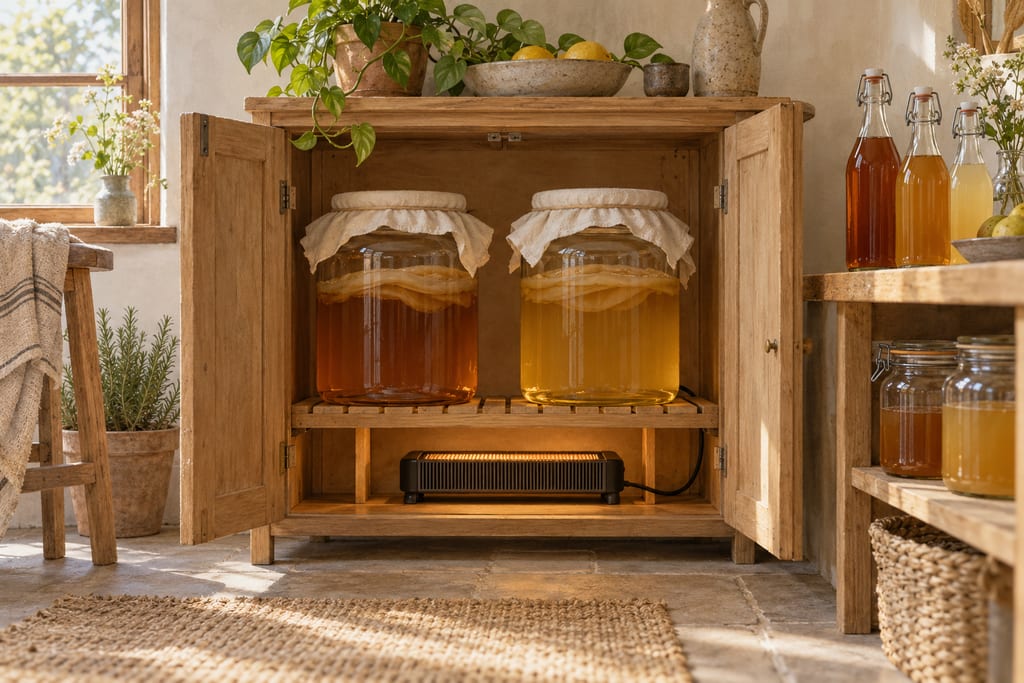
A clean cupboard around breathable vessels, with a gentle external heat source, used to warm kombucha and jun during primary fermentation.
Overview
Kombucha and jun are sweetened teas or honey waters fermented by a symbiotic culture of yeasts and bacteria. A warming enclosure gives the vessel a steady, moderate environment so the primary fermentation does not stall in a cold room.
The enclosure is only a cupboard with a gentle heat source. The vessel, the cover and the thermometer are part of the build.
Sources for this section
Temperature and air
The sources reviewed do not give a kombucha temperature range, so this build measures the liquid. Overheating the air warms the vessel unevenly, while a breathable cover keeps air moving across the surface.
Refrigeration slows the process. Virginia Tech says it limits alcohol and excessive acid production, which makes it a control for the end of fermentation rather than for the warm stage.
Sources for this section
Primary fermentation and bottle conditioning
Primary fermentation takes place in an open or breathable vessel. Bottle conditioning is a separate stage: carbon dioxide builds up in a sealed bottle, and fermentation can continue there.
The enclosure serves the primary stage. Bottling needs its own rules for headspace, pressure-rated bottles and checks, and pasteurisation is described in the extension guidance as heating to 180 F, bottling at once and inverting for 30 seconds.
pH, alcohol and pressure
Regulators use pH as the main safety control. Pennsylvania guidance sets a threshold of 4.2 and calls for a calibrated digital meter. Virginia Tech targets 4.2 or lower and confirms below 4.0 before pasteurising. An Australian resource is stricter, asking for below 3.0 at the end of fermentation.
Alcohol and pressure are not measured by a temperature controller. Virginia Tech notes that the drink may still be under 0.5 percent ABV when bottled, and bottles can burst under carbon dioxide pressure.
Limits and open questions
The sources do not validate a warming temperature for kombucha or jun, and they disagree on the final pH target. A warming enclosure cannot show whether a batch is safe to bottle.
The next research question is a measured temperature and pH profile for a home enclosure, compared with an ambient batch.
Site
A build is made where it stands: moving it means building it again.
How it is built
Risks and precautions · High risk
Carbon dioxide builds up in sealed containers, and bottles or caps can burst.
Hazard sourceExtension guidance treats pH as the main safety control.
Hazard sourceMeasure pH with a calibrated digital meter during fermentation
Control sourceLeave headspace and use pressure-rated bottles
Control sourceVirginia Tech warns the pH should be no lower than 2.5 to avoid an overly acidic product. An Australian food safety resource says below 3.0 at the end of fermentation. The targets disagree and must be checked against local rules.
Virginia Tech notes that alcohol can be under 0.5 percent ABV at bottling and that fermentation can continue afterwards.
Materials
- Cupboard or enclosure with an air gap — Clean, dry and dark, with ventilation so gas does not build up around the vessel.
- Breathable cover for each vessel — A cloth or breathable cover keeps insects out while letting air through.
- Gentle external heat source — A heat mat or a controlled warm spot, set so the air does not overheat the vessel.
- Calibrated pH meter and thermometer probe — Measures the liquid, which is what the process controls.
- Clean the enclosure and the vessels, then place each vessel on a dry, level shelf.
- Cover vessels with a breathable cloth so air exchanges freely.
- Set the heat source gently and measure the liquid temperature with a probe, not only the air.
- Monitor pH through primary fermentation using a calibrated meter.
- Refrigerate or pasteurise before bottling according to the tested process, since fermentation continues in sealed bottles.
Conditions
Places
Documented for international use, with no single place of origin assigned.
Community
No community contributions have been published for this entry yet.
Share what you made
Sign in to contribute. Published comments and photos are free to read.
Sources
Virginia Tech Cooperative ExtensionSafety · Method
What do I need to know to sell kombucha at the farmers market? (FST-297)pH 4.2 or lower target, below 4.0 before pasteurising, pH no lower than 2.5, alcohol under 0.5 percent at bottling, refrigeration limits acid and alcohol, pasteurising at 180 F. Read via search summary.
Cited in: Overview; Temperature and air; Primary fermentation and bottle conditioning; pH, alcohol and pressure; Limits and open questions
Pennsylvania Department of AgricultureSafety
Guidelines for brewing and bottling kombuchaFood safety threshold of pH 4.2 and a calibrated digital pH meter. Read via search summary.
Cited in: Primary fermentation and bottle conditioning; pH, alcohol and pressure; Limits and open questions
Food Safety AustraliaSafety
Kombucha (Food Safety Australia topic page)pH below 3.0 at the end of fermentation. Read via search summary.
Cited in: pH, alcohol and pressure; Limits and open questions