
Built structures · Pits and cavities
Maya chultun
chultun · chultunes
A chultun is an underground cavity cut into bedrock at Maya sites. Archaeological studies document varied forms and uses; a proposed food-preservation role for some southern lowland examples remains a hypothesis.
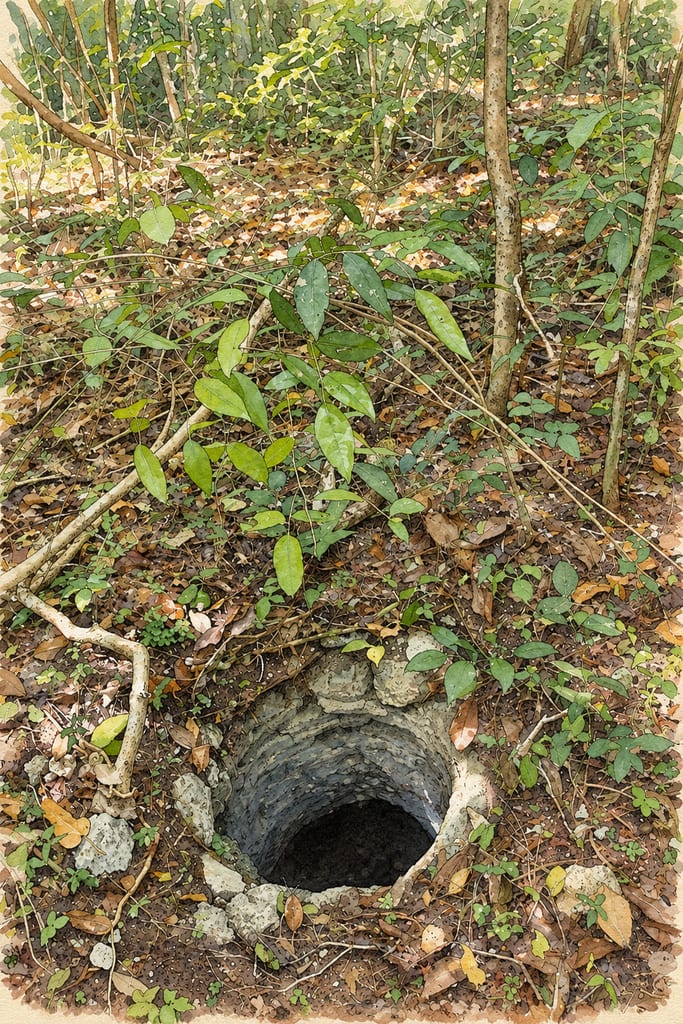
A cavity carved into bedrock
Chultun is the Maya term used for underground pits cut into bedrock. Excavation at Classic-period sites in northwestern Petén documents these features as part of a broader archaeological record across the Maya region. The term covers structures that differ in shape and size, so a single drawing should not be mistaken for a standard plan. The excavation evidence describes underground cavities, not portable containers or built masonry chambers.
Their uses cannot be read from the name alone. Cagnato interprets the excavated examples as primarily utilitarian while also finding evidence for ritual significance. Other documented regional discussions include water storage, refuse and burial contexts. Which interpretation fits depends on the particular feature, its location and its archaeological context.
A food-preservation proposal, not a settled identification
In 1986, Bruce Dahlin and Robert Litzinger challenged the assumption that chultuns were simply household storage pits. They considered distribution patterns and the form of some cavities, then proposed that certain shoe-shaped examples in the southern Maya lowlands might have supported small-scale production of fermented beverages or pickled fruit. Their interpretation connects a possible cool, enclosed working environment with a cottage industry; it does not report identified drink or fruit remains proving that this was the function.
That distinction matters. The excavations reviewed by Cagnato show variation and multiple possible uses, while the fermented-drink interpretation concerns a subset of forms and remains a hypothesis. A chultun should therefore not be presented as a universal Maya fermentation cellar, nor linked to a named drink without site-specific evidence. The cited studies do not give a construction recipe, measured dimensions or an operating protocol, and this page does not turn archaeological interpretation into modern excavation guidance.
History
Cagnato reports chultunes at Classic-period sites in northwestern Petén, but the cited work does not establish when the form began or date every example.
Site
A build is made where it stands: moving it means building it again.
How it is built
Materials
- Bedrock — The archaeological study describes chultunes cut into bedrock; it does not identify a masonry lining or transferable excavation materials.
- Excavated examples are cavities cut into bedrock, but the cited studies do not provide a safe or transferable construction sequence; this page records archaeological form rather than giving excavation instructions.
Places
Northwestern Petén
Historical attestation · Region evidenceThis is the study area, not an origin claim for all chultunes.
Southern Maya lowlands
Historical attestation · Region evidenceThe proposal applies to a subset of features and does not demonstrate a single food use.
Community
No community contributions have been published for this entry yet.
Share what you made
Sign in to contribute. Published comments and photos are free to read.
Sources
Ancient Mesoamerica, Cambridge University PressArchaeology · Form · Geography
Underground Pits (Chultunes) in the Southern Maya Lowlands: Excavation Results from Classic Period Maya Sites in Northwestern PeténExcavations at Classic-period sites in northwestern Petén document chultunes cut into bedrock.
The study reports variation in shape and size and interprets the pits as primarily utilitarian while also recognizing evidence of ritual importance.
Cited in: A cavity carved into bedrock; A food-preservation proposal, not a settled identification
American Antiquity, Cambridge University PressFunctional hypothesis · Historical interpretation
Old Bottle, New Wine: The Function of Chultuns in the Maya LowlandsDahlin and Litzinger argue against treating chultuns as ordinary household storage by default.
They suggest some shoe-shaped southern lowland examples may have supported cottage-scale fermented-beverage or pickled-fruit production; this is a functional hypothesis, not proof of contents.
Cited in: A food-preservation proposal, not a settled identification