
Equipment · Industrial and laboratory plant
Membrane filter
A membrane filter uses a selective polymer or ceramic barrier to clarify or reduce microorganisms in liquid food. Cartridge media sit in a sanitary housing; performance must be validated for the intended product and retained organisms.
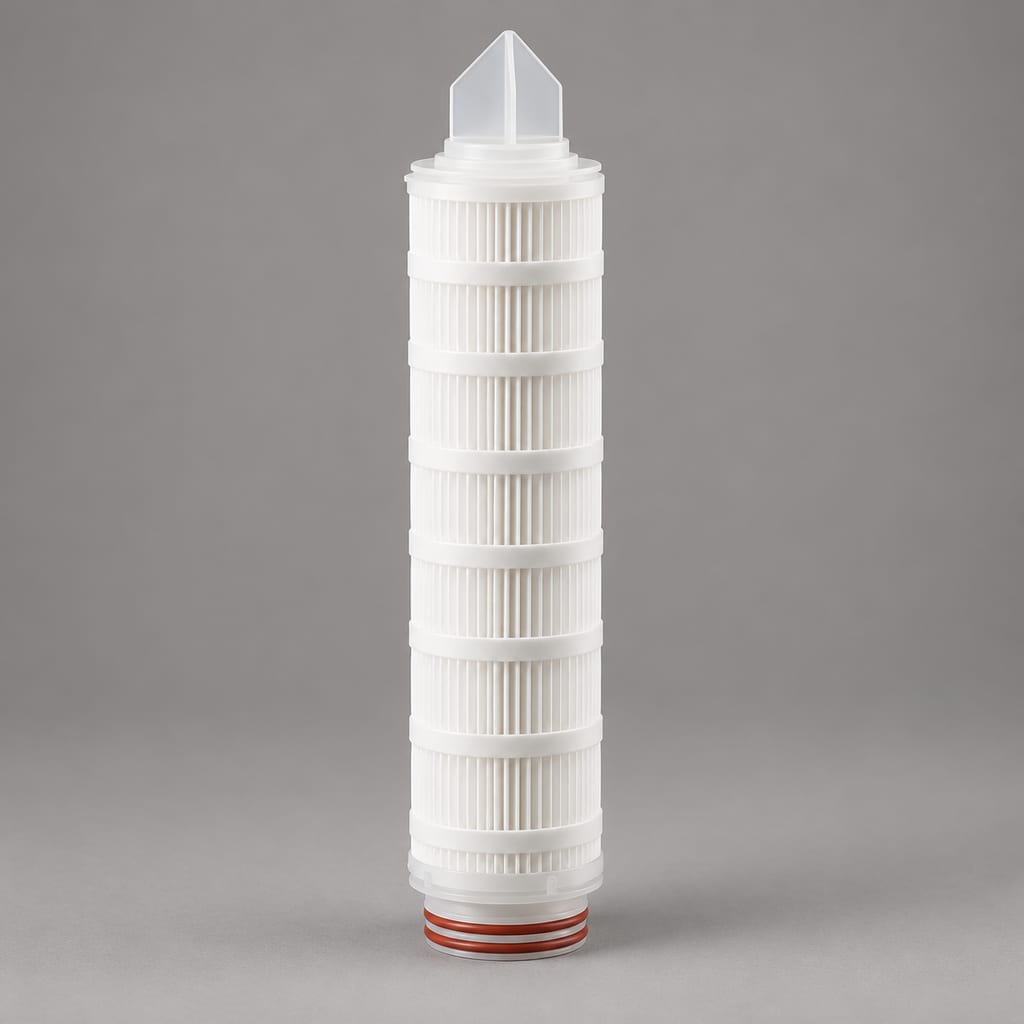
How the cartridge works
A cartridge membrane is folded into pleats to increase filtering area within a compact cylinder. In one Pall beverage-filter design, a single hydrophilic polyethersulfone (PES) membrane uses a laid-over pleat arrangement; the single-open-end fitting seats in a compatible sanitary housing. This is a documented commercial example, not a universal construction standard. Pressure drives liquid through the membrane while retained particles and organisms remain on the feed side. Cross-flow ceramic systems are another design: feed moves along a tubular membrane while permeate passes through it. Filter grade, housing seal, and operating envelope must be selected together.
What filtration does—and does not—show
Kombucha studies illustrate why clarity and microbial stabilization must be distinguished. Daneluz and colleagues reported 80.18–83.30% lower turbidity, 66.40–79.33% lower suspended solids, and 53.93% fewer microorganisms after microfiltration of their tested samples. A later cross-flow study used a ceramic tubular membrane and found a seven-to-nine-fold turbidity reduction, while measured quality attributes had mixed outcomes. These results apply to the studied kombucha and apparatus, not other beverages or filters. A clearer drink can still contain active microorganisms.
Validation and handling
For final beverage filtration, manufacturers distinguish prefiltration from a validated membrane step. Pall describes cartridge challenge testing against particular spoilage organisms and non-destructive integrity checks such as forward-flow and pressure-decay tests. Such checks indicate microbial retention only when correlated to the specified filter and process. Fouling can reduce flow, and a damaged cartridge or contaminated downstream side can undermine the result. Cleaning, sanitization, installation, and testing follow the exact cartridge and housing instructions. Do not infer sterilization, pathogen control, or shelf stability from a micron number alone.
Related fermentation
Research has examined membrane filtration of kombucha after fermentation. The linked black-tea kombucha recipe provides a beverage context; it does not prescribe filtration or establish that it is needed for every batch.
Sources for this section
Equipment details
Made of
- polyethersulfone (PES) membrane
One documented beverage cartridge uses a hydrophilic PES membrane in a laid-over pleat construction. - polypropylene support and cartridge hardware
Specified for Pall's cited cartridge; other products may differ. - elastomer seal
Seal composition is product-specific; Pall lists silicone or other elastomer options depending on model.
Limits
A nominal or absolute pore rating alone does not establish organism removal across products; retention depends on filter, integrity, challenge organism, and process conditions.
Source →A 2023 kombucha study reported 53.93% microbial reduction alongside clarification; it does not support describing microfiltration as complete organism removal or sterilization.
Source →Pall's construction and validated wine-spoilage retention describe particular products and test conditions, not all membrane cartridges.
Source →Places
Unknown
Relationship not established · Place not establishedThe inspected research and product references are modern examples and do not establish a geographic origin or traditional-use area for the membrane-filter equipment class.
Community
No community contributions have been published for this entry yet.
Share what you made
Sign in to contribute. Published comments and photos are free to read.
Sources
Food Chemistry AdvancesResearch · Method
Membrane separation process of microfiltration applied to the filtration of kombuchasKombucha microfiltration reduced turbidity by 80.18–83.30%, suspended solids by 66.40–79.33%, and microorganisms by 53.93% in the samples studied.
Cited in: How the cartridge works; What filtration does—and does not—show; Related fermentation
Chemical Industry and Chemical Engineering QuarterlyResearch · Method
Cross-flow microfiltration of traditional kombucha beverage using a ceramic tubular membraneA 2026 study used ceramic tubular cross-flow filtration for kombucha; turbidity fell seven to nine times and measured quality parameters had mixed outcomes.
Cited in: How the cartridge works; What filtration does—and does not—show
Pall CorporationConstruction · Product example
Supor Beverage Filter Cartridges for Final FiltrationOne product uses a single hydrophilic PES membrane in laid-over pleats and a single-open-end configuration for sanitary housings; design and claims are product-specific.
Cited in: How the cartridge works; Validation and handling
Pall CorporationCare · Validation
Filter Integrity Testing for Food & Beverage ApplicationsForward-flow and pressure-decay tests can check integrity; non-destructive results indicate retention only when correlated to microbial challenge performance.
Cited in: Validation and handling
Pall CorporationProcess · Product example
Final Filtration and Microbial StabilizationPall describes final membrane filtration in cider production as a product-specific process for controlling spoilage organisms before packaging.
Cited in: Validation and handling