
Built structures · Cabinets and chamber conversions
Modular washable biltong cabinet
A rigid frame holding removable food-suitable panels and rails, with the fan, sensor and any heater as separate serviceable modules, for drying biltong.
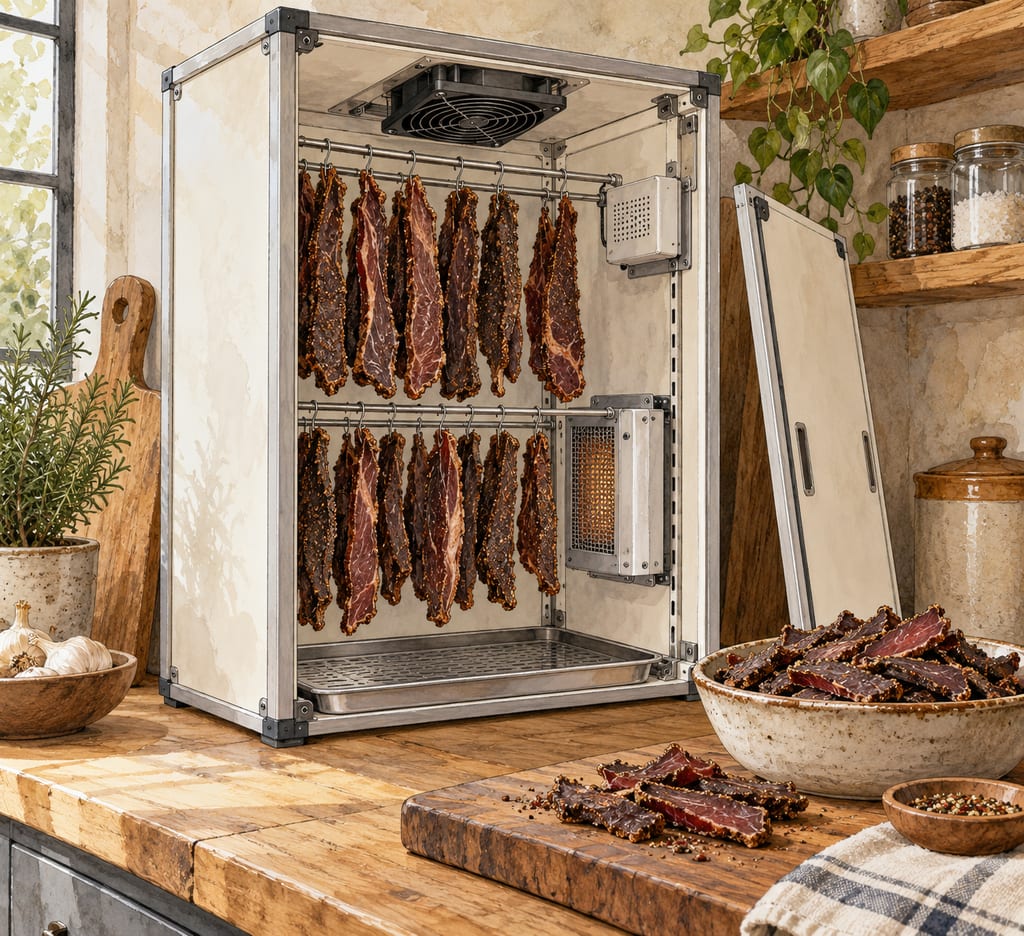
Modules
The design keeps the fan, sensor and heater as separate parts, so each one can be serviced without taking the cabinet apart. Guidance for biltong boxes uses a 120 mm computer fan for the moisture work, and a low-wattage bulb for gentle warmth.
Sources for this section
Materials
Plywood is preferred in one popular guide for rigidity and for holding hooks. Stainless hooks or food-safe twine are used for hanging, and galvanised hooks touching the meat are to be avoided.
Sources for this section
Site
A build is made where it stands: moving it means building it again.
How it is built
Risks and precautions
Do not copy marine varnish, chipboard or hot-glued mains-lamp details from hobby builds; the brief says these are not verified.
Keep the interior under about 35 C where a bulb is used, as the guidance advises.
Materials
- Rigid frame — Timber, plywood or other rigid material; coatings need assessment
- Removable food-suitable panels — Smooth and washable
- Food-suitable hanging rails
- Fan module — Separately serviceable; a 120 mm computer fan is the reference in guidance
- Sensor module
- Heater module — Low wattage; see the heat-assisted cabinet
- Build the rigid frame and check that its coatings suit food contact.
- Fit the removable food-suitable panels and rails so every panel can be removed for washing.
- Mount the fan, sensor and any heater as separate modules with their own connections.
- Run the empty cabinet and check the readings before hanging meat.
Places
Documented for international use, with no single place of origin assigned.
Community
No community contributions have been published for this entry yet.
Share what you made
Sign in to contribute. Published comments and photos are free to read.
Sources
Curing ChamberMethod · Materials · Safety
Biltong Box Design and Build GuideTargets of roughly 25-30 C at 40-60% relative humidity; if humidity stays above 60%, add airflow, more bulb heat or a dehumidifier.
Intake vents low, exhaust vents high; mesh over vents keeps insects out.
A 120 mm computer fan is the main moisture remover; a 15-40 W incandescent bulb gives gentle warmth; keep the interior under about 35 C.
Plywood is the author preference; stainless S-hooks or food-safe twine; avoid galvanised hooks touching the meat.
Hang pieces so none touch; run the empty box for an hour and check a digital hygrometer before use.
Cited in: Modules; Materials
BC Centre for Disease ControlSafety
South African RTE dehydrated meats (biltong, chili bites, droewors)Dried products are treated as shelf-stable at pH below 4.6 or water activity below 0.85 (taken from a search excerpt; the full document was not retrieved).