
Equipment · Baskets, trays and beds
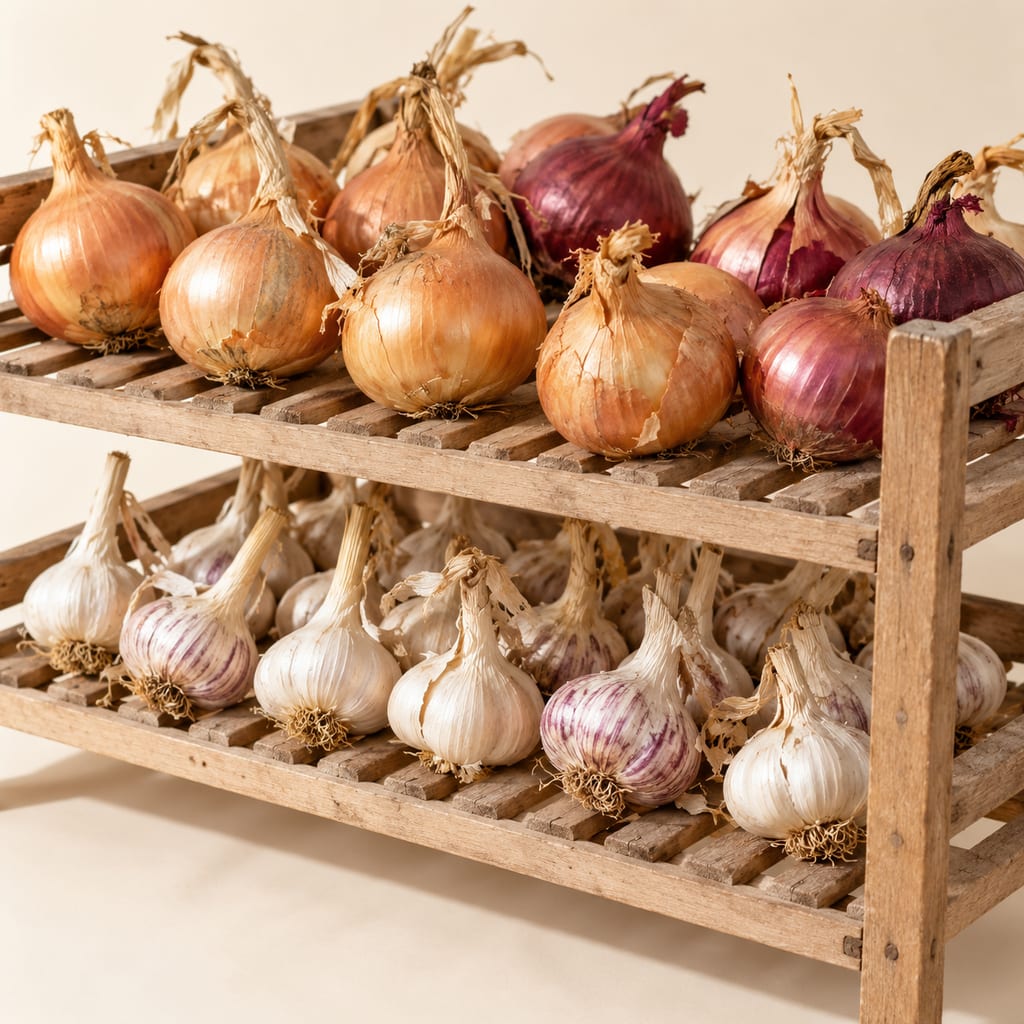
Onion and garlic curing rack
Onion curing rack · Garlic curing rack · Onion drying rack
A ventilated rack or shelf on which harvested onion and garlic bulbs dry for about two to three weeks, closing the neck and drying the outer skins before dry storage.
Overview
A curing rack holds onion and garlic bulbs in a single layer, or on loose shelves, so that air reaches every side. The bulbs dry from the outside in. The aim is a tight neck and dry outer scales, not a fully dried bulb.
Curing is a drying step rather than a wound-healing step. Humid curing, used for some roots, works the other way round, so a rack for alliums should be ventilated and kept dry.
Sources for this section
Timing and signs
Extension guidance describes onions as cured in about two to three weeks, with garlic often taking about three weeks and longer for large bunches. Tops are usually left on so that the neck can close.
The test is the neck and the skin. A tight, dry neck and uniform, dry outer scales show a cured bulb. A thick neck, soft spots or damp skin mean the bulb needs more air or should be used first.
Sources for this section
Rack design
Racks are the usual recommendation because they give bulbs air on all sides. Wire shelving or a mesh rack works well, and a simple frame across sawhorses is a common home version. Bulbs go in one layer rather than in deep piles, because piles restrict airflow and dry more slowly.
Garlic can be laid on the rack whole. Hardneck garlic is sometimes stood on its neck instead. A rack for storage should be sized to the harvest and placed in a shaded, ventilated, dry space.
Sources for this section
Warm airflow and the enclosed version
In humid or cool climates a rack can be enclosed with a gentle fan and heater to speed drying. Humidification points the wrong way for this crop, so an enclosed version should remove moisture rather than add it.
Outdoor seasonal curing and an enclosed version in a humid climate are different tasks. The enclosed one needs rated electrical parts, a way for moist air to leave, and a check that the bulbs are drying rather than softening.
Sources for this section
History
Hanging and drying alliums on racks is an old, widespread practice. The inspected modern extension guidance describes the same method, but no dated source covers a specific rack design.
Equipment details
Risks and precautions
Bulbs that stay wet at the neck or in crowded piles can rot or grow mould before storage.
Hazard sourceSingle-layer spacing with air on all sides, and checking the neck before storage
Control sourceDiscard bulbs with soft or mouldy areas. Smell does not establish that a bulb is safe to eat.
Limits
A correctly cured onion has a dry, tight neck and outer scales that are uniform in colour and dry to the touch.
Source →Thick-necked bulbs store for less time than small-necked bulbs and should be used first.
Source →Places
Documented for international use, with no single place of origin assigned.
Community
No community contributions have been published for this entry yet.
Share what you made
Sign in to contribute. Published comments and photos are free to read.
Sources
Oregon State University, Sustainable Onion ProductionMethod · Signs of cure
Drying and CuringA correctly cured onion has a dry, tight neck and uniform, dry outer scales.
Cited in: Overview; Timing and signs; Warm airflow and the enclosed version
Sow Right SeedsTiming · Rack
How to cure onions for storageCuring takes about two to three weeks; bulbs with thick necks store for less time.
Cited in: Timing and signs; Rack design