
Built structures · Place · Pits and cavities
Pohnpei stone-lined breadfruit pit
Mahr pit
An archaeological look at probable breadfruit-fermentation pits on Temwen Island, where shallow depressions and mostly buried basalt cobbles preserve evidence of Pohnpeian food technology.
Mahr and Pohnpeian food storage
Mahr is fermented breadfruit in Pohnpei. Ethnographic descriptions connect its preparation to large pits, sometimes bounded by stones, and the use of stone cover over the packed fruit. Household and communal examples are both reported, and their sizes vary. This page concerns the fixed pit as a structure; it does not treat every Pacific breadfruit pit as one design.
Pohnpei is a high volcanic island in the Federated States of Micronesia. On Temwen Island, near Nan Madol, researchers surveyed and excavated several depressions they considered possible breadfruit-fermentation pits. These are archaeological interpretations based on the shape, stone placement, soil layers and plant micro-remains, not direct photographs of ancient meals.
A studied Temwen feature
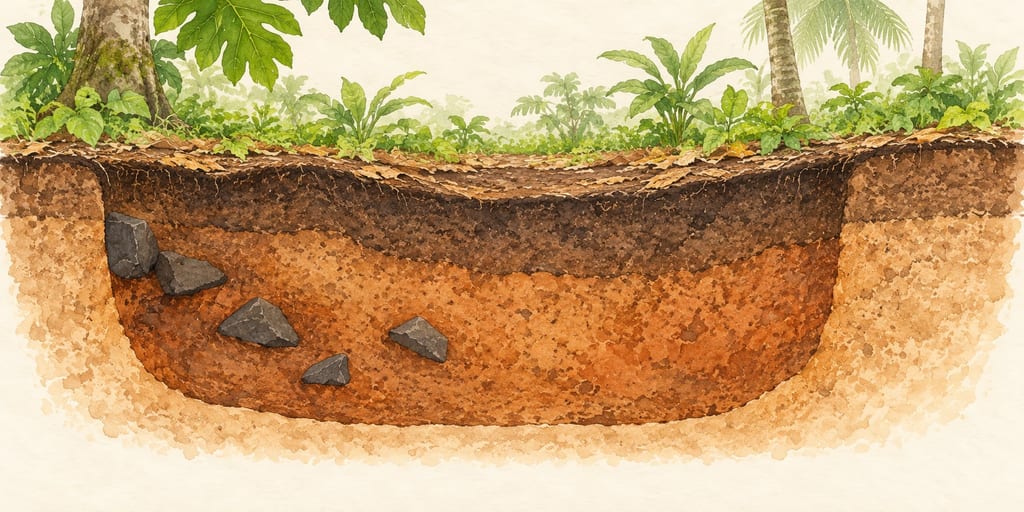
One excavated example, PoC3-18 Feature 1, was roughly L-shaped in plan, about 5.3 by 7.9 metres, and approximately half a metre deep. Most cobbles were underground; basalt stones formed alignments in parts of the depression rather than a clearly documented complete masonry wall. The feature is a shallow cavity cut into soil, not a freestanding stone vessel.
Excavation exposed two soil layers and angular basalt cobbles in purposeful-looking alignments. The archaeologist interpreted the arrangement as consistent with a breadfruit pit, while noting that identification of such features is difficult. Plant evidence offered some support, but the interpretation remains probable rather than certain. A hollow or stones alone cannot establish the past contents.
What survives, and what does not
In ethnographic descriptions of Pohnpeian mahr, peeled and cored breadfruit is packed into a leaf-lined pit, then covered with stones and earth. Fermentation and storage are reported over months or years. These are descriptions of use, not remains recovered inside PoC3-18; its perishable contents are not archaeologically preserved.
Pohnpeian ethnographic descriptions explain how large stones can cover packed fruit and help exclude air; a 1987 field report also photographs a rock-lined pit at Kiti with a central pile covering fruit. That is a different, documented use example, not proof of the exact contents or lining of PoC3-18. Leaves, fruit and fermented mass are perishable, so an illustration of the excavated Temwen feature should show the buried cavity and stones without presenting those materials as archaeological finds.
Levin discusses Pohnpeian breadfruit fermentation pits in the late prehistoric and early historic landscape, but the dated charcoal associated with individual features may relate to land clearance rather than construction. No precise origin date is assigned here. The published study suggests household-level production for much of its surveyed area; it does not make every pit a household feature or prove that all were used in the same way.
History
Pohnpeian breadfruit fermentation pits appear in archaeological and ethnographic sources. For the studied Temwen features, the date of pit construction is not securely established.
How it is built
Risks and precautions
This page describes archaeological evidence, not a plan to excavate or construct a food-storage pit. The cited archaeological sources do not provide a current construction, food-safety or structural safety specification.
Materials
- Basalt cobbles and boulders — Observed in buried alignments in excavated Temwen features; placement differs between pits.
- Clay-rich soil — The pit is a cavity within compact soil; excavation profiles record distinct soil layers.
- Ethnographic descriptions report breadfruit peeled and cored before it is packed into a pit.
- Leaves are reported as a lining or wrapping for packed fruit; the excavated Temwen feature does not preserve that perishable material.
- Stones and soil are reported as a cover for the packed fruit; at PoC3-18, the stones and soil layers are archaeological evidence, while the proposed contents remain interpretive.
- Ethnographic reports describe fermentation lasting months or years in some Pohnpeian pits; that duration is not established for the specific excavated feature.
Places
Temwen Island, Madolenihmw
Historical attestation · Locality evidenceLevin's study and the FSM heritage report examine probable breadfruit pits on Temwen Island; no single feature is used to define all Pohnpeian pits.
Pohnpei
Traditional use · Region evidenceEthnographic reports document Pohnpeian breadfruit fermentation pits; this does not establish uniform construction across the island.
Community
No community contributions have been published for this entry yet.
Share what you made
Sign in to contribute. Published comments and photos are free to read.
Sources
Journal of Island and Coastal ArchaeologyArchaeology · Morphology · Geography · History
Breadfruit Fermentation in Pohnpei, Micronesia: Site Formation, Archaeological Visibility, and Interpretive StrategiesThe study examines probable breadfruit pits on Temwen Island and describes PoC3-18 Feature 1 as roughly L-shaped, 5.3 by 7.9 m and about 0.5 m deep, with mostly subsurface cobbles.
Architecture and some phytolith evidence support a probable breadfruit-fermentation interpretation, while archaeological identification remains interpretive and dates require caution.
The study describes Pohnpeian mahr and a range of household and communal pit forms; no single layout is universal.
Cited in: Mahr and Pohnpeian food storage; A studied Temwen feature; What survives, and what does not
Federated States of Micronesia National Archives, Culture and Historic Preservation; Pohnpei State Office of Historic PreservationArchaeology · Morphology · Geography
The Archaeology of Nan Madol and Temwen Island: Site Distribution, Architecture and Early Agricultural FeaturesThe 2015 report documents Temwen breadfruit-pit features including PoC3-18, PoC3-50 and PoC3-52; pit identification is described as likely/probable.
Figures and excavation descriptions record boulders, cobbles, soil layers and pit plans; the features occur within a managed agroforest landscape.
Cited in: A studied Temwen feature
Water and Energy Research Institute of the Western Pacific, University of GuamEthnography · Image · Materials
Traditional Micronesian HorticulturePhoto 28 caption identifies a rock-lined breadfruit-fermentation pit in Kiti, Pohnpei, with a pile of rocks covering fruit.
The report describes differing pit forms across Micronesia; the Kiti example is not a direct image of the Temwen archaeological feature.
Cited in: Mahr and Pohnpeian food storage; What survives, and what does not