
Built structures · Drying kilns and dryers
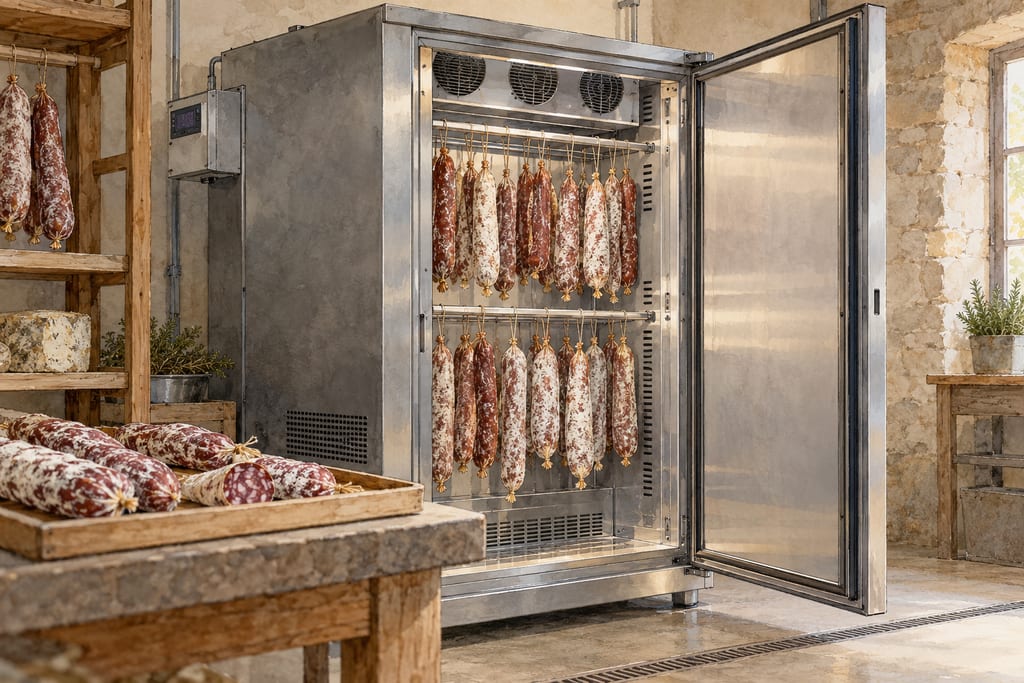
Sausage drying cabinet after fermentation
A cabinet that dries fermented sausage after the fermentation stage, with humidity removal, airflow and temperature control, once the product has reached its safe fermented state.
Overview
A sausage drying cabinet dries fermented sausage after the warm fermentation stage. Its job is to remove moisture in a controlled way while the product keeps the safety it gained in fermentation.
Dry fermented sausage is defined as reaching pH 5.3 or lower through bacterial action, then drying off 25 to 50 percent of its moisture. The moisture to protein ratio is 1.9 to 1.0 or less, or 2.3 to 1.0 for Genoa and Milano.
Sources for this section
Drying after fermentation
Traditional practice moves the sausage to a drying chamber started at about 6 to 15 C. A public-health guidance document, as reported in search results, says dry sausages are dried after fermentation until water activity is 0.90 or below.
Humidity must fall at this stage, because a cabinet with no way to reduce it is useful only for fermentation.
Sources for this section
Limits
The drying cabinet does not establish lethality. FSIS states that degree-hour counting supports control of S. aureus outgrowth during fermentation, not Salmonella lethality. Lethality is verified under the product's own process and records.
No consulted source gives a complete drying schedule for a home cabinet.
Sources for this section
Site
A build is made where it stands: moving it means building it again.
How it is built
Risks and precautions · High risk
USDA guidance on dry fermented sausage ties the pH, moisture loss and moisture to protein ratio to the product; drying a sausage that did not reach its target pH does not make it safe.
Hazard sourceToo much airflow dries the surface before the interior, and uneven drying follows.
Hazard sourceReach pH 5.3 or lower by bacterial action before drying, and dry 25 to 50 percent of the moisture.
Control sourceKeep the product in the fermentation stage long enough to control S. aureus outgrowth, using the degree-hour method.
Control sourceHigh-risk process. Lethality and drying limits must be set and validated for each product; a plant fermenting to a pH above the published basis needs a challenge study.
Materials
- 1 unit Drying cabinet or converted fridge — Must be able to reduce humidity; a cabinet without humidity removal is for fermentation only.
- 1 set Temperature and humidity controller — Drying needs lower humidity and cooler air than fermentation.
- 1 unit Small fan — Keeps air moving without drying the surface too fast.
- Hanging racks — Lined trays or hooks, tested with weight.
- Confirm that the fermentation stage is complete and that the product has reached its fermented state. The chamber cannot establish that.
- Transfer the sausages to the drying cabinet, where humidity is lower and the air is cooler than in the fermentation stage.
- Run the fan to keep air moving around each piece.
- Log weight loss and water activity against the validated drying schedule for the product.
- Clean the humidity device regularly, with vinegar as the guides advise.
Places
Documented for international use, with no single place of origin assigned.
Community
No community contributions have been published for this entry yet.
Share what you made
Sign in to contribute. Published comments and photos are free to read.
Sources
USDA Food Safety and Inspection ServiceSafety
FSIS Ready-to-Eat Fermented, Salt-Cured, and Dried Products GuidelineDry fermented sausage reaches pH 5.3 or lower by bacterial action, then dries 25 to 50 percent of its moisture
Moisture to protein ratio of 1.9 to 1.0 or less, with Genoa and Milano at 2.3 to 1.0
Degree-hour method supports control of S. aureus outgrowth during fermentation, not Salmonella lethality
A plant fermenting to a pH above the model basis needs a challenge study
Cited in: Overview; Limits
HotSpot Outdoors forumMethod
Fermented SausageTraditional drying chamber start at about 6 to 15 C
Cited in: Drying after fermentation
BC Centre for Disease ControlSafety
Fermented Foods Guidance: SausageDry sausages are dried in a drying chamber or room after fermentation, to a water activity of 0.90 or below (as reported in search results; check the document)
Cited in: Drying after fermentation
Meats and SausagesMethod
Equipment for Making Fermented SausagesFast culture fermentation given at 30 to 45 C
A cabinet without a way to reduce humidity is for fermentation only
Cited in: Drying after fermentation