
Equipment · Incubators and warm holds
Shoyu moromi vessel cabinet
A corrosion-resistant cabinet with trays under brine vessels and gentle indirect heating and cooling, for the moromi stage of soy sauce, where soy koji ages in brine for months.
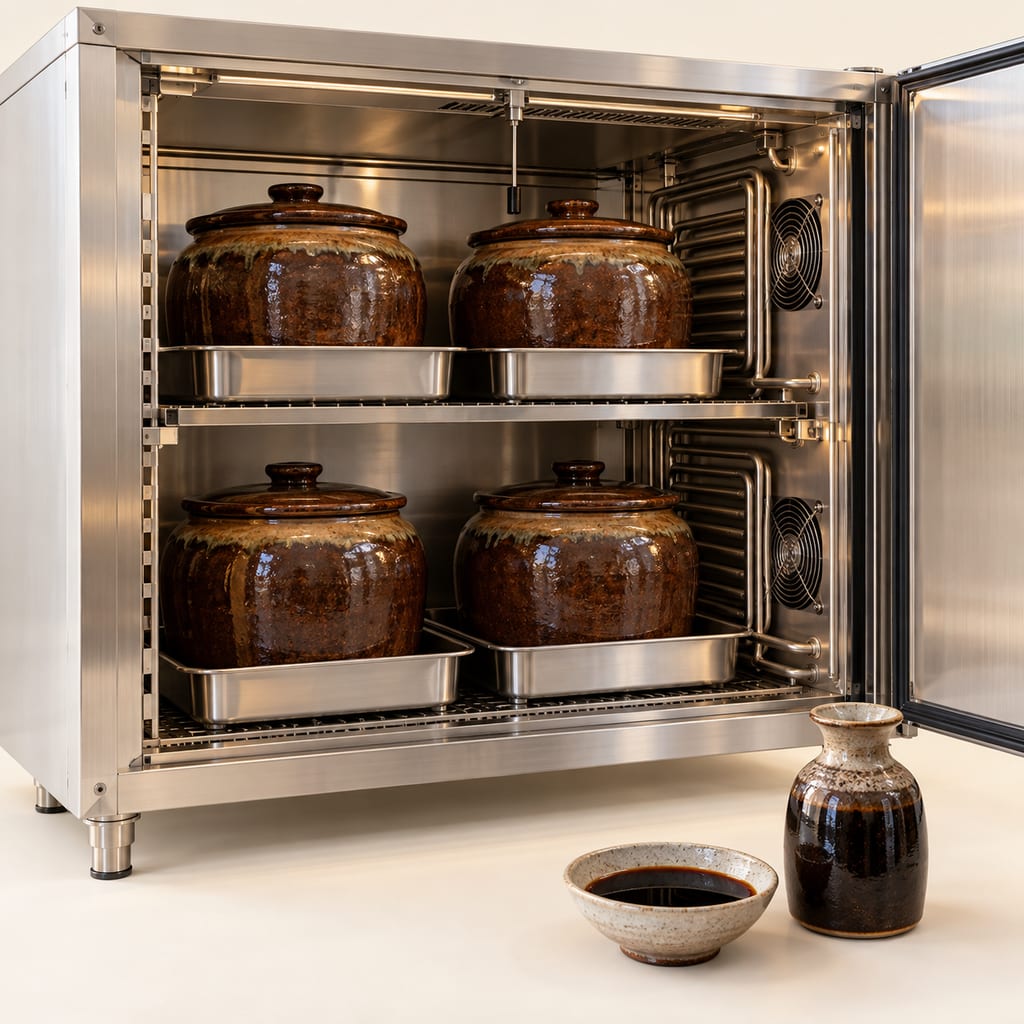
What it is
A moromi vessel cabinet holds the brine vessels in which soy koji and salt water ferment and age into moromi. The brief proposes corrosion-resistant trays under the vessels, gentle indirect heating and cooling, and access for the handling the process needs.
The brief separates the earlier mould-grown substrate from the later brine stage. Soy sauce is a process chain, and the cabinet serves only the brine stage.
Sources for this section
The process
In Kikkoman's account, soy sauce koji is made from soybeans, wheat, salt and water over about three days. Salt water is mixed into the koji to make moromi, which ferments and ages in tanks. Kikkoman's museum page says the characteristic taste and aroma develop over about six months.
The aged moromi is pressed in cloth layers. Liquid runs out by gravity, then the mash is pressed for about ten more hours. The pressed liquid rests to clarify and is then heated or filtered to stop fermentation. The solids are a by-product sold as feed.
Sources for this section
What the article should prove
The brief asks for the recipe, salt balance, culture and sampling method to be established before a setting is published. It also asks for an advanced food-process article rather than a generic temperature.
Sources for this section
Equipment details
Limits
Acidic and salty vapour can damage probes and cables; the brief asks for this to be tested.
Source →A controlled cabinet is not a generic fermentation setting; the recipe, salt balance and sampling method must be proven first.
Source →Places
Documented for international use, with no single place of origin assigned.
Community
No community contributions have been published for this entry yet.
Share what you made
Sign in to contribute. Published comments and photos are free to read.
Sources
KikkomanMethod
How soy sauce is madeSoy sauce koji takes about three days.
Moromi is aged in tanks for months, and pressed by gravity and then mechanically.
Cited in: What it is; The process; What the article should prove
Kikkoman EuropeMethod
How to brew the perfect soy saucePressed raw soy sauce rests in tanks to clarify, then is heated or filtered.
Cited in: The process