
Equipment · Incubators and warm holds
Sweet potato curing cabinet
Sweet potato curing chamber · Sweetpotato curing box
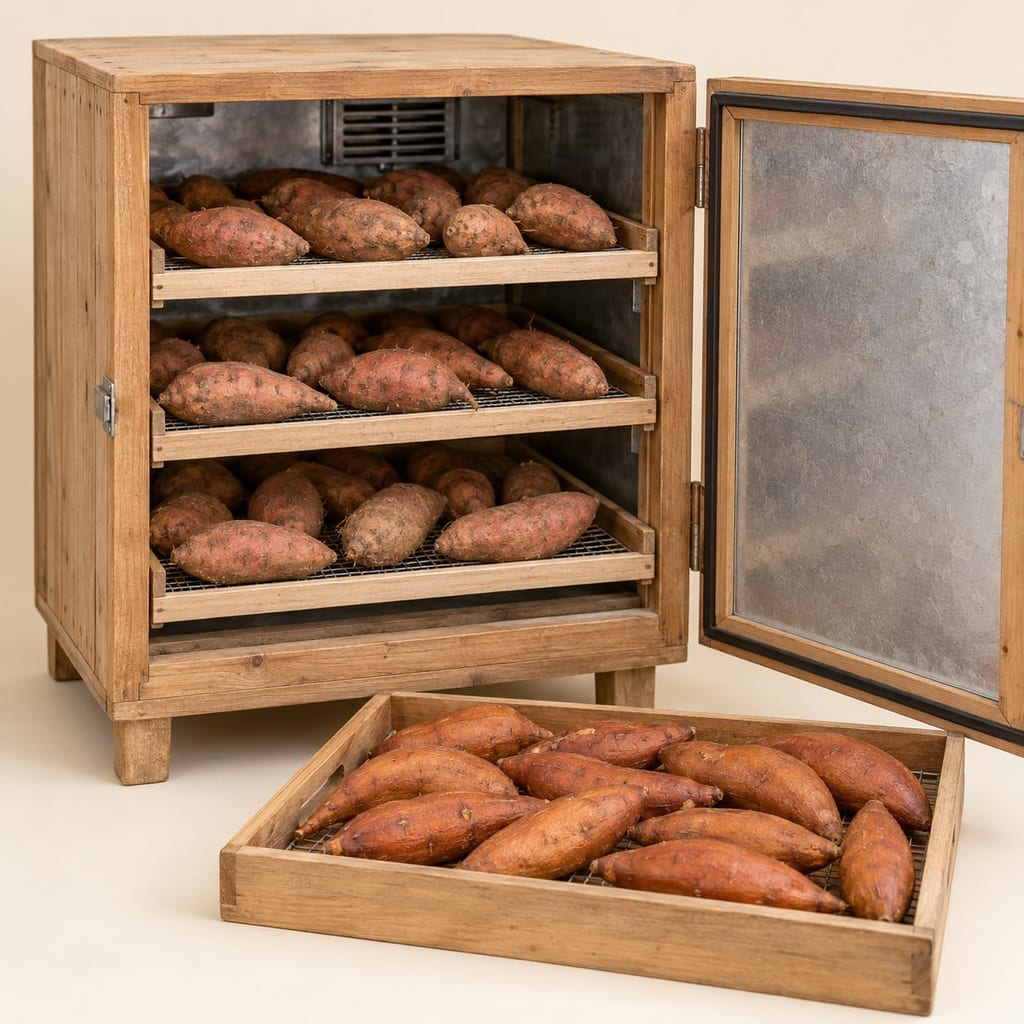
A small enclosure that holds freshly harvested sweet potatoes at high heat and humidity for about a week so the skins harden and wounds heal, before they move to a cooler store.
Overview
A sweet potato curing cabinet is a small, closed enclosure in which freshly harvested roots are held warm and humid for about a week. Curing lets the skin tighten and lets abrasions and cuts heal over before the roots go into storage.
Curing is not the same as storage. Curing uses high heat and high humidity to heal wounds; storage uses cooler and drier conditions to hold the crop. The same enclosure is not used for both.
Sources for this section
Curing conditions
The North Carolina Cooperative Extension target is about 29 °C (85 °F) with 85 to 95% relative humidity for five to seven days, followed by storage at about 13 to 18 °C (55 to 65 °F). Iowa State advises 27 to 29 °C (80 to 85 °F) and 90 to 95% humidity for a week. Washington State gives 27 to 32 °C (80 to 90 °F) and 80 to 90% humidity. Delaware gives 29 °C (85 °F) and 90% humidity for five to seven days.
The extension targets agree on warmth and high humidity for about a week. They differ within a few degrees and several percentage points, so the cabinet should be built to hold a chosen point rather than one fixed value.
Wound healing
Curing works by letting wounds heal, so the cabinet's job is to keep the surface moist enough for healing but not wet enough to rot. A UK-published study reports that drying out tissue blocks inhibits wound healing, and that under moderate humidity sweet potatoes did not always finish healing.
The NC State study of 1974 found that extreme temperatures, 4.5 °C and 45 °C, slowed healing in every cultivar it tested. That supports holding the cabinet near the mid-warm band rather than running it hot to save time.
Design and comparison
The programme brief compares three forms: a passive baseline under plastic, an active controlled cabinet, and a commercial alternative. A cleanable insulated enclosure with vented crates is the design it proposes. Crates keep the roots off the floor and let air circulate, and a fan with a humidifier and heater gives control.
A passive plastic-tented enclosure is cheaper and needs no power, but it cannot be tuned to a target. An active cabinet can be set and logged, at the cost of electrical work and cleaning. No inspected source measures energy use for a small cabinet, so that comparison must be made by testing.
Sources for this section
Monitoring
Record the cultivar, the harvest damage and the actual root temperature for each batch. Map temperature and humidity at more than one point, because moisture and air movement vary inside a small box. Condensation on the lid and walls is a sign that ventilation or temperature needs adjusting.
Sources for this section
History
Curing sweet potatoes after harvest is documented in modern extension guidance and in mid-twentieth-century plant pathology work on wound healing. No dated source covers a purpose-built curing cabinet.
Equipment details
Risks and precautions
A heated, humid enclosure can damage wiring and can create wet, slippery surfaces.
Hazard sourceKeep electrical parts outside the humid zone and use a separate temperature limit
Control sourceCuring targets are guidance for healthy, undamaged roots. Damaged or rotting roots should be removed before curing, and smell or appearance does not establish that a root is safe to eat.
Limits
Curing at about 29 °C (85 °F) and 85 to 95% relative humidity for five to seven days is the most common extension target. Other extensions give slightly different bands.
Source →Storage above about 16 °C (60 °F) may stimulate sprouting, so the cabinet should be followed by a cooler store.
Source →A 1974 NC State study found that 4.5 °C and 45 °C slowed wound healing in roots of all cultivars tested.
Source →Places
No source in this record establishes a place.
Community
No community contributions have been published for this entry yet.
Share what you made
Sign in to contribute. Published comments and photos are free to read.
Sources
NC Cooperative Extension, Burke CenterMethod · Curing conditions
Harvesting and Curing Sweet PotatoesCuring at about 85 °F with 85 to 95% RH for 5 to 7 days, then storage at 55 to 65 °F.
Cited in: Overview; Curing conditions; Design and comparison
Iowa State University ExtensionCuring conditions · Storage
How do I harvest and store sweet potatoes?80 to 85 °F and 90 to 95% humidity for one week; storage above 60 °F may stimulate sprouting.
Cited in: Curing conditions; Monitoring
Washington State University ExtensionCuring conditions
Sweetpotato curing and storage80 to 90 °F and 80 to 90% RH for one week.
Cited in: Curing conditions; Design and comparison
University of Delaware Weekly Crop UpdateCuring conditions
Sweet Potato Harvest, Curing, and Storage85 °F and 90% humidity for five to seven days.
Cited in: Curing conditions
American Phytopathological SocietyWound healing · History
Phytopathology 1974 abstract, sweet potato wound healing4.5 °C and 45 °C retarded wound healing in roots of all cultivars.
Cited in: Wound healing
UK government publicationsWound healing
UK sweet potato wound healing study (R7520b)Desiccation of tissue blocks inhibits wound healing; moderate humidity did not always allow healing to finish.
Cited in: Wound healing