
Built structures · Pits and cavities
Terekeka pit kiln
A customary fish-smoking pit described at Terekeka in a 2018 field study: an earthen cavity, logs supporting wire mesh, and a flat iron cover. The dimensions and trial results belong to that study setting.
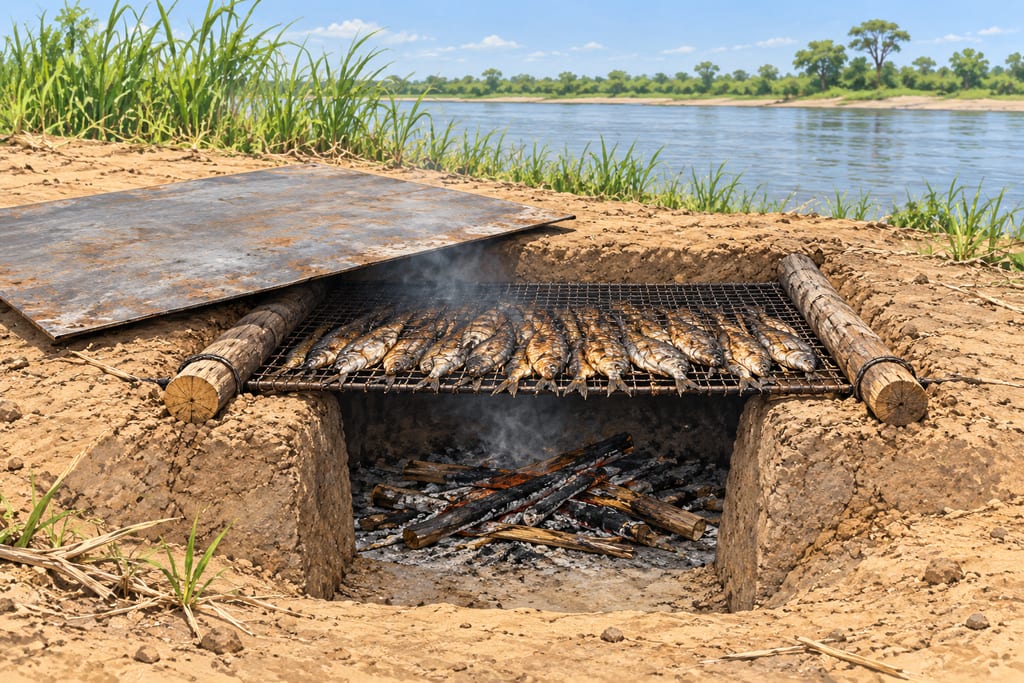
A pit kiln recorded at Terekeka
A field study in June 2018 describes a customary pit kiln used by fisher-folks around Terekeka. The paper gives its dimensions as about 1 m long, 0.5 m wide and 0.5 m deep. Logs placed at the edges supported wire mesh, and a flat iron sheet was put over the mesh to cover the fish samples. This is a record of one local form in a named study setting, not a standard design for South Sudan.
The researchers worked with Nile tilapia (Oreochromis niloticus) and elephant-snout fish (Mormyrus caschive). The paper identifies Acacia seyal as the main tree species used by fisher-folks for smoking in the area. It does not identify species or dimensions for the support logs, or specify the mesh's material or gauge.
The pit and the Chorkor trial
The study compared the customary pit kiln with a separate Chorkor oven constructed for the experiment. The Chorkor had brick walls and tray compartments; its form should not be folded into the description of the Terekeka pit. In the reported experiment, average smoking time was 20 hours in the pit and 8 hours in the Chorkor. Those numbers describe that study's samples and conditions; they are not recommended timings for home or commercial smoking.
The article also measured nutritional values and polycyclic aromatic hydrocarbons (PAHs). Its findings concern the tested fish and experimental setups. They do not establish that every pit kiln or fish batch will produce the same results.
What this record can and cannot tell you
The evidence supports a concise physical description: an earthen pit, edge-set logs, wire mesh, and a flat iron sheet used as a cover. It does not provide a complete construction sequence, lining method, fuel quantity, validated household process, safe endpoint, or storage limit. The page records a source-specific preservation structure and keeps the experimental observations separate from general operating advice.
History
The study's methods describe a customary pit kiln used by fisher-folks around Terekeka and compare it with a separate Chorkor installation built for the experiment. These are site-specific observations, not evidence of one standard structure throughout South Sudan.
Site
A build is made where it stands: moving it means building it again.
How it is built
Materials
- Earthen pit — The study describes a pit kiln about 1 m long, 0.5 m wide and 0.5 m deep.
- Logs — Logs were placed at the pit edges to support wire mesh.
- Wire mesh — The mesh held the fish samples above the pit.
- Flat iron sheet — The sheet was placed over the mesh to cover the samples during smoking.
- Acacia seyal wood — The paper identifies Acacia seyal as the main tree species used by fisher-folks for smoking fish in the area.
- Observed configuration, not an instruction: logs rested at the pit edges to support the wire mesh.
- In the study trial, fish samples were placed on the mesh and a flat iron sheet covered them; the trial does not establish a universal procedure or safe endpoint.
Places
Terekeka
Documented use · Locality evidenceLocality of the customary pit kiln trial. The article does not establish coordinates or an origin date.
Community
No community contributions have been published for this entry yet.
Share what you made
Sign in to contribute. Published comments and photos are free to read.
Sources
African Journal of Food Science, 16(1), 2022Primary study · Structure · Geography · Methods · Context
Effect of smoking technologies on nutritional values and concentration levels of polycyclic aromatic hydrocarbons in smoked fish (Mormyrus caschive and Oreochromis niloticus) of Terekeka, South SudanThe study's June 2018 Terekeka work documents a customary pit kiln measuring about 1 m long, 0.5 m wide and 0.5 m deep.
Logs at the pit edges supported wire mesh, and a flat iron sheet covered the mesh and samples during smoking.
The study examined Nile tilapia (Oreochromis niloticus) and elephant-snout fish (Mormyrus caschive); its separate Chorkor installation was a comparator, not the customary pit.
The study reports an average 20-hour pit-kiln smoking time and an 8-hour Chorkor time under its experimental conditions; these are results of that trial, not household directions.
The article identifies Acacia seyal as the main tree species used for smoking fish in the area.
Cited in: A pit kiln recorded at Terekeka; The pit and the Chorkor trial; What this record can and cannot tell you