
Equipment · Baskets, trays and beds
Woven palm sofra mat (saf al-khous)
السفرة · sofra
The Kuwaiti sofra is a broad, round palm-woven mat. Made through saf al-khous, the palm-frond weaving craft, it served at home and was also used as a surface for drying shrimp, locusts and some herbs.
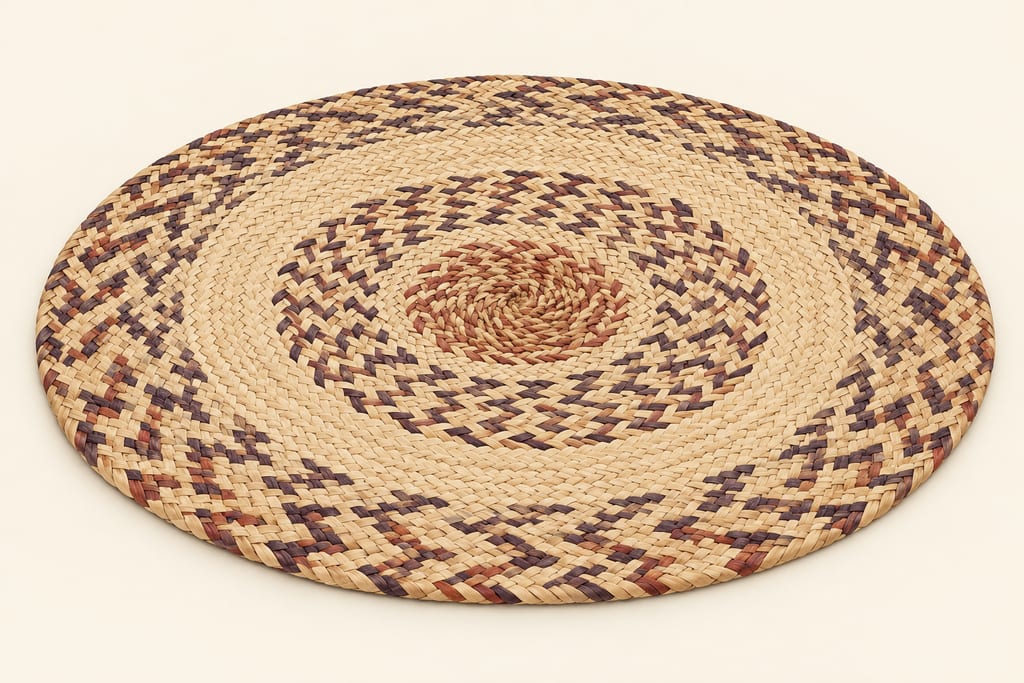
The sofra: a woven palm mat
The sofra is a broad, round mat woven from palm strips. In Kuwait it belongs to saf al-khous, the craft of shaping palm leaves and fibers into household objects. The term names two related but distinct things: saf al-khous is the weaving craft, while the sofra is one of its products. Its flat, portable form could serve at home as a mat and as a surface for drying foods.
A 2016 account describes sofras as large and round, with some reaching four feet across. The reported palm-leaf requirement varies with size, at roughly 30 to 50 metres. These are examples of scale, not fixed specifications for every mat. No standard weave gauge, thickness or weight is recorded.
A food-drying surface in older Kuwaiti use
The sofra is notable as a piece of domestic weaving put to work in preservation. It was used to dry shrimp, locusts and some herbs. The mat therefore connects palm craft with the seasonal storage of foods, but the surviving description is limited: it does not identify shrimp species, preparation, salting, drying conditions, final moisture or storage time.
Those missing details matter. The mat documents the support used for drying, not a complete process that can be copied for modern production. It also does not establish that a traditional drying endpoint is safe under present-day conditions. The equipment's history is clear enough to explain its role, while process parameters remain unstated.
Sources for this section
Palm material and hand weaving
Saf al-khous is built from palm material worked into strips and woven by hand. A current Kuwaiti craftswoman describes lightly wetting the leaves so they can be shaped, splitting them into narrow strips, dyeing them, and plaiting strands in planned patterns. The design depends on arranging the rows and colors rather than on a powered loom.
The method is part of a wider family of palm-woven household objects, including baskets, fans and floor or table mats. A 2025 account documents contemporary teaching and making of the craft, with sofra mats among the products. That establishes the continuing craft of weaving; it does not by itself show that shrimp-drying on the sofra remains current.
Use, care and limits
Some mats were described as durable enough to be washed with seawater without damage. That is a reported feature of the craft, not a general cleaning protocol for every palm mat or a claim about food sanitation. The record does not supply instructions for removing food residue, drying the mat after washing, or storing it between seasons.
The mat's name and form should not be confused with a basket, a serving tray with walls, or a modern mesh dryer. It is a flat woven surface. No food-safety validation, shrimp handling procedure or drying endpoint accompanies the historical account, so the sofra is documented here as equipment and cultural evidence rather than a stand-alone preservation recipe.
Equipment details
Made of
- Palm leaf strips (khous) — woven mat body
The Kuwaiti palm-weaving craft uses palm leaves and fibers; the strips are interlaced by hand.
Limits
The historical account names shrimp, locusts and some herbs as dried on sofra mats but gives no species, preparation, drying conditions, endpoint or storage controls; it is not a validated drying procedure.
Source →The sources describe the mat's uses and craft, but do not establish that the reported seafood-drying use continues in current production.
Source →Places
Kuwait
Traditional use · Country evidenceThe sofra is identified as a large round palm mat used at home and for drying shrimp, locusts and some herbs; the account does not date the practice's beginning.
Kuwait
Manufacture · Country evidenceA Kuwaiti craftswoman demonstrates current saf al-khous work and identifies sofra mats among its products; this documents manufacture, not continued seafood-drying use.
Community
No community contributions have been published for this entry yet.
Share what you made
Sign in to contribute. Published comments and photos are free to read.
Sources
Kuwait News Agency (KUNA), republished by Al-AnbaTraditional use · Form · Materials · Food drying
«سف الخوص».. حرفة يدوية عكست مهارات أهل الكويت قديماً في توفير احتياجاتهمThe Kuwaiti sofra is described as a large round palm-leaf mat, reaching up to four feet in diameter and using about 30–50 metres of palm leaves depending on the requested size.
The report identifies the sofra as a household mat and says it was used to dry shrimp, locusts and some herbs.
Saf al-khous is hand weaving/plaiting palm material without machines; the report says some mats could be washed with seawater without damage.
The report does not identify species or describe drying conditions, endpoints or shelf-life controls.
Cited in: The sofra: a woven palm mat; A food-drying surface in older Kuwaiti use; Palm material and hand weaving; Use, care and limits
AljaridaCurrent craft · Materials · Visual reference
الصايغ: سف الخوص فن ورسالة لحفظ تراث الأجدادKuwaiti craftswoman Shorouq Al-Sayegh demonstrates contemporary saf al-khous work and says she makes palm-woven products including sofra mats.
The maker describes lightly wetting palm material, dividing it into strips, dyeing the strips and plaiting them by hand.
The article caption identifies an old sofra mat among woven items; it does not document seafood-drying use in the present day.
Cited in: The sofra: a woven palm mat; Palm material and hand weaving; Use, care and limits