
Acids
Acid blend
Acid blend is a commercial mixture of food acids for winemaking. Supplier formulas differ, and pH, titratable acidity and tartness describe different effects of an addition.
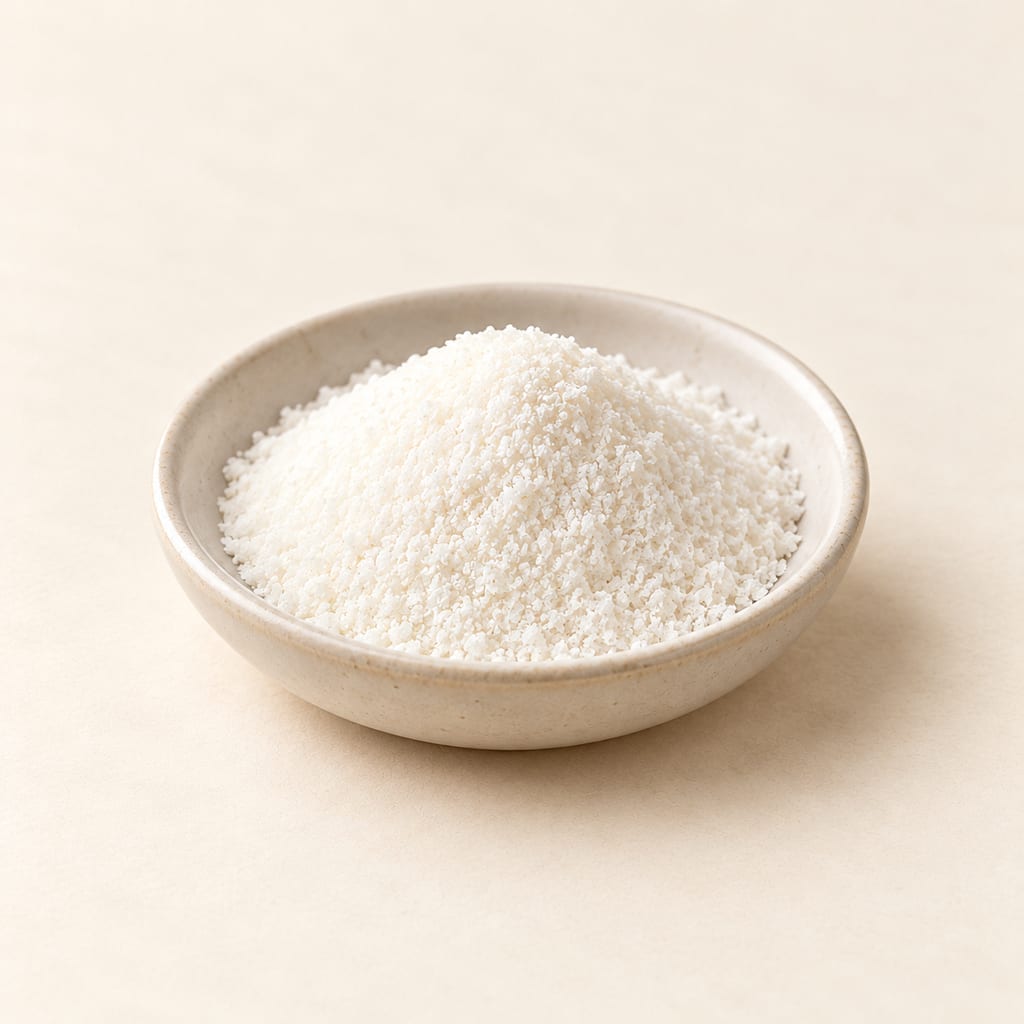
A commercial mixture for adjusting acidity
Acid blend is a purchased mixture of food acids used in winemaking. It supplies acidity directly rather than acting as a yeast culture or waiting for a souring organism to produce acid. The name identifies a category of ingredients, not a single chemical formula shared by all suppliers.
The Concord grape wine recipe linked here includes acid blend among the ingredients mixed into its must. Must is the juice and other grape material prepared for fermentation. The addition is part of that specific formulation; it is not a general instruction to add acid blend to every Concord grape harvest.
Commercial mixtures differ. The current Adventures in Homebrewing product lists malic, citric and tartaric acids, while Grapes to Glass lists tartaric and malic acids. A generic recipe name therefore needs to remain generic unless its actual supplied product is known. The three-acid formula is a documented example, not the definition of acid blend.
The blend’s history is separate from the history of its acids
Wine contains acids before a winemaker makes an adjustment. Grapes contribute several organic acids, and fermentation can add or transform others. A purchased blend belongs to a later supply system in which isolated food ingredients can be combined for a particular use. It should not be described as though grape juice itself were a bag of acid blend.
The constituent acids also have different manufacturing histories. One producer recovers natural tartaric acid from wine lees, the sediment associated with winemaking. Another manufactures citric acid through a controlled microbial fermentation followed by recovery and purification. Neither pathway establishes the origin of every commercial mixture.
No first manufacturer, launch date or earliest recipe for this generic blend is established here. Its commercial name and modern use are documented, while the longer histories of tartaric, malic and citric acids remain distinct. Assigning the mixture the age of one naturally occurring component would give it a history the evidence does not support.
Different formulas change what an addition contains
Adventures in Homebrewing describes its current product as 50% malic acid, 40% citric acid and 10% tartaric acid. Grapes to Glass describes a mixture of 66.6% tartaric acid and 33.3% malic acid. These are supplier declarations for separate products, not competing measurements of one standard blend.
The difference matters even before a winemaker considers quantity. An addition of the first product introduces citric acid and a different balance of the other acids from an addition of the second. Replacing one with the other changes the composition of the must, even if the same gross weight is used.
A supplier’s current formula can identify the product offered now. It cannot establish the precise mixture used in an undated recipe batch or guarantee that a later purchase will have an unchanged specification. Retain the ingredient list and lot information with the actual supply rather than relying on the category name alone.
Sources for this section
Tartness is one effect of acidity
Acids contribute the sour or tart part of a wine’s taste. That sensation interacts with the rest of the drink, including its sweetness and other flavour components. An acid addition is therefore often discussed in terms of balance, but balance describes the resulting drink rather than an intrinsic guarantee printed on the powder.
Malic acid illustrates why formulators distinguish individual acidulants. Bartek describes its malic acid as having a smooth, lingering sourness and supplies it for blends as well as single-acid applications. Those are a producer’s sensory and formulation descriptions; they do not predict the flavour of a particular Concord wine.
A tasting comparison can help assess whether an adjustment fits the intended drink. It cannot identify all acids present or establish a microbiological safety endpoint. Sourness, measured acidity and the organisms able to grow in a wine are connected through chemistry and process, but they are not interchangeable observations.
Sources for this section
pH and titratable acidity answer different questions
Wine acidity is commonly assessed through pH and titratable acidity, often abbreviated TA. pH concerns hydrogen-ion activity, while TA measures the acid neutralized under the defined titration method. They describe related aspects of the liquid without reporting the same property.
A change in the balance between malic and tartaric acids can alter pH without producing the same sort of change in TA. Their chemical behaviour differs even though both contribute acidity. This is one reason that replacing one blend with another cannot be evaluated from the total powder weight alone.
Reporting TA as tartaric-acid equivalents is a convention for expressing an analytical result. It does not mean that every acid in the sample is tartaric acid. Likewise, a pH reading cannot reveal a supplier’s blend formula. Product composition and analysis of the must are separate pieces of information needed to interpret an adjustment.
Sources for this section
Buffering prevents a universal conversion to pH
A wine’s buffering capacity describes its resistance to a change in pH when acid or base is added. Weak acids and their related conjugate bases contribute to that behaviour. Two wines can consequently respond differently to an equal acid addition even when the same product and quantity are used.
This is why a supplier’s spoonful or a general acid-per-volume rule cannot promise a fixed pH drop for every must. The starting liquid is part of the chemical system. Measuring the starting pH is useful, but it does not by itself identify all the buffering components that determine the response.
Iowa State’s bench-trial guidance treats acidification as an adjustment to compare in small samples before applying it to a whole batch. Analytical readings and sensory evaluation provide different observations of those samples. The method supports a decision about the actual wine; it does not turn one trial’s addition into a universal prescription.
Grape handling also changes the starting liquid
A sample needs to represent the must being adjusted. Grape skins contain potassium, and contact with them can change the composition of the juice. A reading taken immediately from one small juice sample may therefore differ from the liquid after skin contact or pressing.
Potassium participates in tartrate chemistry. The formation and precipitation of potassium bitartrate can change both acidity measurements and the response to an addition. The direction of a pH change during precipitation depends on the starting conditions, so acidity is not simply a quantity that stays fixed once powder has dissolved.
These changes explain why the point in the process at which a measurement is made matters. Record whether the sample represents juice, must with skin contact or a later wine. Comparing like stages makes an adjustment more intelligible than treating every reading from the same harvest as equivalent.
Microorganisms can change acid composition
Fermentation is capable of changing acidity rather than merely operating within an unchanging acidic liquid. Yeasts can produce or consume particular organic acids, with behaviour differing among species and strains. An acid blend sets part of the starting composition, but it does not dictate every later acid concentration.
Malolactic fermentation is another distinct conversion: suitable bacteria transform malic acid into lactic acid and carbon dioxide. The acids differ in their chemical properties, so that transformation affects the resulting wine. It is not the same operation as adding a purchased mixture of dry acids.
The presence of malic acid in a blend does not establish that malolactic fermentation will occur, be desired or be appropriate for a given wine. Those decisions belong to the complete fermentation process. A component list identifies what is added, without proving which organisms will later use it.
Citric acid can be made by fermentation and then purified
Jungbunzlauer’s Port Colborne manufacturing account describes citric acid production from glucose syrup using a selected Aspergillus niger culture. The fermentation converts sugar into acid under an industrial production process. This is a documented route for a possible blend component, rather than a method for making acid blend at home.
After fermentation, the fungal biomass is removed. The acid is recovered from the remaining broth, purified using ion exchange and carbon treatment, then concentrated and crystallized. Drying, sieving and packaging create the supplied crystalline ingredient. The isolated acid is not the same material as the fermentation broth or the growing culture.
That sequence makes a useful distinction: an ingredient can have a fermentation step in its manufacture without being supplied as a living starter. It also does not make every acid in a mixed product fermentation-derived. The component supplier and manufacturing record are needed before a claim about a particular blend’s production route can be made.
Sources for this section
A food-grade component has its own specification
Bartek’s food-grade malic acid specification describes white or nearly white crystals and includes identity, assay and particle-size criteria. Those are specifications for a named malic acid supply. They show how a component can be characterized beyond the broad description white powder.
A mixture needs its own information. The shelf life or storage conditions of that single-acid product should not be transferred to an unspecified blend, and the location of a component factory should not become the mapped origin of the mixture. Blending and packing may be separate operations undertaken elsewhere.
Distillerie Mazzari’s account of recovering tartaric acid from wine lees provides another component pathway. It does not prove that the tartaric acid in the linked retail blend came from that producer. Keep a documented manufacturing example separate from a claim about the exact supply purchased for a recipe.
Bench trials connect the product to the batch
A bench trial compares a proposed adjustment on small, measured samples. The Iowa State method starts with a solution of known additive concentration and tests a range of additions. That structure allows the samples to differ in a deliberate, recorded way while the starting wine remains comparable.
Use the actual product being considered for the batch. Testing pure tartaric acid does not directly test a three-acid blend, and testing one supplier’s mixture does not identify the response to another. The concentration of the trial solution also needs to be known; a spoonful in an unspecified volume cannot support a reproducible comparison.
The analytical result and the tasting result serve different purposes. A preferred flavour does not certify safety or stability, and a chosen pH does not by itself demonstrate that the finished wine meets every process requirement. The trial supplies evidence about the proposed addition within a larger winemaking decision.
A trial record needs to connect each sample with its addition, rather than just recording which glass tasted best. Known sample volumes and solution concentrations make that comparison interpretable. Keep an untreated sample in the comparison so that the starting wine remains visible alongside the adjusted samples.
Sources for this section
The recipe and the purchased product remain necessary
The Concord recipe states a tablespoon of acid blend within its five-gallon formulation. It does not provide a corresponding mass, a measured starting acidity or a verified resulting pH. Another supplier’s spoon-to-weight example cannot supply the missing mass because the actual mixture and its physical form may differ.
Professional standards also distinguish named acids and defined practices. The OIV’s chemical-acidification entry concerns specified organic acids under its own code; it is not a universal formulation for retail acid blend. Applicable rules depend on the product, use and jurisdiction rather than on the category name alone.
Keep the package label, supplier directions and batch measurements together. No generic dose, storage life or safety threshold is established by this entry. Acid blend is an adjustable ingredient within a complete recipe, and its name cannot substitute for knowing what was added and how the actual must responded.
Places
Unknown
historical-association · Place not establishedNo generic blend origin or exact batch manufacturing location established. Concord grape identity and supplier addresses do not locate the blend.
Community
No community contributions have been published for this entry yet.
Share what you made
Sign in to contribute. Published comments and photos are free to read.
Sources
Adventures in HomebrewingIngredient identity · Fermentation function · Handling
Concord Grape Medium Bodied Wine RecipeFive-gallon formulation includes one tablespoon acid blend, no mass or measured resulting acidity. Formula refers to supplier product but no historical lot specification.
Cited in: A commercial mixture for adjusting acidity; The recipe and the purchased product remain necessary
Adventures in HomebrewingIngredient identity · Fermentation function · Handling
Acid Blend 2 oz., item 24-6120AMalic 50%, citric 40%, tartaric 10%. A product example, not a universal blend definition or historical recipe lot.
Cited in: A commercial mixture for adjusting acidity; Different formulas change what an addition contains
Grapes to GlassIngredient identity · Fermentation function · Handling
Acid Blend, SKU 70161Tartaric 66.6%, malic 33.3%. Different commercial formula; supplied spoon-weight example not transferred to the recipe.
Cited in: A commercial mixture for adjusting acidity; Different formulas change what an addition contains
Oregon State University ExtensionIngredient identity · Fermentation function · Handling
Preparing for harvest: Grape chemistry and prefermentation adjustments — James Osborne, August 2023, EM 9583Representative sampling, separate pH and TA, potassium and tartrate precipitation, malolactic changes. Numeric targets not adopted as universal limits.
Cited in: pH and titratable acidity answer different questions; Grape handling also changes the starting liquid
OENO One 58(4), DOI 10.20870/oeno-one.2024.58.4.7877Ingredient identity · Fermentation function · Handling
Influence of yeasts on wine acidity: new insights into Saccharomyces cerevisiae — Charlotte Vion, Nadine Yeramian, Ana Hranilovic, Isabelle Masneuf-Pomarède and Philippe Marullo, 2024Published 17 October 2024: weak acids, buffering and microbial acid metabolism in wine. General acidity mechanisms, not a Concord-wine batch study.
Cited in: pH and titratable acidity answer different questions; Buffering prevents a universal conversion to pH; Microorganisms can change acid composition
Iowa State University Extension and OutreachIngredient identity · Fermentation function · Handling
Bench Trials — Maureen Moroney, 24 April 2019Known stock concentration, small samples, comparison across additions, analytical and sensory evaluation. No universally reliable acid-to-pH conversion because buffers differ.
Cited in: Buffering prevents a universal conversion to pH; Bench trials connect the product to the batch
University of California, Davis, Waterhouse LabIngredient identity · Fermentation function · Handling
Fixed Acidity — Doug Nierman, 2004Fixed versus volatile acids, sourness, grape-derived and fermentation-derived acids. Dated California trend comments and concentration ranges not generalized.
Cited in: The blend’s history is separate from the history of its acids; Tartness is one effect of acidity; Microorganisms can change acid composition
Jungbunzlauer; hosted by IngrediIngredient identity · Fermentation function · Handling
Production of Citric Acid, Port Colborne, version 08.21Glucose-syrup submerged A. niger fermentation, removal of mycelium, recovery/purification/crystallization. Component manufacturing example, no exact blend provenance.
Cited in: The blend’s history is separate from the history of its acids; Citric acid can be made by fermentation and then purified
Distillerie MazzariIngredient identity · Fermentation function · Handling
Company: Sustainable evolutionNatural tartaric acid obtained from wine lees. Producer example, not origin of an unspecified acid blend.
Cited in: The blend’s history is separate from the history of its acids; A food-grade component has its own specification
Bartek IngredientsIngredient identity · Fermentation function · Handling
Malic Acid Regular, Food Grade, specification revision 1, 14 April 2023White/nearly white crystals, food-grade identity and named production site. Product shelf life and storage values not transferred to mixed blends.
Cited in: A food-grade component has its own specification
Bartek IngredientsIngredient identity · Fermentation function · Handling
Malic Acid in Food, document 002-1, June 2019Producer sensory descriptions, blends and grades in beverage/food formulation. Not controlled Concord-wine evidence.
Cited in: Tartness is one effect of acidity
International Organisation of Vine and WineIngredient identity · Fermentation function · Handling
International Code of Oenological Practices, II.2.1.3.1.1 Chemical acidificationThe code identifies individual organic acids for defined acidification practice, not a generic commercial blend. It does not alone determine the law applicable to a particular wine.
Cited in: The recipe and the purchased product remain necessary