
Mushrooms
Almond woodwax
Hygrophorus agathosmus, the almond woodwax, is a slimy grey waxy cap of conifer woods with a strong almond-like smell. Its edibility is reported inconsistently, so this page gives no food verdict.
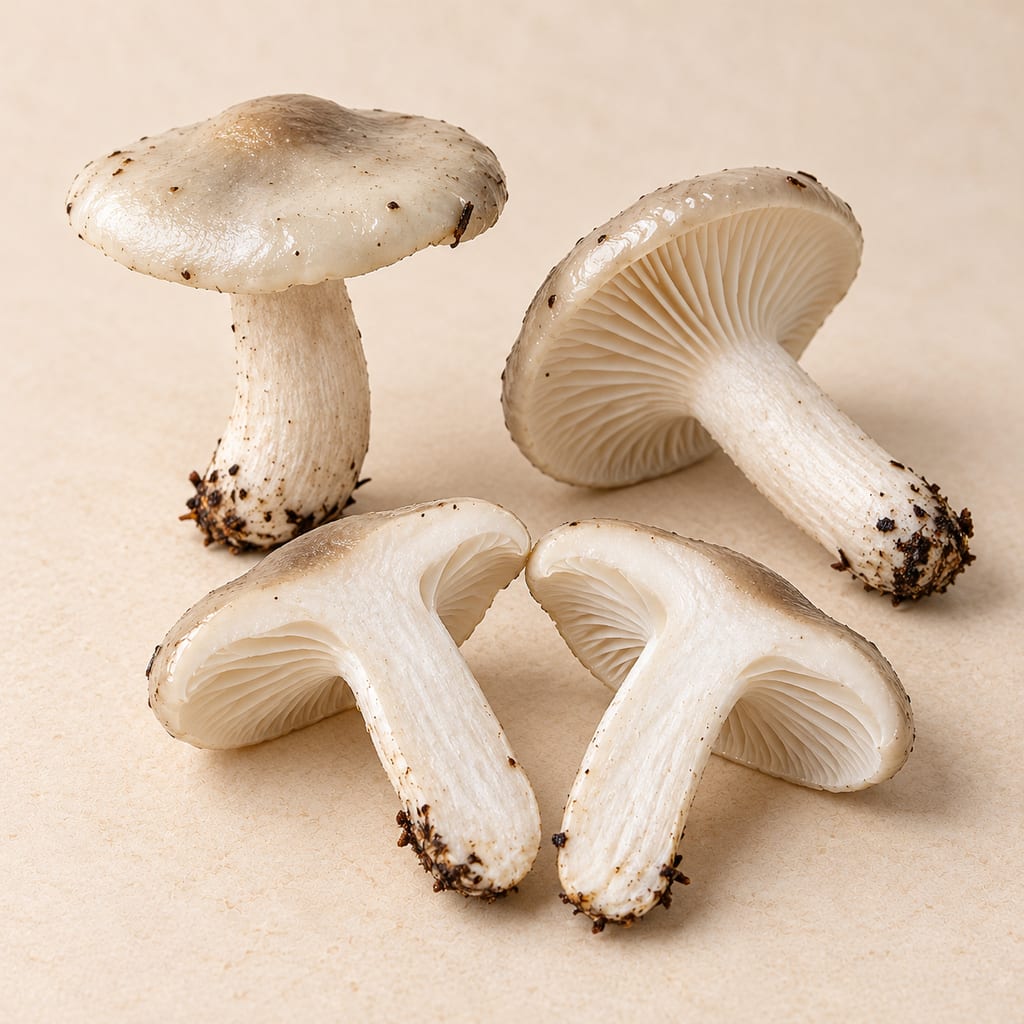
Overview
The almond woodwax, Hygrophorus agathosmus, is a waxy cap fungus of conifer woods. Its cap is slimy and ash grey or pale grey-brown, and its flesh is soft and white. Its most noticed character is a fragrant smell like cherry pits or bitter almonds, which can be weak in some specimens. In the catalogue it is recorded as an aromatic cooked mushroom in Europe, and the sources read here do not support that food role as a settled fact.
Sources for this section
A difficult group
The species belongs to a complex of closely related Hygrophorus species that includes H. agathosmoides and H. albofloccosus. Mycoweb notes that H. albofloccosus is commonly misidentified as H. agathosmus. Similar mushrooms include H. odoratus, which has the same smell but is smaller, and H. pustulatus, which has larger spores.
Because the group is hard to separate in the field, a name that appears in a food record may refer to a neighbouring species. The catalogue marks regional identification as required for this entry.
Sources for this section
Edibility is reported inconsistently
One source describes the species as edible but bland-tasting. Mycoweb says that the closely related H. albofloccosus, which it notes is often mistaken for this species, is probably edible. A third encyclopedia entry says the species is not edible, but its description refers to a coal-gas smell that does not match this species, so it is not relied on here.
The conflicting reports leave the food status unsettled. This page therefore records the reports and does not give a verdict on whether the mushroom is eaten or safe to eat.
Sources for this section
Habitat and occurrence
The species grows under conifers in forest habitats. The catalogue places its food record in Europe and describes its ecology as conifer-associated mycorrhizal. The fruiting season and the host trees are not given in the evidence read, so neither is stated here.
Sources for this section
Safety and what is not known
No source read for this page gives a safety assessment for this species, and the reports on edibility conflict. Confirmation by a qualified expert is needed before any use, because look-alikes differ in edibility. Nothing on this page is advice for collecting or identifying wild waxy caps.
Sources for this section
Places
Europe
Relationship not established · Region evidenceThe catalogue places the food record in Europe without a locality; the identification difficulty means the record is not tied to a confirmed occurrence.
Community
No community contributions have been published for this entry yet.
Share what you made
Sign in to contribute. Published comments and photos are free to read.
Sources
WikipediaIdentity · Food use
Hygrophorus agathosmusSlimy ash-grey or pale grey-brown cap; soft white flesh; almond or cherry-pit odour under conifers; one source calls it edible but bland.
Cited in: Overview; A difficult group; Edibility is reported inconsistently; Habitat and occurrence
MycowebIdentity · Safety · Food use
Hygrophorus agathosmus (Mycoweb, Chambers Atlas of Fungi)H. albofloccosus commonly misidentified as H. agathosmus and probably edible; similar species H. odoratus and H. pustulatus; complex includes H. agathosmoides.
Cited in: Overview; A difficult group; Edibility is reported inconsistently; Safety and what is not known
Boletín Oficial del EstadoNames
Spanish official document BOE-A-2009-1110 (supplied catalogue source)Supplied catalogue source for the record; its text was not read for this page.