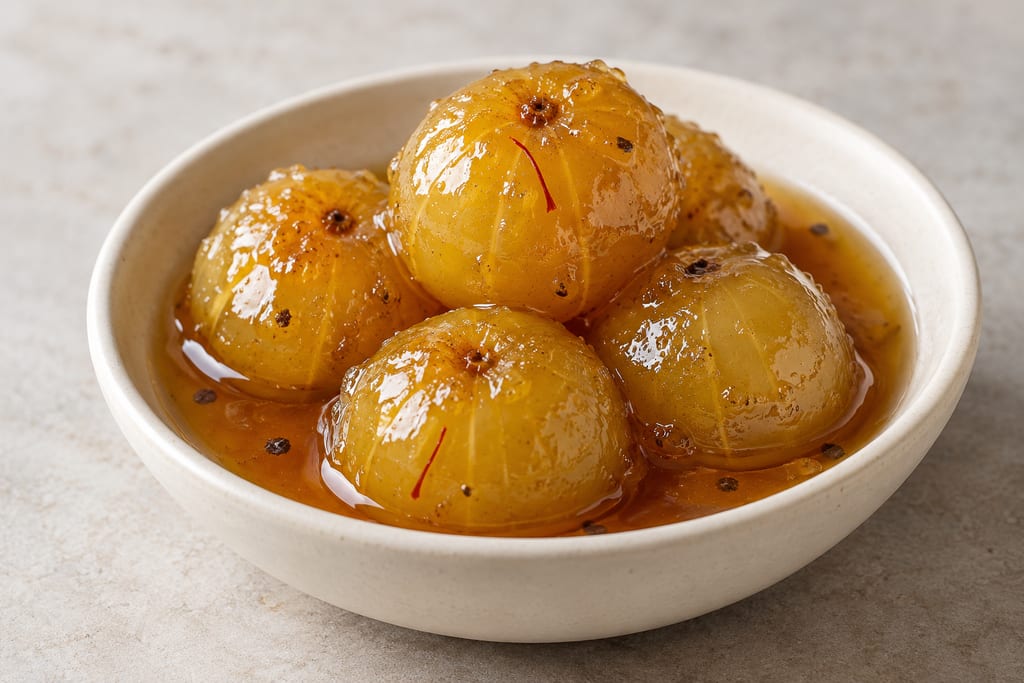
Amla murabba
Amla murabba preserves whole Indian gooseberries in a heavy sugar syrup scented with cardamom and sharpened with pepper and black salt. This household method soaks the fruit before cooking.
 FermenteaWhere food goes to change
Processing aids
An unspecified alum named in an amla murabba soaking step. Potassium alum, ammonium alum and aluminium sulfate are distinct materials with different properties.
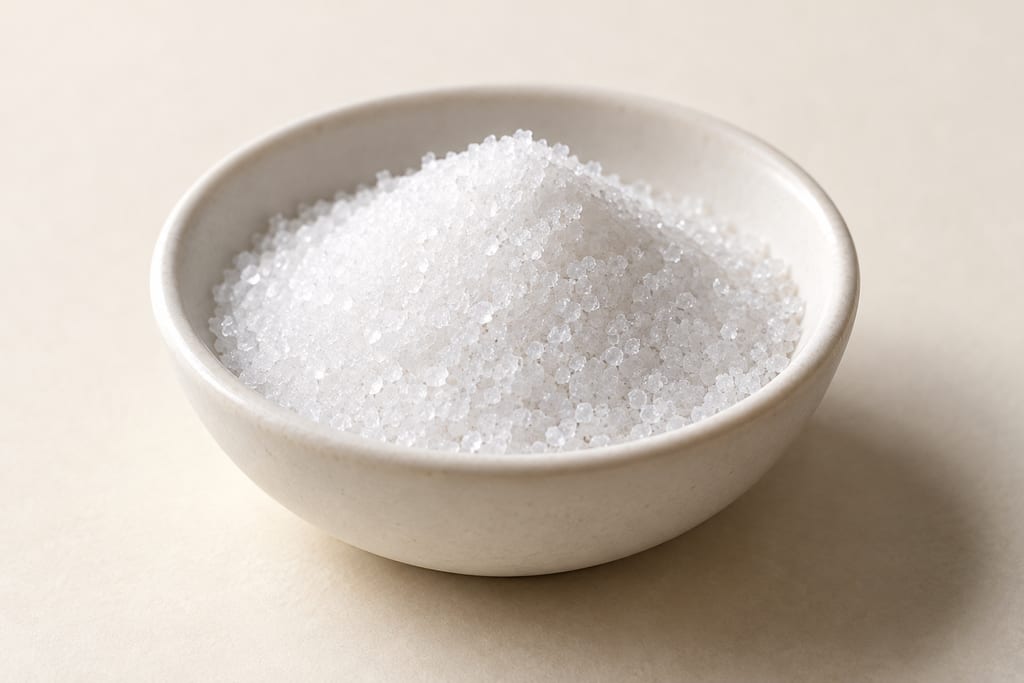
Fitkari, written फिटकरी in Hindi, is the material called alum in the linked amla murabba method. It enters the water used to soak the fruit before the preserve is cooked in sugar syrup. The name identifies a customary kitchen material, but the recipe does not specify its chemical composition or grade.
One precisely defined substance is potassium alum, also called potash alum or aluminium potassium sulfate. Its common crystalline form is a hydrated double salt containing aluminium, potassium and sulfate. Ammonium alum contains ammonium in place of potassium and is a different compound. Aluminium sulfate is different again, although older trade language has also called it alum.
These distinctions matter more than a resemblance between white powders or transparent crystals. A formula, purity specification and intended food use identify a material more closely than its appearance. The fitkari in an unspecified household formula cannot automatically be relabelled as one of these defined salts.
In London in 1820, Frederick Accum described alum in bread as an adulteration. His account connected the practice with a strong consumer preference for white loaves and the commercial use of flour of varying quality. He reported that the addition made the finished bread look whiter and firmer.
The bread was still a yeast-raised food. Accum described dough preparation through mixing, fermentation, further additions and kneading before shaping and baking. Alum entered that sequence as a material used to alter the loaf, rather than the organism that made the dough rise. Its presence in a fermented food did not make it a fermentation starter.
His account also exposed a trade in mixtures whose names concealed their contents. Alum could be supplied with salt under an obscure commercial description, or arrive through flour. The issue was therefore both what a substance did to bread and whether the purchaser knew it had been added.
Accum’s discussion belongs to an investigation of adulteration and disputed food quality. It is evidence of a particular British urban practice and the concern it provoked, rather than an endorsement of alum in bread. His medical arguments and old analytical tests do not provide present-day handling or toxicological instructions.
Accum’s bread discussion distinguished flour destined for fine baking from the lower grades entering ordinary bread. He described buyers judging the loaf strongly by its whiteness, while the baker worked with grain and flour of uneven quality. Alum was attractive within that commercial pressure because a changed appearance could make an inferior starting material less evident.
The argument concerned the relationship between what a loaf looked like and what it contained. A pale, porous bread could satisfy a visual expectation while concealing an addition. Conversely, the slightly darker appearance of household bread did not by itself establish poorer flour. Colour and firmness were being used as signs of value, and the disputed ingredient altered those signs.
This history also explains why a record of alum in food is not automatically a culinary tradition to revive. Some uses were openly described in preserving books; others were criticized precisely because the addition was hidden. The same material name appears in accounts with different intentions, and those intentions belong to the history of each food.
The anonymous New England Cook Book, published in New Haven in 1836, used alum water in several preserve methods. Watermelon rind was treated before entering clarified syrup. Muskmelon and the preparation called mock citron likewise passed through separate soaking and cooking stages before sugar preservation.
These were ways of making recognizable pieces of rind or flesh into sweetmeats, rather than boiling the whole material into a uniform jam. Some preparations also used ginger, lemon flavouring or repeated treatment of the syrup. The desired food retained enough structure to be handled as pieces.
The mock citron could be eaten as a preserve or put into cake in place of citron. That use connects the preserving pan to later baking: a treated plant material became a sweet ingredient with a role beyond its original vessel. Alum appeared within the preliminary handling rather than serving as the principal sweetener or flavouring.
The book also included alum in vinegar-pickle preparations, including cucumbers and onions. Its use crossed the boundary between sweet preserves and acidified vegetables. Those separate historical methods should not be collapsed into one general alum process, and their old proportions and storage practices are not current preservation guidance.
The 1836 book treated the syrup as a separate part of the work. A preserve might rest before its syrup was removed, heated again and returned to the pieces. In that sequence, soaking, tenderizing, sweetening and holding were distinct operations. Alum water was one stage among them, rather than a complete preservation system in itself. The range of methods also shows how misleading it would be to assume that every historical mention meant one standard concentration or the same final texture.
In the linked Hindi amla murabba method, the fruit is soaked, pricked and placed in fitkari water, then rinsed before later cooking and syrup treatment. The sequence separates the preliminary soak from the sugar that forms the preserve. Fitkari is not described as the culture responsible for a fermentation.
Nisha Madhulika’s dated replies to readers explain her intended purpose more closely. In August 2008, she identified fitkari by the market name alum and associated it with softening the murabba and removing a particular unwanted taste. In a March 2009 reply, she described reducing amla’s astringency and said the preserve could also be made without fitkari.
These are the recipe author’s culinary explanations. They do not establish a measured chemical mechanism, and the wording should not be replaced with a claim that alum necessarily makes this fruit crisp. The author’s explanation of softness and astringency differs from the firming purpose familiar in some pickle literature.
The method gives half a spoon of fitkari without identifying a standard spoon or the volume of soaking water. Its concentration therefore cannot be reconstructed from that line. Keeping the original description does not supply a measured substitute or justify converting the quantity into grams.
Plant tissue holds together through cell walls and the material between adjacent cells, including pectic substances. Cooking, acidity and the ions present can change that structure. An additive’s effect is therefore tied to the plant, solution and heat treatment rather than simply its name.
Experiments on sweet-potato slices illustrate the complication. Potassium alum used in a preheating treatment produced a different result from cooking slices in an alum solution. The work connected prevention of softening with preheating, aluminium ions and acidity, while also identifying potassium and sulfate as influences that could promote pectin solubilization.
This makes alum more interesting than a universal hardening powder. Several parts of the treatment can act in different directions. The experiment concerns sweet potato under defined laboratory conditions; it does not measure the effect of the long, unspecified fitkari soak used for amla murabba.
A 1972 investigation of fresh-pack dill pickles began by distinguishing four commercial alum salts: potassium, ammonium and sodium aluminium sulfates, and aluminium sulfate. Their aqueous solutions had different acidic properties. The same trade word did not give the researchers one chemically identical material.
For the subsequent pickle experiments they used aluminium sulfate, a material the pickle industry had commonly used. This point limits what the findings say about other salts. The paper’s title contains alum, but its final cucumber trials were not a direct test of every product sold under that name.
The experiments connected added aluminium sulfate with lower brine pH and reduced cucumber firmness under the conditions studied. Acetic and lactic acid formulations also produced different results. The amount and kind of acid, the vegetable’s buffering effect and the added salt all belonged to the outcome.
Fresh-pack pickles are acidified directly, commonly with vinegar, rather than relying on a full lactic fermentation to create their acidity. Fermented pickles begin with a different sequence of microbial change and brining. A texture practice associated with one cannot simply be carried into the other.
That distinction was central to the 1972 study. A material already used with processed fermented pickle stock had also been adopted in fresh-pack products, despite limited evidence for its value there. Testing the newer application challenged the assumption that a familiar additive would improve every pickle.
Current home-preservation guidance makes the same practical separation. The National Center for Home Food Preservation describes alum as unnecessary in its fermented-pickle recipes and says it does not improve the firmness of quick-process pickles. Fresh ingredients and an up-to-date method matter more than automatically adding a firming material.
Food-additive specifications define potassium alum much more closely than a household common name. The specification for aluminium potassium sulfate describes its crystalline identity, solubility and purity requirements. A material can be supplied as large transparent crystals or white crystalline powder while still needing chemical and purity checks.
The JECFA entry assigns this defined potassium salt functional classes that include firming agent, acidity regulator and raising agent. These are possible technological functions, rather than a promise that each function occurs usefully in every food. A functional classification does not provide a home dose.
Permission to use an additive is another question. A register entry for E522 refers to particular legislation and its conditions of use. Product identity, permitted food category and quantity limits must be read together. A familiar code on a list does not authorize an unspecified fitkari soak in every jurisdiction or establish the composition of an unlabelled block.
For a documented food application, use a product explicitly supplied for food use and follow the relevant manufacturer’s instructions. Preserve the chemical name and product information. An unidentified crystal cannot be judged suitable by matching its colour to a photograph or by recognizing the word alum on a shop sign.
Different chemical identities also prevent casual substitution. Potassium alum, ammonium alum and aluminium sulfate are not alternative spellings of one substance. A study using one does not establish the effect of another at the same spoonful, and a household measure does not compensate for missing information about concentration.
The linked murabba account supplies no product-specific storage instructions or purity declaration. Those belong to an identified supplier’s material. Keeping that uncertainty visible is more useful than inventing a shelf life or directing a reader to use a non-food product because it looks familiar.
A firm fruit or vegetable is a textural result. Pickle preservation also depends on the complete formulation and processing method, including the acidity or the salt required for a particular fermentation. A firming additive cannot stand in for those controls.
Use tested preserving methods and keep their specified ingredient proportions. In fermented pickles, salt helps select the intended microbial activity; in directly acidified products, the acid formulation matters. These are different mechanisms from changing the texture of plant tissue.
The same distinction helps read historical preserves. An alum soak, a rinse and a glossy syrup can describe stages of preparation without establishing a finished food’s safe storage. The specific fitkari identity, concentration and process evidence must be resolved for a reproducible modern method. Alum’s history explains its place in food making; it does not remove those practical questions.
The Hindi recipe does not establish the preparation location or the exact fitkari’s geographic origin.
Amla murabba preserves whole Indian gooseberries in a heavy sugar syrup scented with cardamom and sharpened with pepper and black salt. This household method soaks the fruit before cooking.
No community contributions have been published for this entry yet.
Sign in to contribute. Published comments and photos are free to read.
Nishamadhulika.com
आंवले का मुरब्बा - Amla Murabba RecipeOriginal Hindi recipe: fitkari is measured as half a spoon and used in a soaking stage before rinsing, cooking and syrup treatment. Chemical identity, grade, spoon size and soak volume are unreported. No conversion or claimed keeping period adopted.
Cited in: A familiar name can cover different salts; Amla murabba gives fitkari another culinary setting
Nishamadhulika.com
Reader questions and author replies on Amla Murabba RecipeOriginal dated replies on 24 August 2008 and 12 March 2009 identify the market name ALUM and explain intended softness and astringency reduction; the author says fitkari may be omitted. These are culinary explanations, not controlled chemical or safety evidence.
Cited in: Amla murabba gives fitkari another culinary setting
Joint FAO/WHO Expert Committee on Food Additives
Aluminium potassium sulfateDefined potassium alum synonyms, hydrated and anhydrous forms, INS522 and functional classes. No dose or safety assurance inferred.
Cited in: A familiar name can cover different salts; An additive specification is an identity document
European Commission
Commission Regulation (EU) No 231/2012: specifications for E522 and E523Official specification text: E522 potassium alum identity, hydrated formula, crystal/powder appearance, solubility and purity. E523 ammonium alum is distinct. Identity specifications do not establish permission in every food or identify the recipe material.
Cited in: A familiar name can cover different salts; An additive specification is an identity document; Choosing a material starts with its declaration
Longman, Hurst, Rees, Orme, and Brown, London
A Treatise on Adulterations of Food, and Culinary Poisons, chapter Adulteration of BreadOriginal1820 transcription: London bread whiteness and firmness, flour quality and trade, hidden alum in salt/flour, and staged yeast dough. The author treats it as adulteration. Historical amounts, tests and medical assertions are not adopted.
Cited in: White bread made alum a disputed food material; Flour quality shaped the bread debate
Hezekiah Howe & Co. and Herrick & Noyes, New Haven
The New England Cook Book, or Young Housekeeper’s GuideThe anonymous New England Cook Book, published in New Haven in 1836, describes alum water in melon-rind preserves, sweetmeats and vegetable pickles in entries 105–111 and 242–245. These entries document historical culinary use, not tested modern preservation or storage guidance.
Cited in: Preserving books placed alum before the syrup
Journal of Food Science
Firming of Cooked Sweet Potatoes as Affected by Alum TreatmentThe publisher’s abstract reports different texture and pectin responses to preheating and cooking in the presence of aluminium ions, acidity, potassium and sulfate. Alum-cooked slices were firmer than water controls but softer than aluminium-chloride or buffer treatments at matched acidity. This January 1999 study did not examine amla.
Cited in: Plant texture depends on the whole treatment
Journal of Food Science; primary scan hosted by USDA Agricultural Research Service
Influence of Alum on the Firmness of Fresh-Pack Dill PicklesThe study compares four salts for acidity, then uses aluminium sulfate in cucumber experiments. The added material lowered brine pH and reduced firmness under the tested conditions; the acid formulation affected the result. These findings do not establish a potassium-alum treatment for amla.
Cited in: The chemical called alum changes the comparison; Fresh-pack pickles and fermented pickles are different foods
National Center for Home Food Preservation, University of Georgia
General Information on PicklingCurrent guidance distinguishes fermented and quick-process pickles, calls alum unnecessary, and says it does not improve quick-process firmness. Tested proportions and salt required for fermentation remain important. No generic dose, rinse or canning control borrowed.
Cited in: Fresh-pack pickles and fermented pickles are different foods; Firmness does not establish preservation
Oregon State University Extension Service
Pickling vegetablesUse food-grade firming products and manufacturer directions. Alum is unnecessary and does not improve quick pickles. These directions do not identify the material in the murabba recipe.
Cited in: Choosing a material starts with its declaration; Firmness does not establish preservation
Food Standards Agency, Regulated Food and Feed Products for Great Britain
Aluminium potassium sulphate — E522The official E522 register links potassium alum to specific use conditions under Regulation 1333/2008 and specifications under Regulation 231/2012. A listing does not establish permission for every food or in other jurisdictions.
Cited in: An additive specification is an identity document