
Amanita rubromarginata
Amanita rubromarginata is a forest mushroom documented in food markets and edible-mushroom surveys in parts of China and northern Thailand. Those regional records do not make a wild specimen identified from a photograph safe to eat.
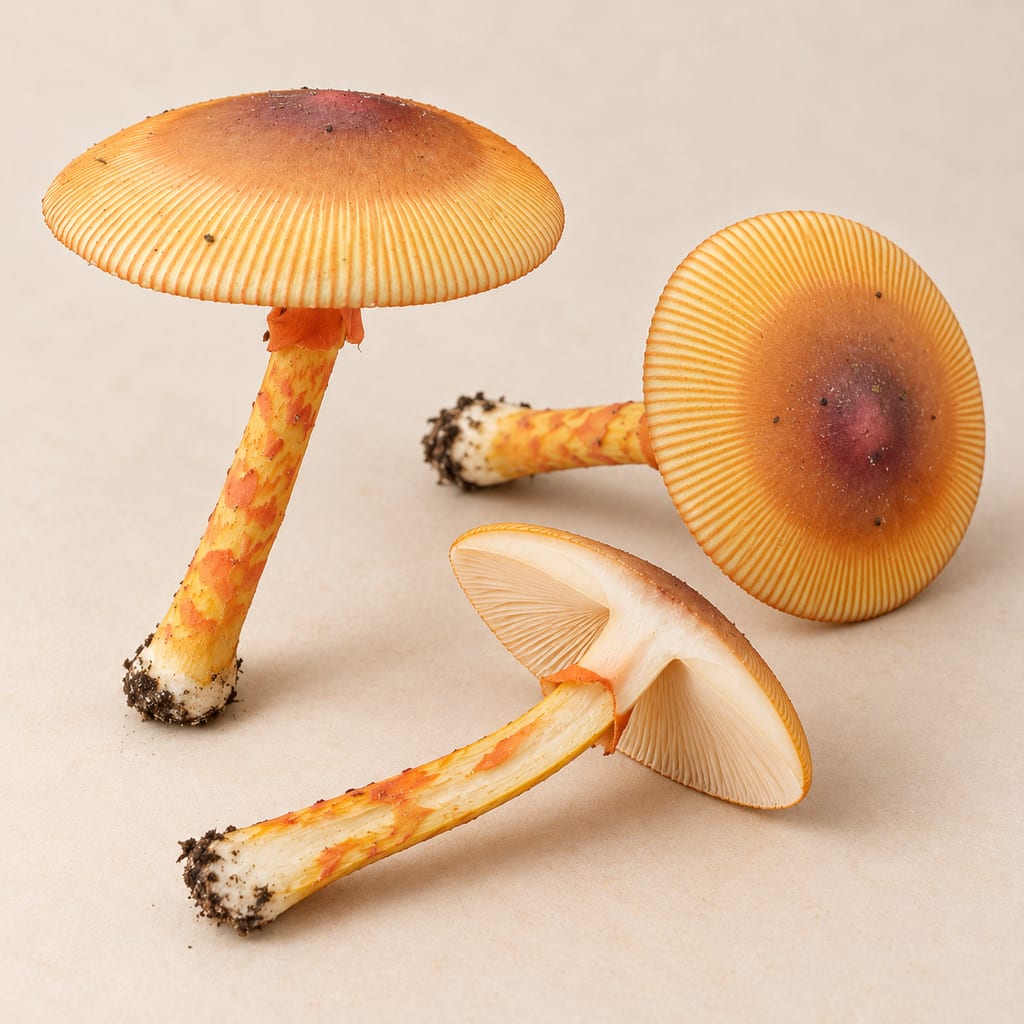
A named Amanita from East Asia
Amanita rubromarginata Har. Takah. was described as a species in 2004 from the Yaeyama Islands in southwestern Japan. The original account placed it in Amanita section Caesareae and described it from oak forest on Ishigaki Island. Later molecular work retained the species in this group and documented specimens from China and Thailand. The name refers to the conspicuously colored gill edges described in the taxonomic literature. Its accepted name is still used by NCBI and recent mycological papers; there is no supported alternative current combination in the sources consulted.
Section Caesareae includes several attractive, large, forest Amanitas. Shared ancestry and similar cap colors do not make the members interchangeable. The name “red-margined Caesar” appears in a specialist Japanese account, but common names vary and can point readers toward other Caesar mushrooms. For a product record, the scientific name and regional source are more reliable than an English label.
Form and variation
The Thai voucher-based description characterizes the fruit body as medium to large, with a reddish-orange cap, paler toward the margin, and a margin with pronounced radial striation. Its crowded, free gills are pale yellow, with reddish-orange edges. The stem is yellow and covered in yellow to orange scales; the base has a white, sac-like veil and the partial veil leaves a dark orange to orange ring. These published features describe examined specimens, not a recipe for identifying a wild mushroom.
The same species can vary in color and apparent proportions with age, location and conditions. The Japanese field account notes a shift from an orange-brown young cap toward darker central color and yellowish or olive tones toward the margin in mature specimens, and mentions a yellow form on Ishigaki. Thai specimens have been reported with somewhat different mature cap coloration from Japanese material. That variability is one reason taxonomic studies combine morphology with DNA sequence evidence.
Sources for this section
Forest ecology
Amanita species are ectomycorrhizal fungi: their underground mycelia form associations with the fine roots of trees. The mushroom is the temporary fruit body of a larger organism in the soil. The original Japanese description records the species in oak forest; later accounts place it on soil in broad-leaved or mixed forests. The Thai paper describes specimens in tropical deciduous forest, while the 2022 Yunnan study documents the species in both natural habitat and market sampling.
One Thai habitat description gives forests dominated by Dipterocarpus and Shorea, and the northern Laos edible-fungi monograph reports a Fagaceae-dominated mixed-forest setting for its account of this species. These are regional observations, not a claim that the mushroom requires one universal tree partner. The Chinese and Thai material has been supported by voucher collections and sequence data, while the original Japanese work and later photographed records supply further geographic evidence.
Sources for this section
- Survey of Edible Amanita in Northern Thailand and Their Nutritional Value, Total Phenolic Content, Antioxidant and α-Glucosidase Inhibitory Activities →
- Ethnomycological study on wild mushrooms in Pu’er Prefecture, Southwest Yunnan, China →
- An Introduction to the Edible, Poisonous and Medicinal Fungi of Northern Laos →
Where it is documented
Evidence places Amanita rubromarginata in southwestern Japan, China and Thailand. The type-region record is Ishigaki Island in the Yaeyama Islands. The 2022 ethnomycological survey in Pu’er Prefecture, Yunnan, China, lists a voucher-backed specimen from market and natural-habitat sampling and records it as edible. It is one species among a large, diverse seasonal trade; this record should not be inflated into a claim that it is a major commercial crop across China.
In northern Thailand, the 2023 survey identified four specimens using morphological examination and multi-gene phylogeny. It sampled natural forests and roadside markets in Chiang Mai and Lamphun provinces. The voucher records include Mae Taeng and Doi Saket districts in Chiang Mai, and Mae Tha district in Lamphun. These local collections support a regional food-market presence; they do not establish equal use throughout Thailand or elsewhere in Southeast Asia.
Sources for this section
- Ethnomycological study on wild mushrooms in Pu’er Prefecture, Southwest Yunnan, China →
- Survey of Edible Amanita in Northern Thailand and Their Nutritional Value, Total Phenolic Content, Antioxidant and α-Glucosidase Inhibitory Activities →
- Two new species of Agaricales from southwestern islands of Japan →
Seasonal records
The available dates cluster in the warm, wet months, but no source reviewed supplies a complete species-specific fruiting calendar. Thai collections identified in the 2023 study were made in July and August across Chiang Mai and Lamphun. The broader survey took place during rainy seasons from 2019 to 2022; that study-wide period should not be treated as the exact fruiting season of every species it examined.
Photographic and voucher records from Ishigaki include specimens dated in May, June and August in different years. These observations show that the species has been encountered across more than one part of the local warm season, but they are not continuous monitoring. Pu’er market interviews ran from July through October over three years, which describes the study’s market-season fieldwork and not necessarily the entire fruiting window of A. rubromarginata. Local weather, forest and elevation matter; a product page should preserve these regional limits.
Sources for this section
Documented food use
Food use is supported by more than a bare checklist entry. In the Pu’er study, A. rubromarginata appears in the market and natural-habitat inventory, alongside a voucher number and an edible classification. The study combined field collections, market observation and interviews with vendors about wild mushroom use. It is direct evidence that the species was part of a local food-market setting during the study, although it does not by itself document every household’s use or a single standardized preparation.
Kumla and colleagues’ 2023 northern Thailand study explicitly treats A. rubromarginata as an edible Amanita. It examined four specimens collected from forest and roadside-market sources, with identification confirmed by multi-gene analysis. The authors report nutritional and phenolic measurements for the studied material. Those measurements concern the analyzed samples and should not be generalized to all specimens or translated into health claims.
China’s 2026 catalogue of edible and medicinal fungi also lists the species as edible. Together these sources support regional use in China and northern Thailand. They do not provide a species-specific recipe in the material reviewed here. No preparation method, flavor profile, storage life or preservation tradition is sufficiently documented here to present as characteristic.
Sources for this section
Markets and gathered supply
The Pu’er survey describes markets that sell many kinds of wild fungi, supplied by collectors who gather from natural habitats. It reports established markets, mobile markets and roadside stalls, and records local knowledge about marketability, seasonal availability, habitat and food use. A. rubromarginata is one of the documented taxa, but the paper’s general descriptions of market activity should not be assigned to the species as if its own volume, price or seller network had been measured separately.
The Thai study likewise found A. rubromarginata in both forest and roadside-market sources. This is useful evidence that it was gathered and entered local sale channels in the sampled areas. Its ectomycorrhizal ecology also means that supply depends on forest associations rather than a simple substrate that could be replaced by a standard cultivation bed. The reviewed studies do not document commercial cultivation of this species.
Taxonomy and lookalike uncertainty
Amanita identification is a specialist problem. Published researchers used detailed morphology and molecular sequence data to resolve the Thai material, and they note that visible traits may vary with environment and geography. In section Caesareae, A. rubromarginata can resemble other orange or red-capped Amanitas, including A. javanica and A. rubroflava. Taxonomic papers use microscopic, molecular and multiple morphological characters to compare them. A short visual checklist or a photograph cannot safely replace that work.
The genus also contains species that cause severe or fatal poisoning. Some dangerous Amanitas may overlap in broad color or growth stage with food species, and young specimens can hide important structures. This page is not a field guide and should not be used to select or identify a mushroom for eating. A regional market record applies to specimens identified within that study; it does not certify an unexamined lookalike.
Sources for this section
- Survey of Edible Amanita in Northern Thailand and Their Nutritional Value, Total Phenolic Content, Antioxidant and α-Glucosidase Inhibitory Activities →
- Ethnomycological study on wild mushrooms in Pu’er Prefecture, Southwest Yunnan, China →
- The family Amanitaceae: molecular phylogeny, higher-rank taxonomy and the species in China →
Reading a market record carefully
The Pu’er ethnomycological survey is valuable because it places taxonomic sampling beside market observation and interviews, rather than relying only on a checklist. Researchers visited markets and gathered mushrooms from natural habitats, documented vendor knowledge and recorded whether each listed taxon was found in a market, in its habitat, or both. The row for A. rubromarginata gives voucher HKAS-122664 and an edible classification. This supports local availability and food-market recognition in the surveyed area.
That evidence has boundaries. One voucher is not a measure of abundance, annual harvest or household consumption across Yunnan. The study's July-to-October interview and market period covers all included fungi, not a proven seasonal limit for this species. Its general findings about market types and vendor practice describe the larger mushroom trade. They should not be turned into a species-specific price, recipe, customary name or cultural ceremony without a separate source. Keeping these distinctions clear preserves what the study actually contributes: a traceable taxon-level record within a broader ethnomycological survey.
Sources for this section
Nutritional measurements in context
The Thai study measured proximate composition for a voucher identified as A. rubromarginata, as part of a comparison among edible Amanitas. For voucher CMUNK0780 it reports, on a dry-weight basis, 17.84% ash, 31.45% carbohydrate, 10.24% fat, 7.75% fibre and 26.88% protein. These values describe prepared laboratory material and the analytical basis stated in that article; they are not a serving-size nutrition label.
Drying removes most water and changes the denominator used for percentages. The reported figures therefore should not be read as the proportion of those nutrients in a fresh market mushroom, nor compared casually with a fresh-food label. The paper analyzes a limited set of voucher specimens collected in particular Thai localities. It is a useful record of research on this taxon, not a comprehensive survey of seasonal, geographic or within-species variation.
The study also measured phenolic content and several laboratory assays using extracts. These are biochemical research outcomes, not evidence that eating the mushroom prevents or treats disease. They do not establish a suitable serving, consumer benefit or safety threshold. A reader-facing ingredient account can describe that the species has been analyzed, but should avoid turning exploratory extract results into health claims.
Buying, use and practical limits
Where the species is sold under expert local practice, its market record should be understood in that setting. The sources reviewed do not provide a dependable consumer-facing label, grading system or freshness standard specific to A. rubromarginata. Nor do they establish a universal cooking method or claim that one treatment removes all risks. Do not infer that a market species name can be applied to a wild specimen found elsewhere.
The 2023 study dried voucher specimens for herbarium deposition and reported laboratory nutritional analysis. Those are research procedures, not home storage guidance. No shelf-life, refrigeration duration, raw-eating advice or safety process can be derived from them. This dossier therefore limits practical information to the documented regional market and research context and gives no foraging or preparation instructions.
Image records and what they can show
Published photographs provide useful documentation of the species concept when they are tied to vouchers. Figure 5 in the 2023 northern Thailand paper shows four fruit-body collections identified as A. rubromarginata: SDBR-CMUSTO-2019-451, SDBR-CMUSTO-2019-452, SDBR-CMUNK0780 and SDBR-CMUNK0854. The cited study gives its identification method and collection localities. Figure 1C in a 2025 Chiang Mai Journal of Science paper provides another species-labelled photograph. Japanese field photographs document collections on Ishigaki Island in 2002, 2010 and 2011.
These images are records, not a photographic safety key. Field pictures do not show every character needed for expert identification, and lookalikes can overlap. The 2023 paper is openly licensed CC BY 4.0; the other image sources require their own rights review. No hero image is attached in this draft because a polished ingredient portrait could be mistaken for an endorsement or identification cue, while the images available here are documentary field photographs rather than controlled product photography.
Places
No source in this record establishes a place.
Community
No community contributions have been published for this entry yet.
Share what you made
Sign in to contribute. Published comments and photos are free to read.
Sources
Journal of Fungi / MDPITaxonomy · Food use · Geography · Season · Ecology
Survey of Edible Amanita in Northern Thailand and Their Nutritional Value, Total Phenolic Content, Antioxidant and α-Glucosidase Inhibitory ActivitiesA. rubromarginata treated as edible; four voucher specimens identified through morphology and multi-gene phylogeny.
Thai forest and roadside-market collections; voucher records in Chiang Mai and Lamphun during July and August.
Notes identification difficulty and phenotypic variation across Amanita.
Cited in: A named Amanita from East Asia; Form and variation; Forest ecology; Where it is documented; Seasonal records; Documented food use; Markets and gathered supply; Taxonomy and lookalike uncertainty; Nutritional measurements in context; Buying, use and practical limits; Image records and what they can show
Journal of Ethnobiology and EthnomedicineFood use · Markets · Geography · Season
Ethnomycological study on wild mushrooms in Pu’er Prefecture, Southwest Yunnan, ChinaA. rubromarginata listed in market and natural-habitat inventory as edible with voucher HKAS-122664.
Study market/interview work covered July to October 2019–2021; not a species-specific season.
Cited in: Forest ecology; Where it is documented; Seasonal records; Documented food use; Markets and gathered supply; Taxonomy and lookalike uncertainty; Reading a market record carefully; Buying, use and practical limits
Fungal Diversity / SpringerTaxonomy · Geography
The family Amanitaceae: molecular phylogeny, higher-rank taxonomy and the species in ChinaChinese Amanitaceae taxonomy and molecularly-informed species records include A. rubromarginata.
Cited in: Taxonomy and lookalike uncertainty
MycoscienceTaxonomy · Geography · Habitat
Two new species of Agaricales from southwestern islands of JapanOriginal species description from oak forests on Ishigaki Island; placement in Amanita section Caesareae.
Cited in: A named Amanita from East Asia; Where it is documented
MycosystemaFood use · Taxonomy
Species cataloging of edible and medicinal fungi in China2026 catalogue lists A. rubromarginata as edible.
Cited in: Documented food use
YoukinzukanGeography · Season · Imagery
Amanita rubromarginata, Yaeyama Islands mushroom guideJapanese photographic records on Ishigaki Island dated 2002, 2010 and 2011; author credited as H. Takahashi; rights status not stated.
Cited in: Form and variation; Seasonal records; Image records and what they can show
Chiang Mai Journal of ScienceTaxonomy · Imagery
New records and species of Amanita from Thailand2025 Figure 1C depicts A. rubromarginata; species also appears in Thailand checklist.
Cited in: Image records and what they can show
LaoFABFood use · Habitat · Geography
An Introduction to the Edible, Poisonous and Medicinal Fungi of Northern LaosRegional account describes edible use and Fagaceae-dominated habitat, while warning of uncertainty within the Hemibapha group.
Cited in: Forest ecology
NCBITaxonomy
Amanita rubromarginata Taxonomy BrowserCurrent taxon name and family placement.
Cited in: A named Amanita from East Asia
Research SquareTaxonomy · Lookalikes · Habitat
Amanita species within section Caesareae from the highlands of LaosComparative discussion of A. rubromarginata and similar Caesareae taxa; regional forest and host context.
Cited in: Form and variation