
Mushrooms
American yellow morel
The American yellow morel, Morchella americana, is a wild spring morel of North America that is eaten only after thorough cooking, because raw or undercooked morels have caused serious illness.
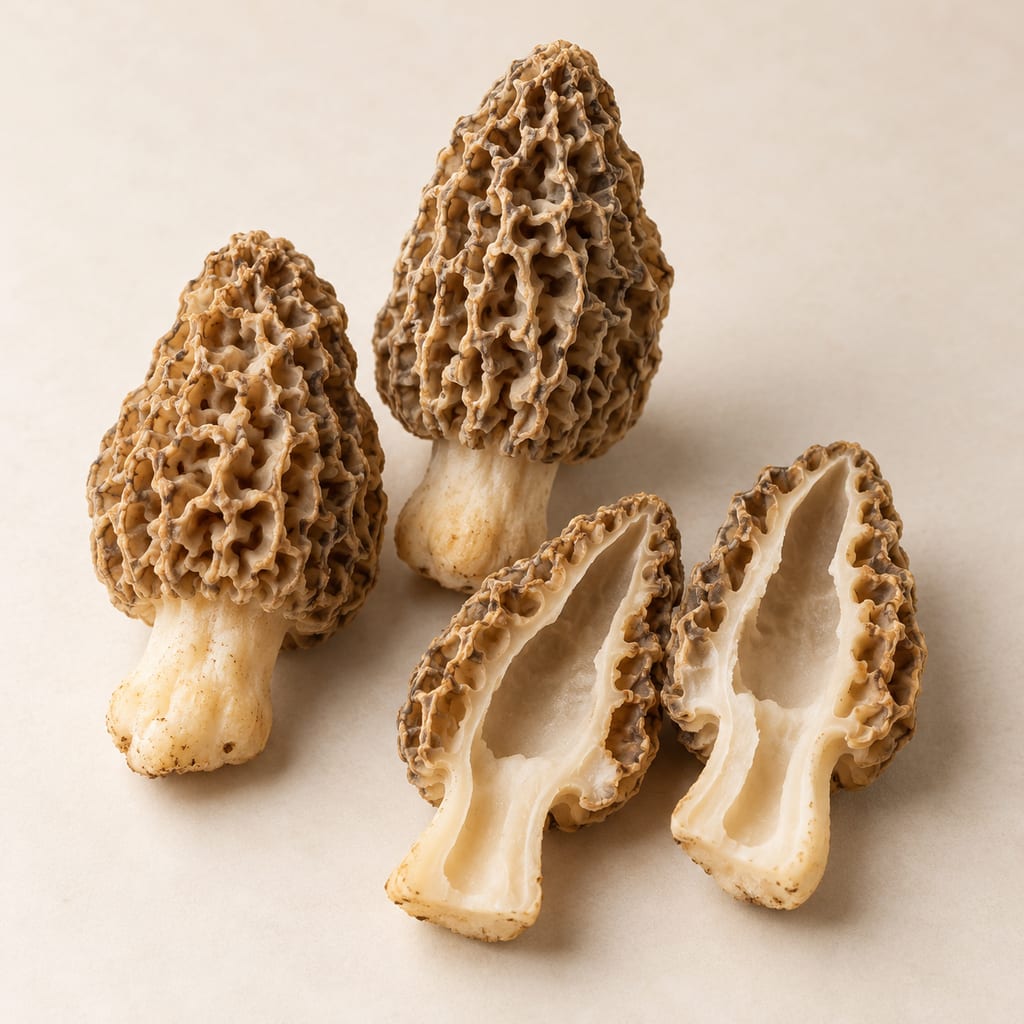
What it is
The American yellow morel is a true morel, a spring mushroom with a honeycomb-like cap and a hollow stem. The Michigan Department of Natural Resources lists it among the easiest spring mushrooms to recognize, and the honeycomb cap with a hollow stem is the key feature that separates it from the false morels.
The name is not settled. Some sources use Morchella americana and others use Morchella esculentoides, a name that was split from the European Morchella esculenta. Some sources also describe a grey morel, which may be young American yellow morels.
Sources for this section
How it is eaten
Morels are cooked rather than eaten raw. Sources describe sauteing, grilling and roasting, rolling sliced morels in a buttermilk and cornmeal batter for pan frying, and cooking them with onion, pepper and butter into a cream gravy. One source says they can occasionally be eaten raw; the outbreak evidence below points the other way.
The Michigan DNR says all wild mushrooms should be cleaned and thoroughly cooked before eating. Slicing a morel lengthwise shows whether insects are inside.
Sources for this section
The 2023 outbreak
In March and April 2023, 51 people reported gastrointestinal illness after eating at one restaurant in Bozeman, Montana. Of these, 46 were patrons and 5 were employees. Two people died, three were hospitalized and four visited an emergency department.
DNA sequencing identified the mushroom as Morchella sextelata, a true morel. A case-control study linked the illness to a sushi roll that contained salmon and morels. Illness was more strongly associated with raw morels than with cooked or partially cooked ones, and the association followed a dose-response pattern. The report does not identify the toxin, and it says morel toxins are not well characterized.
Sources for this section
Safety and identification
The CDC report says: "Morel mushrooms should be cooked before eating to mitigate potential toxic effects." It also says cooking is likely to reduce toxin levels, but it does not claim that cooking makes morels absolutely safe.
The main identification risk is confusing true morels with false morels in the genera Verpa and Gyromitra. The Michigan DNR says the easiest test is whether the cap attaches to the stalk, and that free-hanging caps should not be eaten. Cooking does not make false morels safe. The Michigan DNR also warns of stomach upset from the black morel, Morchella angusticeps, especially in large amounts or with alcohol; that warning concerns the black morel, not this species.
Nothing on this page identifies a specimen. A wild morel should be checked by an experienced local forager or a field guide before it is eaten.
Sources for this section
Places
North America
Documented use · Region evidenceThe species is documented across North America as a wild spring morel; no single locality is given.
Community
No community contributions have been published for this entry yet.
Share what you made
Sign in to contribute. Published comments and photos are free to read.
Sources
Centers for Disease Control and PreventionSafety · History
Morel-associated illness outbreak, Bozeman, Montana, 2023 (MMWR)51 cases, 2 deaths; Morchella sextelata; raw morels more strongly associated; cook before eating.
Cited in: How it is eaten; The 2023 outbreak; Safety and identification
Michigan Department of Natural ResourcesIdentification · Safety · Method
Morel identificationCap attachment test; cook all wild mushrooms; black morel stomach upset warning.
Cited in: What it is; How it is eaten; Safety and identification