
Mushrooms
Ashen chanterelle
Ashen chanterelle, Craterellus cinereus, is a dark, funnel-shaped wild mushroom of European woodland, valued as a mild flavouring and easily confused with black trumpets.
What it is
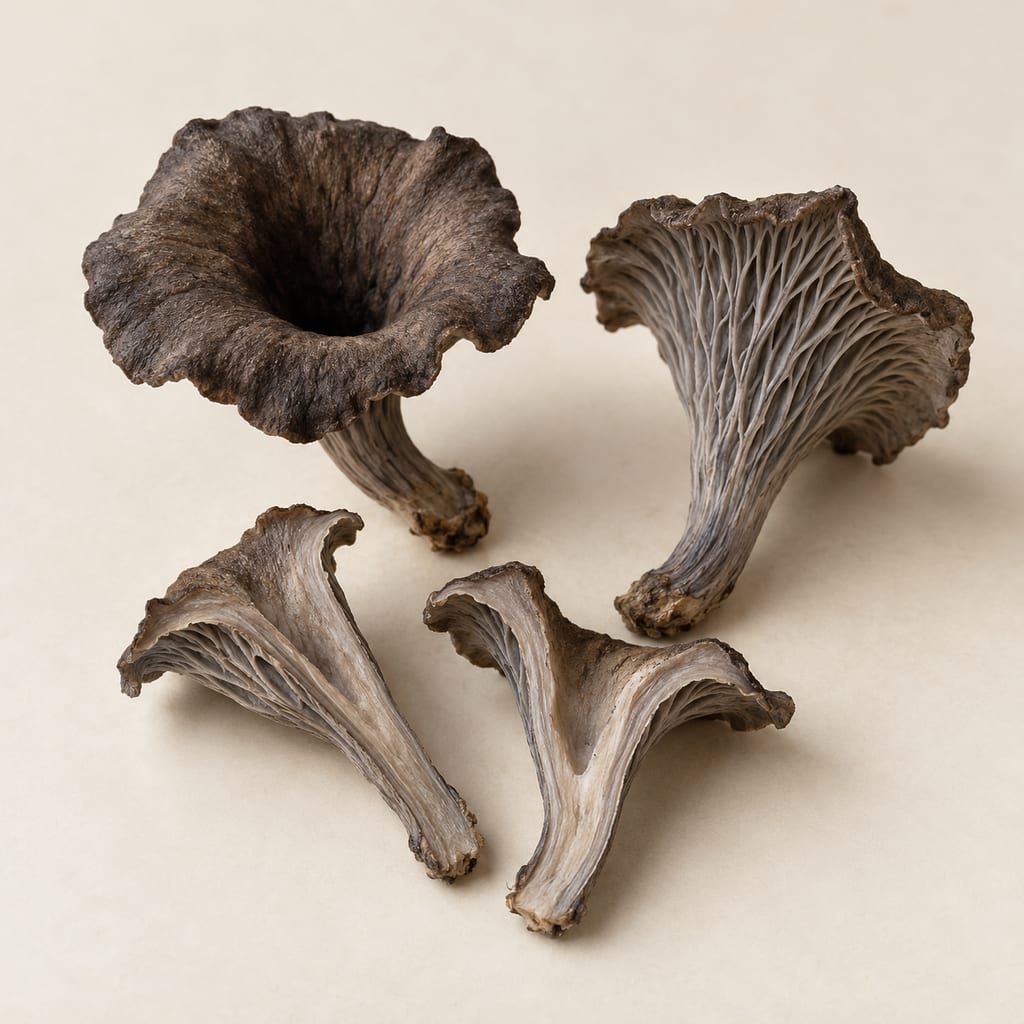
The ashen chanterelle is a wild mushroom of the Craterellus genus, with a dark grey to black funnel-shaped fruit body. Its common English names include ashen chanterelle and black chanterelle. It is usually listed under the name Craterellus cinereus, though some sources still use Cantharellus cinereus for the same species.
Its appearance is close to that of the black trumpet, Craterellus cornucopioides, and the two are the usual confusion in the field. The main difference noted in the sources is that the ashen chanterelle has gills or gill-like folds, while the black trumpet does not. Ashen chanterelles also lack the yellow colouring that separates the species from its relatives in some descriptions.
Sources for this section
Flavour and use
The species is described as mild in taste and indistinct in smell. Sources say it can be used in the same ways as black trumpets but with a milder flavour, so cooks treat it as a flavouring mushroom that adds depth to a dish rather than a dominant ingredient.
Most of the consulted sources call the species edible, and one describes it as having a good taste. The Swedish-Norwegian guide Svampguiden lists it as edible but not recommended for picking because it is rare, and its header label reads inedible, which conflicts with its own notes. The catalogue record for this topic treats the food use as documented in regional specialist sources, not as a verdict on any specimen.
Ecology
The ashen chanterelle is a mycorrhizal fungus associated with trees. It grows in woodland, and the consulted sources place it in Europe. Because it forms a partnership with tree roots, it cannot be grown on a substrate in the way that saprotrophic mushrooms are, and every specimen used in the kitchen is wild.
Sources for this section
Identification and safety
Identification rests on the gills, the grey to black colour and the funnel shape, and it is made against the black trumpet. The sources consulted say that none of the lookalikes they list are poisonous, but they do not establish a complete list of look-alikes for every region, and no source here authorises a reader to identify a mushroom for eating.
Wild mushrooms should be identified by an experienced forager or a specialist, using the full set of features and a field guide for the region. Catalogue inclusion, a food-use record or a description on this page is not a method of identification.
Sources for this section
Open questions
The consulted sources give no detail on culinary preparation beyond substitution for black trumpets, no regional names beyond the English ones, and no preservation method. The Svampguiden conflict between its header and notes is unresolved. A regional guide with a recorded food use would settle the distribution and the local preparation more firmly than the sources used here.
Sources for this section
Places
Europe
Documented use · Region evidenceThe consulted guides describe the species as European woodland fungus. It does not establish a precise range.
Community
No community contributions have been published for this entry yet.
Share what you made
Sign in to contribute. Published comments and photos are free to read.
Sources
WikipediaIdentity · Flavour · Lookalikes
Craterellus cinereusKnown as ashen or black chanterelle; usually Craterellus cinereus, some sources Cantharellus cinereus
Mild taste and indistinct odour; used like black trumpets but milder
Cited in: What it is; Flavour and use; Ecology; Identification and safety
SvampguidenSafety · Identification
Craterelloid fungiNotes say edible but not recommended for picking due to rarity; header labels it inedible, which conflicts with the notes
Cited in: Flavour and use; Open questions
Galloway Wild FoodsIdentification · Lookalikes
Winter Chanterelle: edibility, identification, distributionGills distinguish it from black trumpets
Lookalikes listed are not poisonous per the source
Cited in: What it is; Flavour and use; Identification and safety