
Mushrooms
Bay bolete
The bay bolete, Imleria badia, is a pored mushroom of Eurasian and North American conifer and mixed woods, valued for cooking and drying; it should always be cooked and identified with care.
Overview
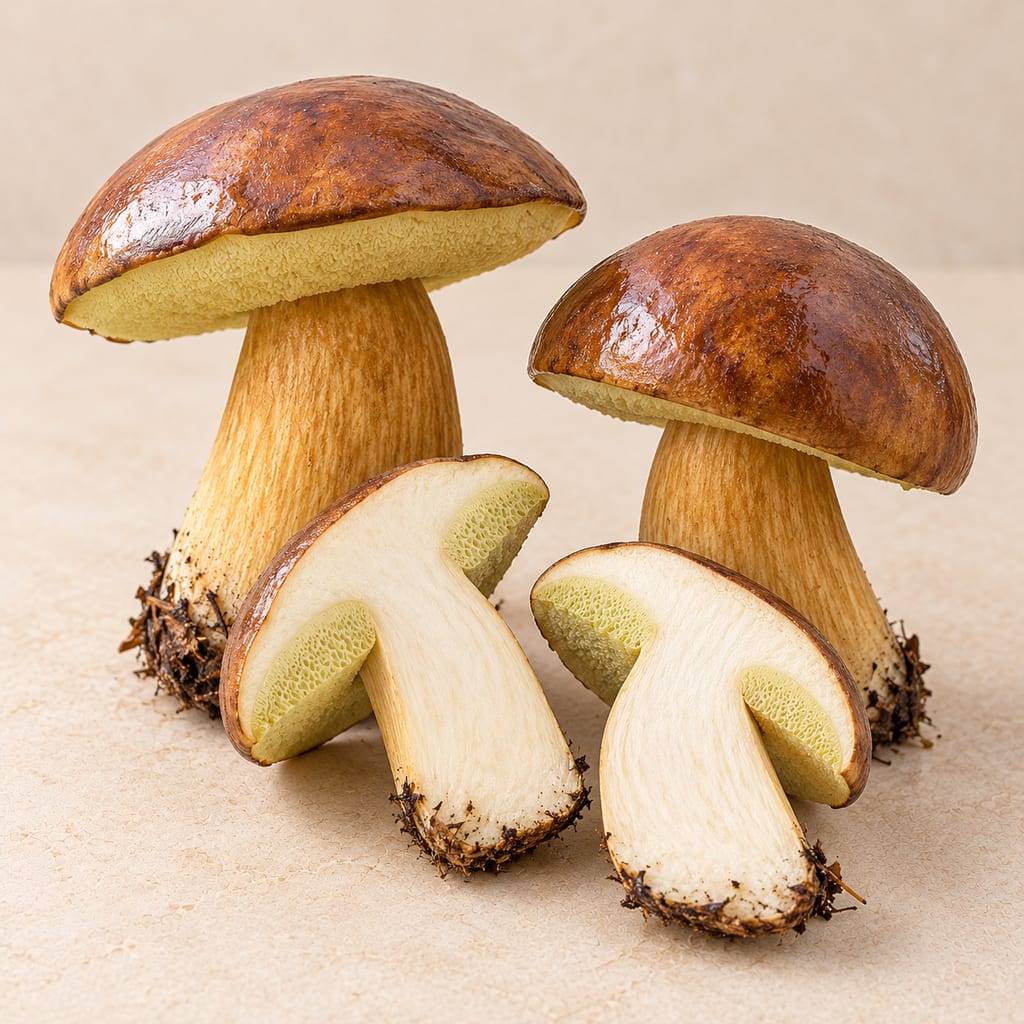
The bay bolete is a pored mushroom, a boletus in the broad older sense, with a cap in bay-brown or chestnut tones. Its scientific name is Imleria badia, from the older names Boletus badius and Xerocomus badius. The name badia refers to the cap colour.
It grows in coniferous or mixed woods, usually on the ground and sometimes on decaying stumps, and it can appear in large numbers. Guides in Sweden and the United Kingdom present it as an edible wild mushroom.
Sources for this section
Identity and lookalikes
The cap is usually 5 to 15 centimetres across, firm, and slightly downy when young. The flesh is pale and turns slightly blue when cut. The pores are fine and creamy yellow and bruise a greenish blue when pressed.
The cep, Boletus edulis, can have a similar bay-brown cap, and the reticulate net pattern on its stem separates it from the bay bolete. Field identification of boletes needs care, and a single feature should not decide an identification.
Sources for this section
Habitat and ecology
The species is ectomycorrhizal, forming a partnership with tree roots. Guides associate it mainly with pine, with spruce and oak in mixed woods. It fruits from summer into autumn. The IUCN assessment describes it as common and widespread across Europe and north-eastern North America.
Sources for this section
Cooking and use
Foragers describe the flavour as mild and nutty, with a little sweetness. Caps are used fresh in cooking and dried, then rehydrated for sauces and stews. One British forager suggests that the species suits many cooking methods and points to a mushroom stroganoff as a good use. A Swedish guide calls it a very good edible and notes that larvae rarely infest it.
Cooking is the common practice in the guides reviewed. The sources do not agree on eating the bay bolete raw, and this page does not recommend it.
Sources for this section
Safety
One British guide warns that the bay bolete contains xerocomic acid and is poisonous eaten raw, and it recommends cooking for at least fifteen minutes. The sources do not settle this point, so the safe course is to cook every bay bolete thoroughly and not to eat it raw.
Foraged boletes can be confused with other species, and an identification should be checked by someone experienced before the mushroom is eaten. This page is not an identification guide and does not replace one.
Sources for this section
Places
Europe
Documented use · Region evidenceRegion-level record from the catalogue and Nordic and UK food guides; no national figure is given.
Northeastern North America
Documented use · Region evidenceNamed in the IUCN assessment as one of the two areas where the species is common; the record says nothing about local dishes.
Community
No community contributions have been published for this entry yet.
Share what you made
Sign in to contribute. Published comments and photos are free to read.
Sources
Nordic Council of Ministers (DiVA)Food use · Identity
Supplied catalogue source for Imleria badia (Nordic edible fungi document)Supplied catalogue source for the European food record. The PDF was not retrieved for this revision; its content is taken from the catalogue record.
SvampguidenIdentity · Edibility · Lookalikes
Xerocomoid boletes (Svampguiden, bay bolete entry)Describes the bay bolete as a very good edible bolete that is rarely infested by larvae.
Read from a search summary of the page.
Cited in: Overview; Identity and lookalikes; Habitat and ecology; Cooking and use; Safety
Gone71 foraging guidePreparation · Safety
Bay bolete, Imleria badia (foraging guide)Warns that bay boletes contain xerocomic acid and should not be eaten raw; recommends cooking for at least 15 minutes. Other sources reviewed disagree on raw consumption.
Read from a search summary of the page.
Cited in: Identity and lookalikes; Cooking and use; Safety
IUCNEcology · Distribution
IUCN Red List assessment, Imleria badiaDescribes the species as common and widespread in Europe and north-eastern North America, an ectomycorrhizal fungus that is edible.
Read from a search summary.
Cited in: Overview; Habitat and ecology