
Mushrooms
Black morel
The black morel, Morchella elata, is a pitted, hollow fungus of conifer woods and disturbed ground. It is a popular edible in Europe, and its sources insist it must always be cooked thoroughly.
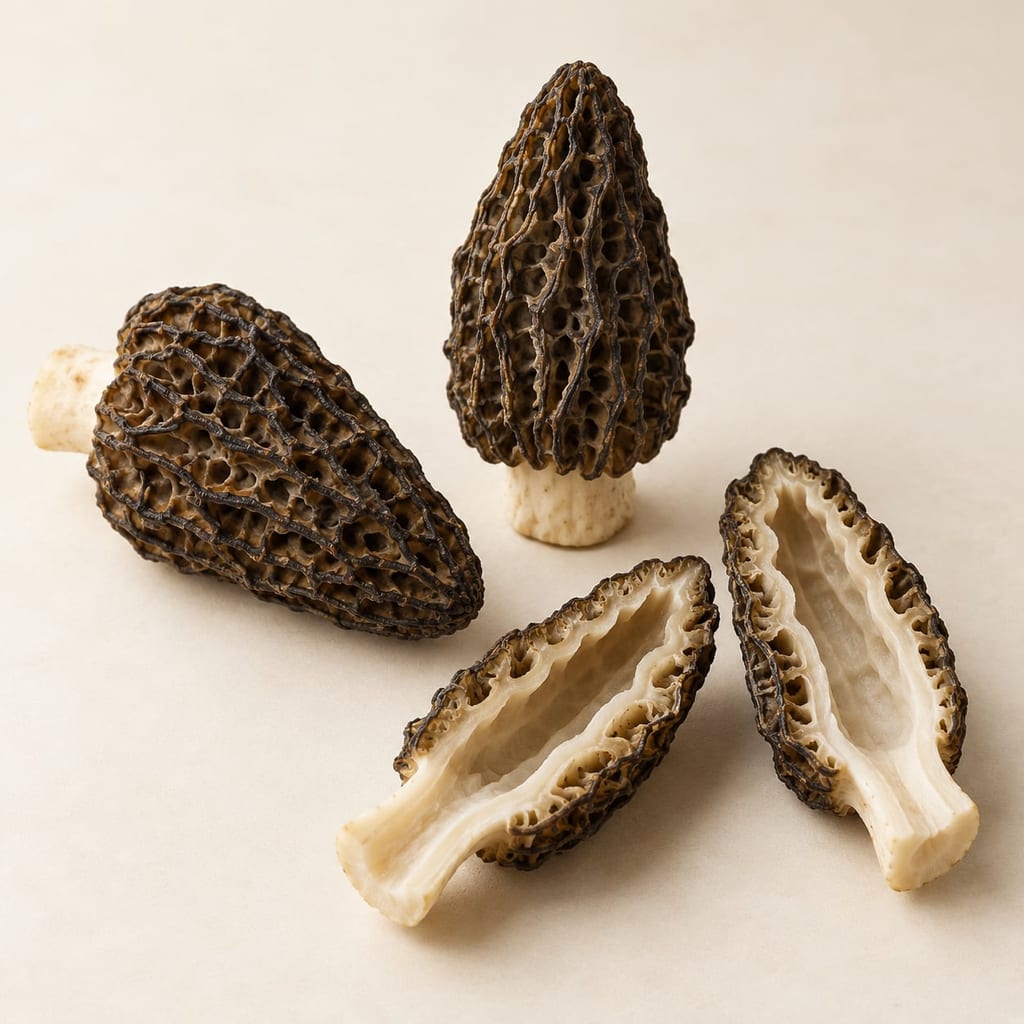
A pitted, hollow morel
Morchella elata has a cap 3 to 8 centimetres wide and 6 to 8 centimetres tall. It is hollow, conical or egg-shaped, and deeply pitted like an irregular honeycomb. The pits are pale brown to grey and darken with age. The stem is 1 to 3 centimetres wide and 4 to 10 centimetres tall, smooth near the top and usually grooved near the base, with one hollow chamber inside. The spores are ellipsoidal and smooth, 18 to 25 by 11 to 15 micrometres, with an oil droplet at each end, and they make a pale cream spore print.
Its odour and taste are not distinctive. Its look is the main way it is recognised, and the pitted cap is what separates it from smooth false morels.
Sources for this section
Habitat and season
The black morel grows in rich, well-drained soil under trees, often beneath hedges or on disturbed soil at garden edges. It is also found in woods and forests, especially beside woodland tracks. In recent decades it has increasingly appeared on conifer bark mulch in parks and gardens, where the source suggests it lives as a saprobe on the wood.
The season is March to June overall. In Britain and Ireland it is usually March, April and May. A fruiting in one year does not guarantee a crop in later years.
Sources for this section
Taxonomy and the name
The species was described by Elias Fries in 1822. Its synonyms include Helvella esculenta, Phallus esculentus and Morchella rotunda. Molecular studies show that there are several dozen separate morel species rather than the few once recognised, and European and North American morels that look alike are mostly not the same species.
North American black morels are a different species from the European M. elata. A pale violet variety, M. elata var. purpurescens, has been recorded in Scotland. The catalogue research name therefore points to a European taxon, and the American black morels should not be assumed to share its record.
Sources for this section
Cooking and safety
The black morel is a popular edible species, but its sources insist that it must always be cooked thoroughly. The source warns that raw or undercooked morels can cause severe stomach pains and sickness. The same source says the toxins are destroyed by cooking.
The most serious lookalike is Gyromitra esculenta, the false morel. It is deadly poisonous, with a brain-like cap and a stem hollowed into several chambers. Helvella crispa, with its fluted, broader stem, is another lookalike. The cap of a false morel is not a safe guide on its own, and a finder should confirm the identification with an experienced local expert before eating any morel.
Sources for this section
Use in food
The page calls the black morel popular and gives no preparation, portion or storage advice beyond the cooking warning. This page therefore records the warning and the rule, not a recipe.
Its use in cooking is not described in detail by the sources consulted, and nothing about a method is recorded here.
Sources for this section
Places
Europe
Documented use · Region evidenceRegional edible use as the source describes it; seasonal records for Britain and Ireland. No single origin claimed.
Community
No community contributions have been published for this entry yet.
Share what you made
Sign in to contribute. Published comments and photos are free to read.
Sources
First NatureMethod · Safety · History · Distribution
Morchella elata Fr. - Black MorelPitted cap, hollow stem, spore measurements and print.
Habitat under trees, woods and bark mulch; season March to June, March to May in Britain and Ireland.
Must always be cooked thoroughly; raw or undercooked morels cause severe stomach pains; toxins destroyed in cooking.
Fries 1822; synonyms; molecular species complex; M. elata var. purpurescens in Scotland.
Gyromitra esculenta and Helvella crispa lookalikes.
Cited in: A pitted, hollow morel; Habitat and season; Taxonomy and the name; Cooking and safety; Use in food