
Mushrooms
Agaricus sylvaticus
Agaricus sylvaticus, the blushing wood mushroom, is a scaly woodland mushroom of conifer and mixed litter. It is regarded as edible when cooked, and its flesh reddens when cut, which separates it from yellow-staining toxic species.
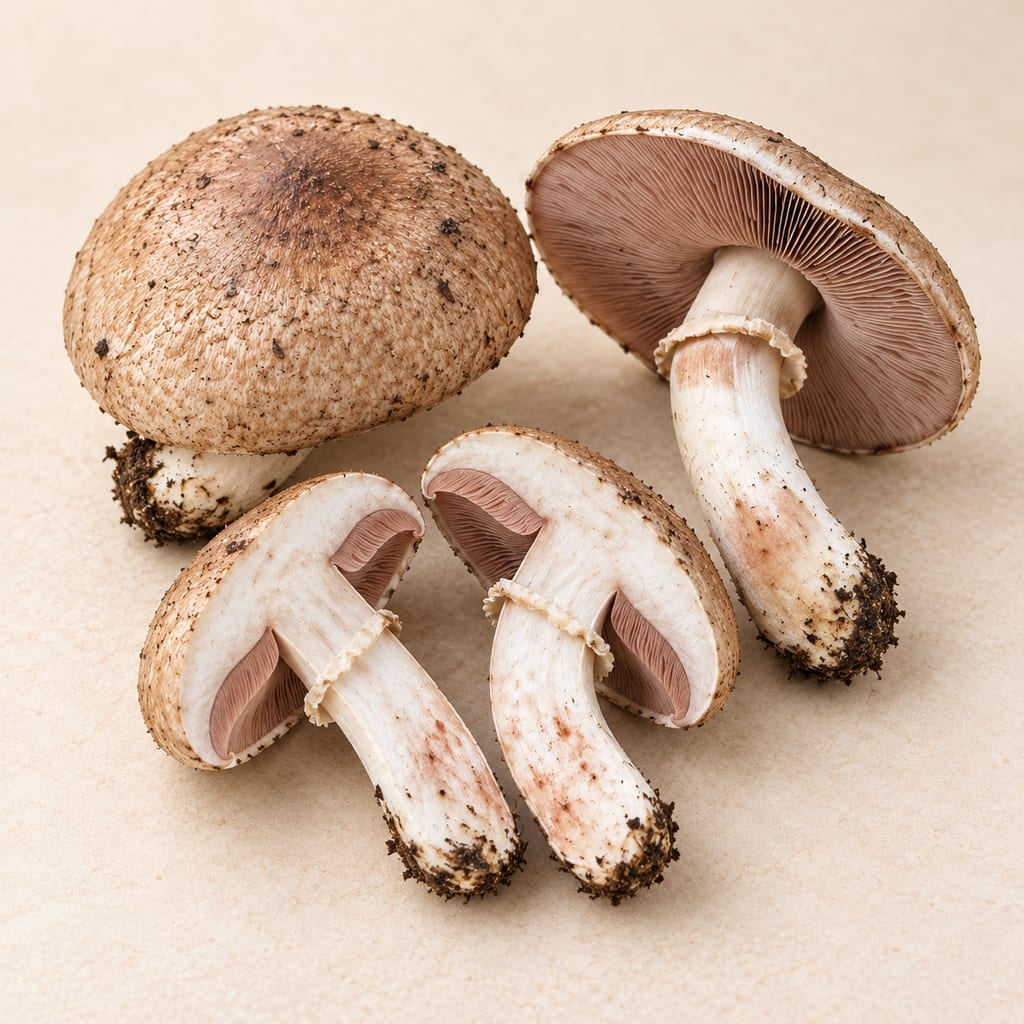
A scaly mushroom of the woods
Agaricus sylvaticus has a greyish-brown cap, hemispherical when young and later flattening, up to 10 cm across and covered in broad scales. The gills are grey when young and darken considerably with age. The spore print is chocolate brown. The stem is brownish, often with a hanging ring and a small bulb at the base.
The flesh is white with a mild taste and turns reddish when cut. That reddening is the feature the sources use to separate it from the yellow-staining Agaricus species, which turn yellow. The Wikipedia page does not describe its odour.
Sources for this section
Name and early description
Jacob Christian Schaeffer first validly described the species in 1774. The epithet sylvaticus means 'of the woods'. The preferred spelling in Species Fungorum is sylvaticus, while Wikipedia uses silvaticus. Its common names include blushing wood mushroom, scaly wood mushroom and pinewood mushroom.
Sources for this section
Where it grows and when
It grows in groups in coniferous woodland and in deciduous and mixed leaf litter under trees. It appears from early summer, and the sources give a fruiting season of summer to autumn, with one giving September to November. It is recorded from Europe, North Africa and North America.
Sources for this section
Eating and edibility
The sources rate the species as edible. One source states it is edible cooked; another rates it edible and good; a third says it is considered a good edible species in some countries. The sources read give no preparation method, cooking time or preservation method, and none of them is a toxicological study of the species.
The same sources warn that it resembles inedible mushrooms and that some lookalikes cause stomach upset. Edibility here means only that the species is recorded as edible in these sources; it is not a safety assessment for any collection.
Sources for this section
Lookalikes
The scaly wood mushroom, Agaricus langei, is the closest confusion. It is also reddish when bruised and is recorded as edible. Agaricus haemorrhoidarius is usually treated as a synonym, though some sources keep it separate; its flesh reddens immediately when cut. Agaricus phaeolepidotus has a stem that yellows as well as reddens, and it smells of iodine or ink. Tricholoma vaccinum looks similar from above but has no ring and has reddish-brown gills.
Poisonous Agaricus species stain yellow rather than red. This page keeps the species separate from A. langei and from the yellow-staining toxic species, because the identifying colour changes differ. Foragers should have a wild specimen confirmed by an expert before eating it.
Sources for this section
Open questions
The sources read do not give a traditional preparation, a regional name, or a toxicological review of the species. The next research question is which European cooking traditions use it and whether the reddening and ring characters hold across the regions it is recorded in.
Sources for this section
Places
Europe
Documented use · Region evidenceRegion-level. Described as found in Europe; one guide calls it a good edible species in some countries, and the sources do not give a single national food tradition.
North Africa and North America
Relationship not established · Region evidenceRegion-level occurrence only. The sources do not record food use in these regions.
Community
No community contributions have been published for this entry yet.
Share what you made
Sign in to contribute. Published comments and photos are free to read.
Sources
WikipediaIdentity · Safety · History
Agaricus silvaticusSchaeffer 1774; epithet of the woods; cap up to 10 cm with broad scales; flesh white, reddens when cut; edible cooked; lookalikes cause gastric upset; Europe, North Africa and North America records; A. langei confusion; yellow-staining toxic Agaricus species.
Wikipedia is a lead and several statements carry citation-needed tags on the page; these are recorded as sourced claims only.
Cited in: A scaly mushroom of the woods; Name and early description; Where it grows and when; Eating and edibility; Lookalikes; Open questions