
Mushrooms
Burn-site morel
The burn-site morel, Morchella exuberans, is a wild morel that fruits in conifer forest in the year after a fire in western North America. It is eaten only after thorough cooking, because raw morels can cause serious poisoning.
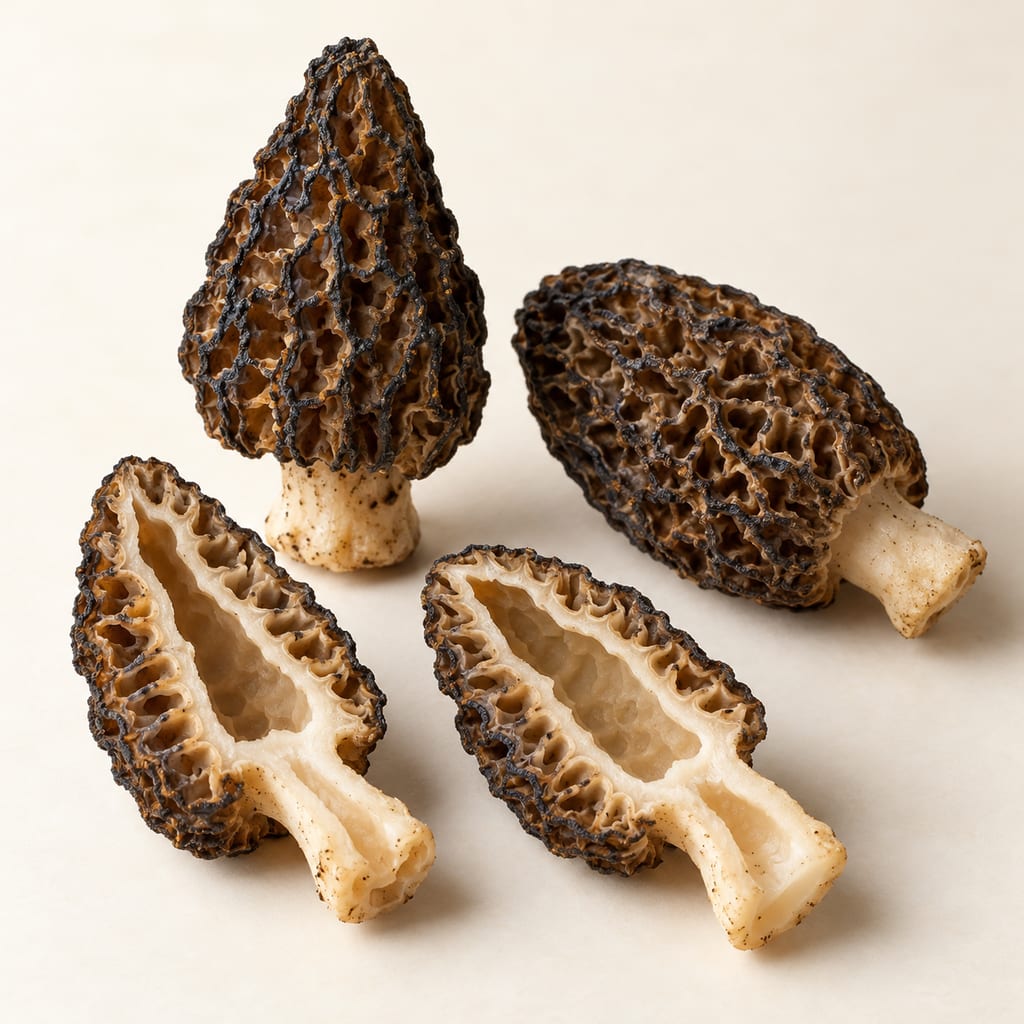
What it is
The burn-site morel is a true morel with a hollow cap 4 to 8 centimetres tall. The cap is conical or nearly round, with dark brown to black ridges and vertically elongated pits that are brown to tan. The stem is white and layered or chambered, especially near its base, and the cap is attached to the stem with a small groove.
Its common name describes its habitat. The species appears in burned ground, and the morel name in some references is Morchella capitata, a synonym the catalogue lists as a search alias.
Sources for this section
Where and when it grows
The species is a saprotroph and root endophyte that fruits in conifer forest, usually in the first year after a forest fire and rarely two years after. Fruiting is reported from May to mid-June. The catalogue places its records in western North America.
Because it depends on fire, the species cannot be relied on in unburned forest. Collecting depends on a recent fire, a season and a site, and records should note all three.
Sources for this section
Names and identification
The catalogue uses the name Morchella exuberans and lists M. capitata as a search alias. Many morel species are being reclassified on the basis of DNA, so a morphological name for a true morel is a working identification until it is checked.
The guide cited here says that DNA evidence does not confirm the identifications of this species. Look-alikes are not listed for the burn-site morel because it appears only after fires, but that absence is a fact about one guide, not a field test.
Sources for this section
Eating and safety
The cited guide describes the species as edible. The guide notes that sand and fire residue lower its commercial value.
The guide says that morels should be cooked thoroughly and never served raw, because cooking destroys gastro-irritant compounds. Most people can eat cooked morels safely, though some become allergic and some develop stomach upset. Raw or undercooked morels are associated with serious illness: the 2023 Montana outbreak linked illness to morels, with more illness among raw than cooked morels, and no single toxin was confirmed.
Cooking reduces the risk but is not a guarantee. A cooking method is not a validated preparation for this page, and the catalogue treats the entry as research, not preparation advice.
Notes
Open points: the species boundaries within the burn-site group, its exact range within western North America, and the food traditions that use it are not established by the sources reviewed here.
Sources for this section
Places
Western North America
Documented use · Region evidenceThe catalogue gives the region. The cited page is a Great Lakes morel guide that describes this species; it does not map its range.
Community
No community contributions have been published for this entry yet.
Share what you made
Sign in to contribute. Published comments and photos are free to read.
Sources
Midwest MycologyIdentification · Ecology · Safety · Use
Morchella americana (Midwest Mycology), which describes Morchella exuberans as burn-site morelHollow cap 4 to 8 cm tall, conical or nearly round, with dark brown to black ridges and vertically elongated brown to tan pits; white stipe layered or chambered near the base; saprotroph and root endophyte appearing from May to mid-June in conifer forest, usually the first year after a fire and rarely two years after; edible, though sand and fire residue lower commercial value; morels should be cooked thoroughly and never served raw; DNA evidence does not confirm this species' identifications.
Cited in: What it is; Where and when it grows; Names and identification; Eating and safety; Notes
MMWR, CDCSafety
Outbreak Linked to Morel Mushroom Exposure, Montana, 2023Raw morels were more strongly associated with illness than cooked or partially cooked morels in the 2023 Montana outbreak; no causative agent was identified.
Cited in: Eating and safety