Pork fat
Pig adipose tissue used raw in some fermented meats and made into distinct products such as cured lardo, salo and rendered lard. Cut and firmness affect processing.
 FermenteaWhere food goes to change
Mushrooms
Caesar’s mushroom, Amanita caesarea, is a prized wild, tree-associated fungus of Mediterranean Europe, gathered seasonally for regional dishes. Its celebrated name and food traditions sit beside serious identification risks.
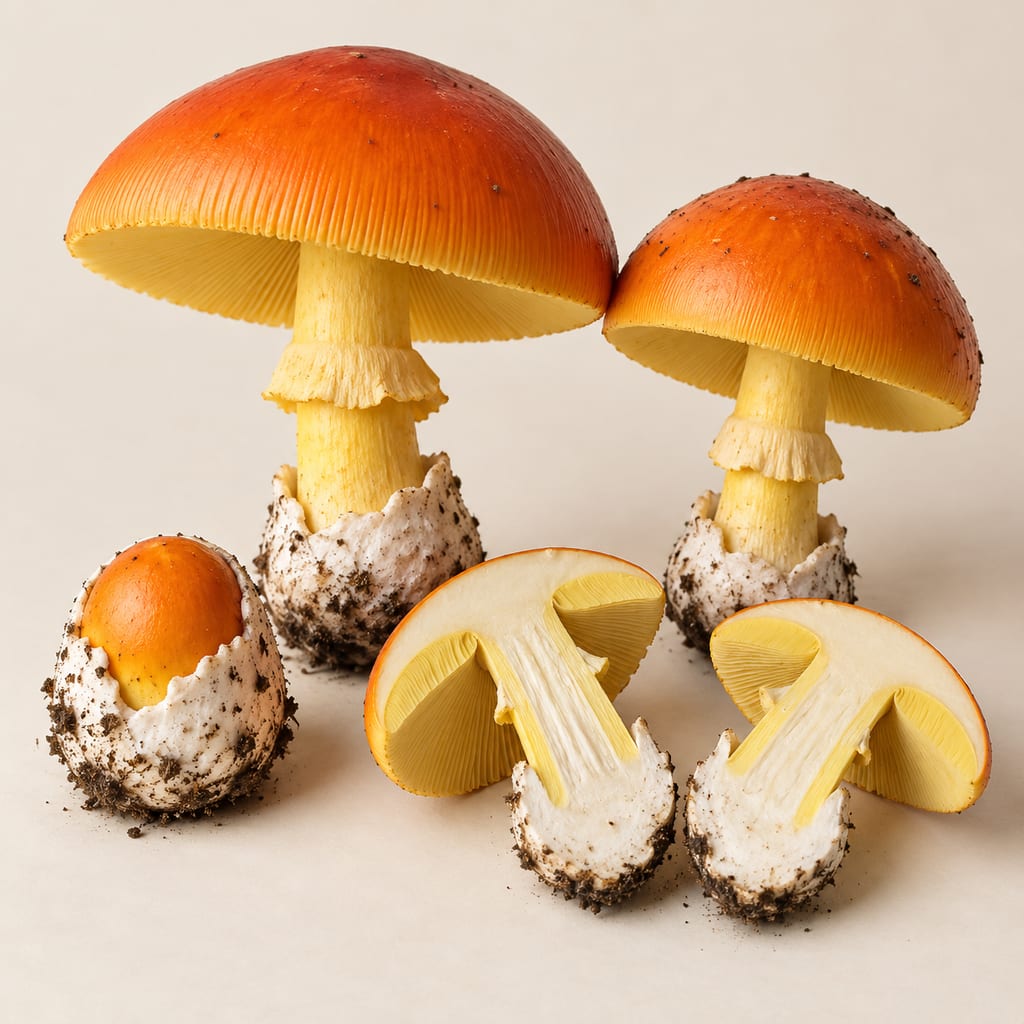
Caesar’s mushroom is the culinary name commonly attached to Amanita caesarea, an orange-capped amanita gathered in parts of Mediterranean Europe. Local names include the Italian ovulo buono and ovuli; a central Tuscan study also records cocchi. The name’s regal ring has encouraged stories about Roman emperors, but a familiar tale is not the same as a securely documented food history. The evidence collected here is strongest for modern regional practice and specialist descriptions.
This species deserves a page as a food ingredient because it is gathered and sold as a mushroom, not made through fermentation. Its fresh fruiting body is used whole or cut. The fungus itself forms a below-ground partnership with tree roots, so it is not a straightforward cultivated crop that can be reproduced on a kitchen substrate.
A mature Amanita caesarea has a smooth orange to orange-red cap, with radial lines at its edge; the gills, stem and ring are yellow, and a broad white membranous volva remains around the stem base. The volva is the remnant of the universal veil, the membrane that encloses the young fruit body. As the mushroom expands, this outer covering tears, leaving the cup-like base. Young specimens can therefore look very different from the familiar open-capped form.
The species is ectomycorrhizal: fungal threads associate with living fine roots, exchanging resources with a host tree. North Macedonia’s Red List documents a strong association there with several oaks and less frequent associations with beech, sweet chestnut and oriental hornbeam. A regional specialist page in Greece also describes broadleaf woodland, and mentions pine woods. These observations are regional; they should not be turned into an exhaustive host list for every country.
Taxonomic names and market names do different work. Amanita caesarea is the scientific name for the species discussed here, while ovuli can be a familiar food name. That food name does not safely identify every unopened mushroom, nor should the European species name be transferred to similarly named Caesar mushrooms elsewhere. The North Macedonia Red List records Agaricus caesareus Scop. as a synonym. Reports of an ancient Caesar association remain a separate historical question.
In North Macedonia the species is reported from open, sunny forest edges and coppice woodland on dry to moderately damp soils. The national assessment names Quercus frainetto, Q. pubescens, Q. cerris, Q. coccifera and Q. petraea as primary partners there, with Fagus sylvatica, Castanea sativa and Carpinus orientalis less frequent. Because the fungus depends on living roots, its fruit body is only the visible seasonal part of a longer relationship under the soil.
Season changes with climate and place. North Macedonia’s account reports fruiting from mid-spring to mid-autumn, often in warm, rainy periods. The Greek Mushroom Society gives May through November for Greece, usually in groups and often near openings and edges. These are regional descriptions, not a Mediterranean forecast; rainfall, temperature, habitat and local populations shape when fruit bodies appear.
The North Macedonia assessment recorded the species at 158 sites across 50 biogeographic regions and estimated that suitable habitat might support more sites. It classified the national population as Least Concern and stable. The same account discusses logging: open coppice can provide suitable conditions locally, while repeated changes to forest structure may diminish mycorrhizal habitat over time. A national assessment cannot establish a global conservation status, and a season with few market mushrooms does not by itself indicate a population trend.
In central Tuscany, interviews recorded ovuli and cocchi among local names and described several ways people prepare Amanita caesarea: raw, grilled, fried with pasta, garlic and sage, or made into a pasta sauce with garlic, parsley and cream. These are specific regional food traditions documented through interviews; they are not a single canonical recipe. The study also compares generational recollections, so its record says something about changing local food heritage as well as what people eat.
A raw preparation leaves the mushroom’s texture and mild flavour prominent; grilling and pan cooking bring heat and browning, while pasta sauces combine it with other ingredients. Those are ordinary culinary effects, not proof of a species-specific nutrition or health benefit. The sources reviewed do not establish a standardized preservation method, safe storage duration, or fermentation use for this ingredient.
Descriptions of the food as prized are common in specialist and regional accounts, but taste is not uniform. People may value the mushroom for its delicate flavour, seasonal scarcity, or local tradition, while another cook may prefer a more aromatic species. Market reputation and a memorable common name are cultural evidence; neither establishes identity or safety.
Amanita is a high-risk genus because it includes species that can cause fatal poisoning. An enclosed young fruit body has not yet displayed the orange cap, yellow gills and stem that help characterize mature Caesar’s mushroom. A dangerous lookalike such as the death cap can also be enclosed in a white veil at this stage. Colour, a common name, a single photograph or the presence of a volva is not enough to identify a wild specimen safely.
This page intentionally does not provide a foraging checklist or say that a reader can distinguish edible from poisonous Amanita using a few visible features. California Poison Control advises against eating wild mushrooms and notes that poisonous mushrooms can resemble edible ones. That general warning is not a species-specific assessment, but it reflects the consequences of mistaken identity. Buy through an established food market and use local official mycological inspection where that is available. If a wild mushroom may have been eaten and poisoning is suspected, contact local emergency or poison-control services promptly.
The available evidence supports a regional food ingredient of Mediterranean Europe, with detailed habitat and conservation information from North Macedonia, a season account from Greece, and contemporary culinary interviews from Tuscany. It does not establish the first date of human use, a universal range map, or a standardized method of storage or preservation. Ancient imperial stories should remain attributed traditions until primary historical evidence is checked.
The article also cannot resolve what to do with an unidentified wild specimen. That is deliberate: evidence that a species is eaten in a place does not turn a web page into identification, inspection or food-safety advice. The practical conclusion is to keep food heritage and mushroom identification separate.
Specialist account describes warm Mediterranean localities and food markets; this broad region does not assert presence in every area.
National Red List describes it as edible and highly appreciated, collected by foragers, with a stable Least Concern assessment in this country.
Study records local names and preparations; not a claim that all Italian regions share these traditions.
Society page describes the species as edible and gives a regional season; the calendar is not a forecast for other countries.
No community contributions have been published for this entry yet.
Sign in to contribute. Published comments and photos are free to read.
National Red List of North MacedoniaIdentity · Ecology · Season · Geography · Use · Conservation
Caesar’s Amanita — National Red List of North MacedoniaAccepted name Amanita caesarea and authority (Scopoli) Persoon; synonym Agaricus caesareus Scop.
Ectomycorrhizal relationship primarily with Quercus species in North Macedonia, less often Fagus, Castanea and Carpinus.
Open sunny forest-edge habitat on dry to moderately damp soils; mid-spring to mid-autumn fruiting, often warm and rainy.
North Macedonian range, elevation, local status, collection and forestry discussion.
Cited in: A Mediterranean mushroom, not a safe shortcut; The species behind the name; A seasonal forest relationship; Scope and remaining questions
Journal of Ethnobiology and Ethnomedicine, Springer NatureCulinary use · Names · History
Diachronic changes in local food heritage: the ethnobiology of wild foods in central TuscanyCentral Tuscany food heritage study records Amanita caesarea as ovuli and cocchi.
Interview participants reported eating it raw, grilling it, frying with pasta, garlic and sage, and making pasta sauce with garlic, parsley and cream.
Interview evidence documents local recollections and current food heritage, not universal practice or food-safety recommendations.
Cited in: A Mediterranean mushroom, not a safe shortcut; How people use it; Scope and remaining questions
Greek Mushroom Society (Μανιταρόφιλοι Ελλάδας)Identity · Habitat · Season · Names
Amanita caesarea (Scop.) Pers.Expert society page describes the edible species and its morphology.
Reports Greek fruiting from May to November in groups, chiefly broadleaf woods and also pine, often in openings and at edges.
Source itself cites an unpublished species file, so use its calendar and morphology as specialist guidance rather than a formal national survey.
Cited in: The species behind the name; A seasonal forest relationship
The Mycologist, Cambridge University PressHistory · Geography · Food use · Safety
Useful Fungi of the World: Caesar’s mushroom and the Christmas mushroomSpecialist account describes the species as highly prized and edible, occurring in Mediterranean markets and warm localities, typically with oak or sweet chestnut from late summer.
Notes that the prized edible species belongs to the same group as highly toxic Amanita species and that careful distinction is essential.
Cited in: A Mediterranean mushroom, not a safe shortcut; How people use it; Why identification needs expertise
California Poison Control SystemSafety
Wild MushroomsPoisonous mushrooms may resemble edible mushrooms and severe or fatal poisonings occur.
The service advises against eating wild mushrooms and directs users to emergency or poison-control support after suspected poisoning. This is general wild-mushroom guidance, not a species-specific Amanita caesarea determination.
Cited in: Why identification needs expertise; Scope and remaining questions
Index FungorumTaxonomy
Amanita caesarea — Index Fungorum nomenclatural recordNomenclature is maintained separately from culinary common-name stories. The record number is supplied as an authority lookup; consult alongside the North Macedonia Red List for the accepted name.