
Mushrooms
Cantharellus miniatescens
A tropical African chanterelle anchored by a sequenced epitype from Cameroon. Voucher-backed Tshopo research records local food use; older records and illustrations require taxonomic caution.
Name, identity and the problem of older records
Cantharellus miniatescens Heinem. was described in 1958 from material associated with Martha Goossens-Fontana’s Congo field collections. It has no established common English name in the sources reviewed. Its taxonomy has a complicated history: the original herbarium type material was heterogeneous and in poor condition, and the name was once treated as doubtful. A 2016 study selected a lectotype and a molecularly sequenced epitype, anchoring the name to newly collected African material.
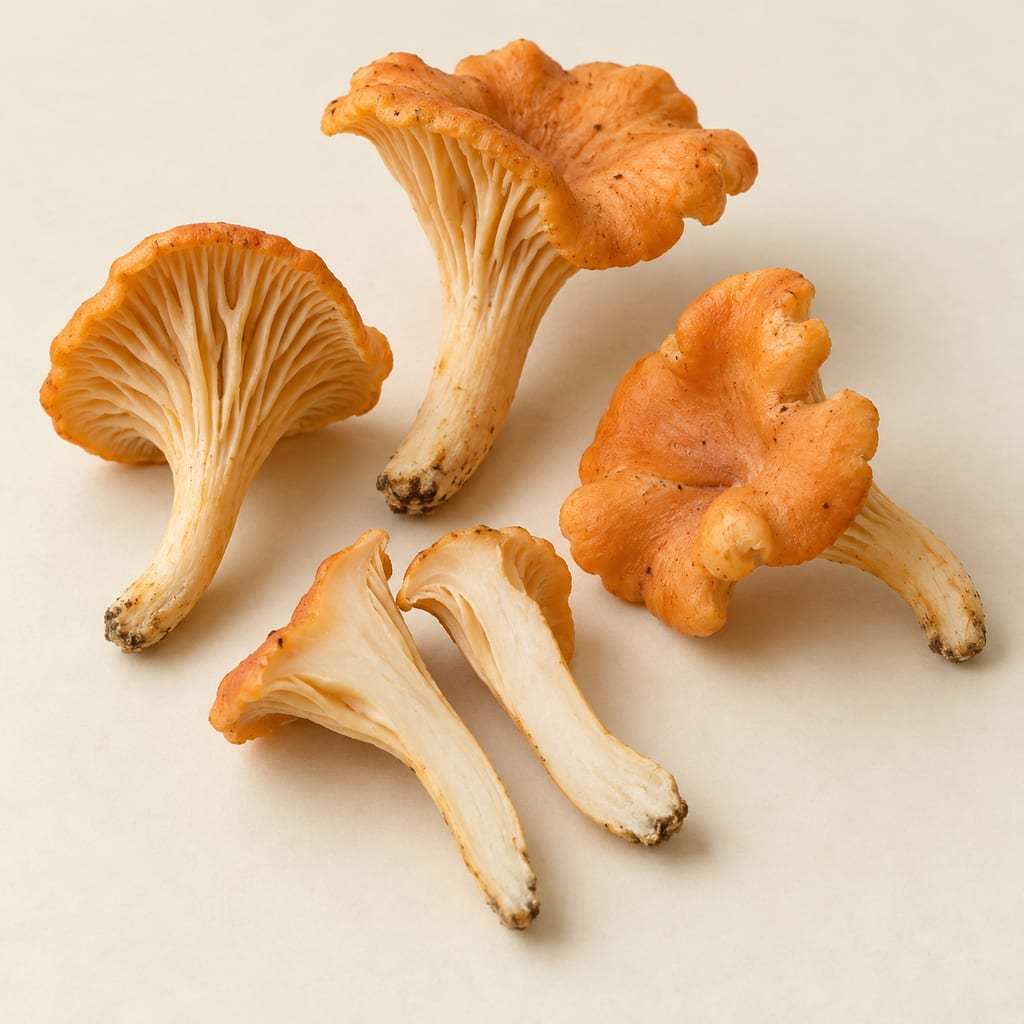
The revised description is of a small-to-medium, thin-fleshed chanterelle. Young caps are pinkish-vinaceous to reddish and finely tomentose; as they expand, the surface becomes yellow-orange, often retaining darker or reddish tones in the center and margin. The cap becomes depressed or funnel-shaped with coarse radial grooves. Its pale, decurrent folds are low, forked and strongly interconnected by cross-veins; they are not true gills. The stem is slender and pale yellow to orange, sometimes pinkish, with off-white fibrous flesh. Fresh material has a fruity, chanterelle-like aroma.
The 2016 authors concluded that the 2011 illustrated account of C. miniatescens actually depicted a Hygrocybe. A 2013 Himalayan study reported a specimen from India under this name after morphological and LSU sequence work, but the later taxonomic treatment cautions that non-African reports may not represent the same species. India should therefore be treated as a contested record, not an established range. A color match or photograph alone cannot resolve difficult tropical chanterelle identifications.
Sources for this section
- Multigene sequencing provides a suitable epitype, barcode sequences and a precise systematic position for the enigmatic, African Cantharellus miniatescens →
- New records of Cantharellus species from the northwestern Himalayas of India →
- Champignons comestibles des forêts denses d’Afrique centrale: Taxonomie et identification →
Forest ecology, places and fruiting time
The best-supported modern concept is an ectomycorrhizal forest fungus associated with Gilbertiodendron dewevrei. Its sequenced collections came from Gilbertiodendron-dominated rainforest in Cameroon’s Dja Biosphere Reserve and the Dzanga-Sangha Forest Reserve of the Central African Republic. Older type material came from forest soil and leaf litter near Binga in what is now the Democratic Republic of the Congo. In Tshopo Province, a 2020 rainforest survey records vouchers ADK5216 and MKH142 from fungi collected in the Yangambi and Yoko reserve areas.
There is no single supported calendar. The Cameroon collections were made in August and September 2014 during the early rainy season. Central African Republic collections were made in May 2016 despite unusually dry conditions. The older Congo type collections date to July 1942 and 1946. These are observations from different places and years, not a complete phenology study. The Tshopo survey collected fungi from 2013 to 2016 but does not give a species-specific month for C. miniatescens.
Sources for this section
Food use and the limits of the evidence
The 2020 Tshopo study lists C. miniatescens as food and ectomycorrhizal, supported by vouchers ADK5216 and MKH142. Its interview table records the species as eaten among each of six surveyed communities. This supports documented local food use in Tshopo. The study does not establish how the mushroom is prepared, whether it is sold, or that every specimen identified under this name is safe to eat. Its method records informants’ edibility responses and links taxon records to herbarium vouchers; it is not a toxicological assessment.
The 2016 taxonomic article describes the epitype’s aroma and taste, but sensory observations do not establish culinary practice. It discusses an old bitter or acrid taste note and suggests it may have reflected prolonged quinine use rather than the mushroom. The 2011 central-African guide calls the species edible, but its illustration was later determined to represent a Hygrocybe. This draft therefore relies on the voucher-backed Tshopo record for local consumption and the 2016 revision for species identity. No preparation method or foraging advice is given.
Sources for this section
- Wild edible ectomycorrhizal fungi: an underutilized food resource from the rainforests of Tshopo province (Democratic Republic of the Congo) →
- Multigene sequencing provides a suitable epitype, barcode sequences and a precise systematic position for the enigmatic, African Cantharellus miniatescens →
- Champignons comestibles des forêts denses d’Afrique centrale: Taxonomie et identification →
Places
No source in this record establishes a place.
Community
No community contributions have been published for this entry yet.
Share what you made
Sign in to contribute. Published comments and photos are free to read.
Sources
Cryptogamie, MycologieIdentity · Use · Ecology
Multigene sequencing provides a suitable epitype, barcode sequences and a precise systematic position for the enigmatic, African Cantharellus miniatescensSupports claims cited in the linked section.
Cited in: Name, identity and the problem of older records; Forest ecology, places and fruiting time; Food use and the limits of the evidence
Journal of Ethnobiology and EthnomedicineIdentity · Use · Ecology
Wild edible ectomycorrhizal fungi: an underutilized food resource from the rainforests of Tshopo province (Democratic Republic of the Congo)Supports claims cited in the linked section.
Cited in: Forest ecology, places and fruiting time; Food use and the limits of the evidence
ABC Taxa, volume 10Identity · Use · Ecology
Champignons comestibles des forêts denses d’Afrique centrale: Taxonomie et identificationSupports claims cited in the linked section.
Cited in: Name, identity and the problem of older records; Food use and the limits of the evidence
MycologyIdentity · Use · Ecology
New records of Cantharellus species from the northwestern Himalayas of IndiaSupports claims cited in the linked section.
Cited in: Name, identity and the problem of older records