
Mushrooms
Cantharellus miomboensis
Cantharellus miomboensis is a large yellow chanterelle of African miombo woodland. Its edibility is reported but not established by the sources read.
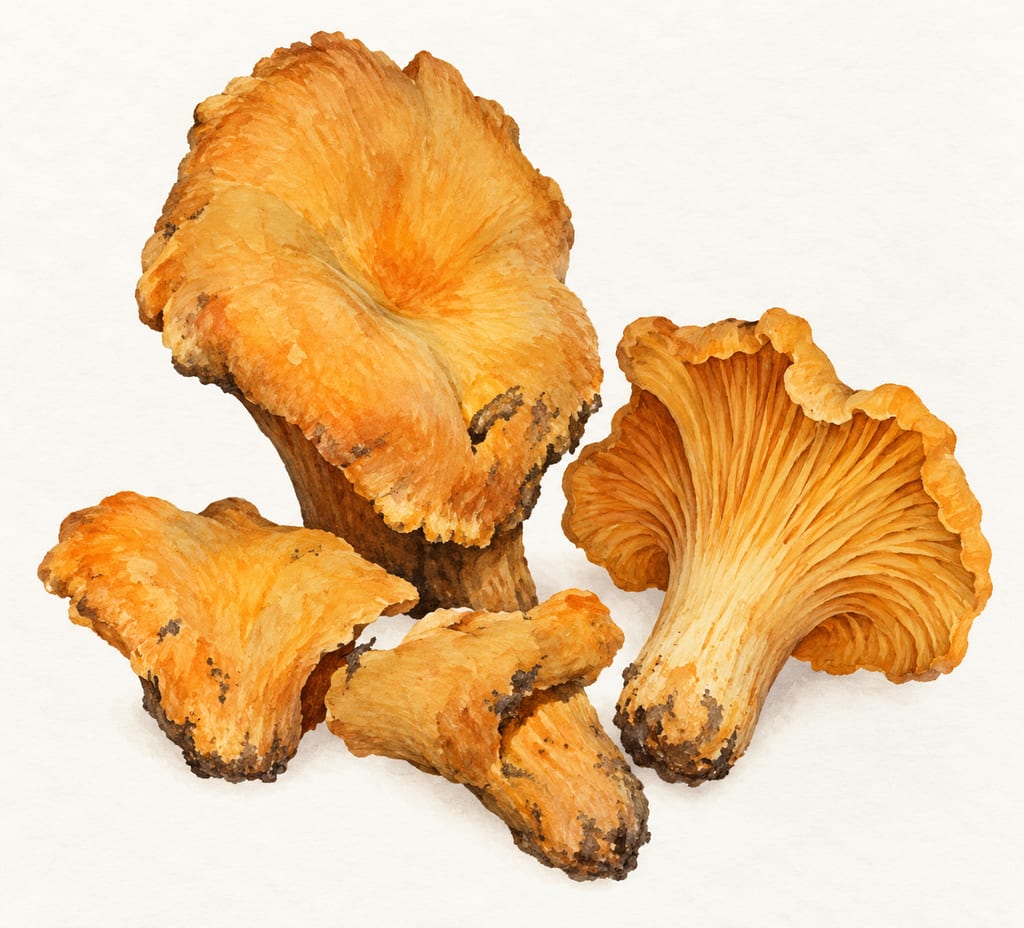
A large yellow chanterelle of miombo woodland
Cantharellus miomboensis is a large chanterelle. Its cap is yellow and covered in squamules, its gills are orange and decurrent, and its stipe is cylindrical and covered in loose scales. The spores are ellipsoid, hyaline and smooth. The species has no cystidia and no clamp connections. The fruity odour and mildly sweet, sometimes slightly bitter taste are descriptions in the species account, not statements about edibility.
It forms ectomycorrhizal partnerships with trees of the genera Julbernardia and Brachystegia, trees of the miombo woodland. The sources read do not describe its habitat beyond that woodland.
Sources for this section
Name and classification
Buyck and Hofstede described the species in the journal Fungal Diversity in 2013, in the volume's page 291. The EFTA species page gives no common name, so the catalogue's African chanterelle label is not confirmed by the source read. This page uses the scientific name as the title.
The species belongs to a group of Cantharellus species that were confused with one another in older miombo records. The catalogue notes that older records under the name C. rufopunctatus from miombo may refer to this species or to related taxa.
Sources for this section
Where it grows
The EFTA page records the species from the Democratic Republic of the Congo, Kenya, Mozambique, Tanzania, Zambia and Zimbabwe, and notes that it occurs in the miombo and related Zambezian region. The closest relative it names is C. pseudomiomboensis, which has a whitish stipe with tiny scales and rare clamp connections.
C. rufopunctatus and its variety ochraceus are often confused with it. The page says they are associated with Gilbertiodendron dewevrei in dense moist forest and are absent from miombo and open forest.
Sources for this section
Edibility: reported, not established
The catalogue describes the species as listed in an edible-species inventory. The EFTA page read here makes no edibility or food-use statement at all, and it gives no preparation, cooking method or safety warning. The edibility claim therefore rests on a source this page has not confirmed.
Wild African cantharellus species are collected and sold locally, and some are sold in European markets under the name chanterelle. Those market records do not identify this species specifically. Anyone considering eating a wild chanterelle from this region should have it identified by a specialist; no toxicological study of this species was found in the sources read.
Sources for this section
Open questions
The sources read do not give a food tradition, a regional name, a preparation method or a toxicological review. The next research questions are which edible-species inventory lists this species and what it states, and which local markets sell it under that name.
Sources for this section
Places
Zambezian miombo woodland
Documented use · Region evidenceRegion-level. The EFTA page records the species from the Democratic Republic of the Congo, Kenya, Mozambique, Tanzania, Zambia and Zimbabwe. It does not record food use in those countries.
Community
No community contributions have been published for this entry yet.
Share what you made
Sign in to contribute. Published comments and photos are free to read.
Sources
EFTAIdentity · History · Method
Cantharellus miomboensisBuyck and Hofstede, Fungal Diversity 58(1): 291 (2013).
Distribution: DR Congo, Kenya, Mozambique, Tanzania, Zambia, Zimbabwe.
Ectomycorrhizal with Julbernardia and Brachystegia in miombo.
Morphology: yellow squamulose-areolate cap, orange decurrent gills, scaly cylindrical stipe; no cystidia or clamp connections.
Lookalikes: C. rufopunctatus (var. ochraceus), C. pseudomiomboensis; no edibility or safety statement on the page.
Cited in: A large yellow chanterelle of miombo woodland; Name and classification; Where it grows; Edibility: reported, not established; Open questions