
Mushrooms
Cauliflower fungus
Cauliflower fungus, Sparassis crispa, is a conifer-associated fungus with frilled, pliable lobes. It is eaten fresh or dried, and is also grown commercially on larch sawdust in several countries.
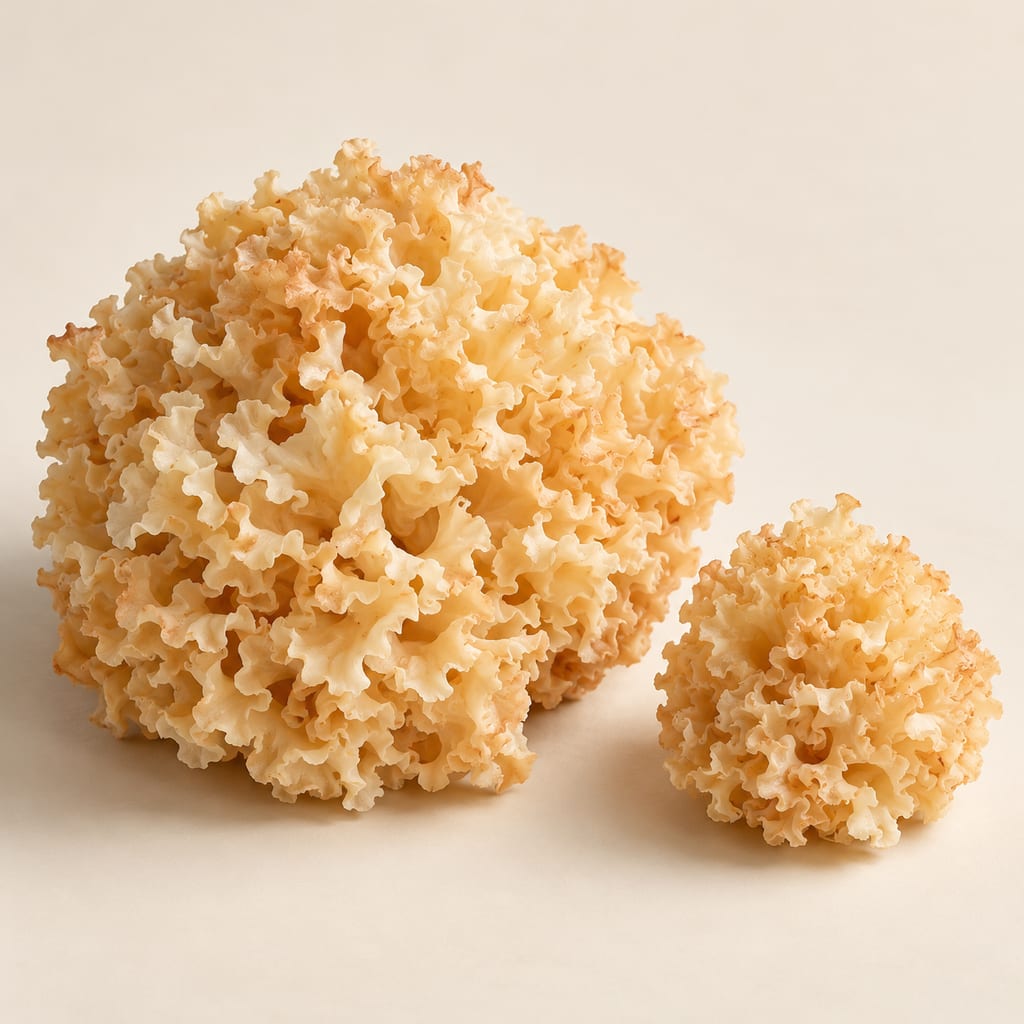
What it is
Sparassis crispa is the cauliflower fungus. Its fruit body is a large, frilled mass of flattened lobes, which the species epithet crispa refers to: the lobes are pliable and cartilaginous. The fungus grows at or near the base of conifers, where it attacks roots and the base of the trunk and causes a brown cubical rot. Fruiting occurs from July to October.
The name is applied broadly. A 2022 review uses S. crispa in a broad sense, notes that Index Fungorum lists 17 names for the group, and says that molecular phylogenies have reduced these to ten. The predominant Asian isolate was named Sparassis latifolia. The supplied catalogue notes that other regions have separate Sparassis species, so the name does not identify one organism across the world.
Sources for this section
Distribution and host trees
The review describes the fungus as widely distributed across the north temperate zone, and lists reported records in the United States, Australia, France, Germany, Russia, China, Japan, Nepal, Turkey and India. In India it is most commonly found in Himachal Pradesh. Its hosts include larch and Korean pine, and the review says it does not cause major harm to trees.
Sources for this section
Food and culinary use
The review describes the species as considered edible across the world. It is usually eaten young and fresh, and sometimes dried and preserved. The review states that it has been used in traditional cooking in China, Japan and Korea for centuries.
The supplied catalogue describes it as a frilled culinary fungus, used cooked, and notes that cleaning its folds is a practical challenge. The review does not describe cleaning or cooking methods, so no method is set out here.
Sources for this section
Cultivation
The review states that the fungus is commercially cultivated in Japan, Korea, China, Germany and the United States, mainly on larch sawdust. Methods reported include bottle, bag and log cultivation. One reported substrate was 76 percent sawdust, 18 percent wheat bran, 2 percent cornmeal and 1.5 percent sucrose, with a moisture content of 65 percent described as best for growth.
Cultivation is therefore a regular source of supply in several countries, and the catalogue records regional cultivation in several European countries. Cultivated supply and wild collection are not the same, and the catalogue does not record which one a given product comes from.
Sources for this section
Safety and identification
This entry is not an edibility verdict or an identification. The review states that no harmful effects have been recorded following human consumption. It does not give field features for telling the species apart from toxic look-alikes, and it says that identity should be authenticated using molecular methods in research.
Wild collection needs a qualified identification before any use, because the review's own taxonomy shows that the name covers several species. The review's account of harm is a statement about consumption records, not a guarantee for a specimen collected elsewhere.
Sources for this section
Places
North temperate zone
Documented use · Region evidenceThe review describes the fungus as widely distributed across the north temperate zone; it names reported countries but gives no single origin.
China, Japan and Korea
Traditional use · Region evidenceThe review states it has been used in traditional culinary practice in these three countries for centuries. It gives no European food history.
Community
No community contributions have been published for this entry yet.
Share what you made
Sign in to contribute. Published comments and photos are free to read.
Sources
PubMed Central (IMA Fungus, 2022)History · Method · Safety
Medicinal, nutritional, and nutraceutical potential of Sparassis crispa s. lat.: a reviewBroad circumscription and reduction of names to ten by molecular phylogeny; distribution and host trees; edible worldwide; fresh or dried; traditional use in China, Japan and Korea; commercial cultivation on larch sawdust; substrate and moisture figures; no harmful effects recorded; molecular authentication
Cited in: What it is; Distribution and host trees; Food and culinary use; Cultivation; Safety and identification
DiVA portal (Nordic)Method
Source cited in the supplied catalogue for Sparassis crispaCatalogue record: cleaning the folds is a practical challenge; regional cultivation in several European countries