
Mushrooms
Chanterelle
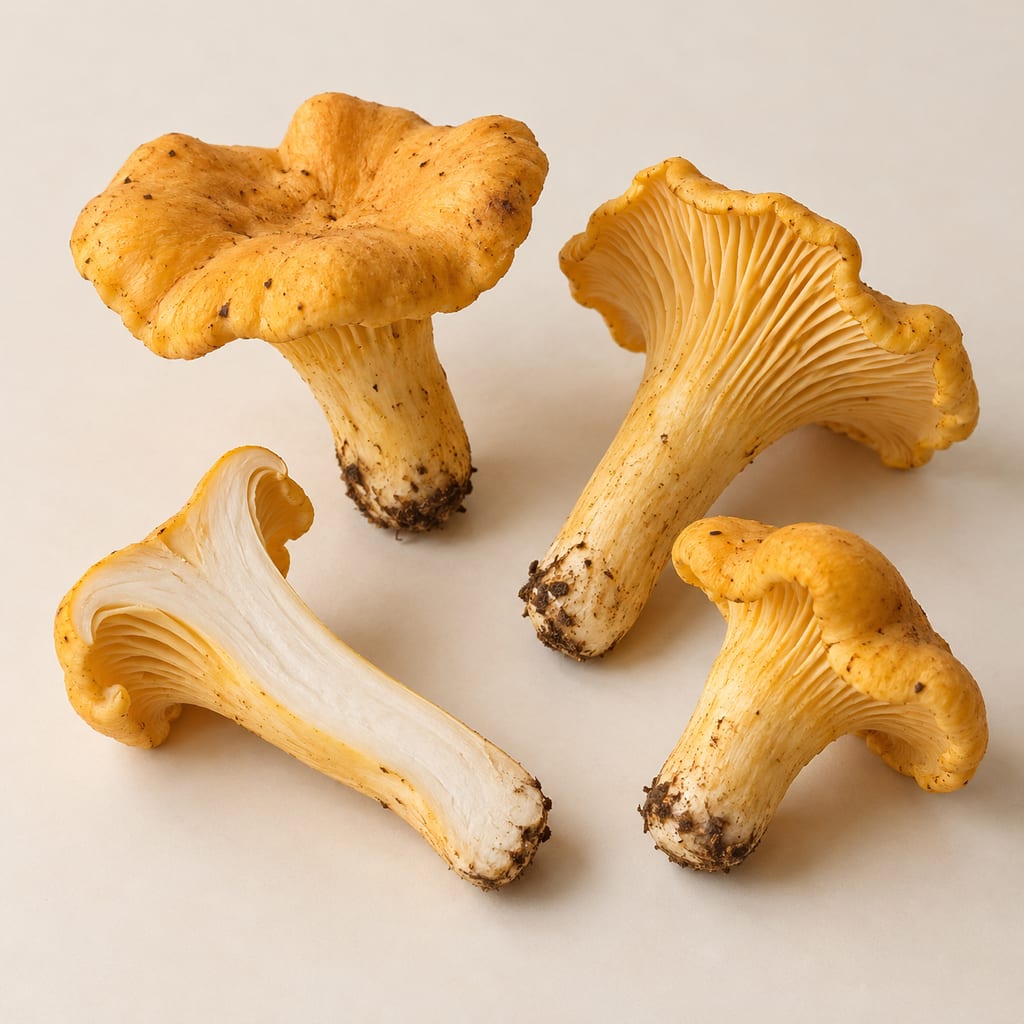
The chanterelle, Cantharellus cibarius, is a wild golden-orange mushroom of European woodland. Its ridged, gill-less underside, fruiting on the ground under trees, separates it from the poisonous jack-o'-lantern, which grows on wood.
Overview
The chanterelle is a mushroom of deciduous and coniferous forest in Europe. It is one of the best-known wild edible fungi of the continent. Its flavour and firm flesh make it a standard item in wild-mushroom cooking, and it is sold fresh and processed.
Cantharellus cibarius fruits in the ground, not on wood. Its orange to yellow cap is convex and later flattens or funnels, often with wavy edges. The flesh is white. Many local records of golden chanterelles outside Europe belong to other species in the same group.
Identification
The underside has no true gills. It carries forked, cross-veined ridges that run down the stalk. The stalk is orange to yellowish and smooth. The spore print is pinkish yellow. Some sources say the fruit smells of apricots.
Missouri's extension guide describes the golden chanterelle as a choice edible mushroom and says to be sure of the identification and to try only a small amount first. This page records that advice and does not add a field verdict.
Lookalikes
The jack-o'-lantern, Omphalotus illudens, is poisonous. It grows in clusters on stumps or buried wood, has close, sharp-edged gills and fruits in autumn. Chanterelle-like fungi on wood must be ruled out.
The false chanterelle, Hygrophoropsis aurantiaca, has thin, frequent gills and a reddish hue. The hedgehog, Hydnum repandum, has a toothed underside. The smooth chanterelle, Cantharellus lateritius, is smooth underneath and grows under oaks; it is also edible.
Habitat and season
In Missouri's guide the golden chanterelle grows singly or in groups in moss, leaves and grass, on paths and under oaks, and often returns to the same spots for years. In Europe it appears from June to December, typically from late summer to late autumn for harvest.
The chanterelle is mycorrhizal with trees. Most golden chanterelles in conifer stands are associated with conifers, while some grow near oaks and hardwoods.
Use and preservation
The supplied regional catalogue records the chanterelle in Europe for fresh cooking, pickling and processed products. Missouri's guide suggests sautéing in butter with a little onion.
Freezing or drying preserves it. Oven drying is discouraged because it can make the mushroom bitter. Watery specimens rot more easily.
Taxonomy and names
Cantharellus cibarius Fr. (1821) is in the family Cantharellaceae. Common names include golden chanterelle and girolle. The name has been narrowed: C. cibarius sensu stricto is restricted to Europe, and related species include C. formosus, C. cascadensis, C. californicus and C. anzutake from Japan and Korea.
Safety
Reference and research information only. Fermenta cannot identify your gathered specimen or guarantee it is edible. Have any wild mushroom competently identified by a qualified local expert before eating it. The jack-o'-lantern is a poisonous lookalike and must be excluded in the field.
Places
Europe
Documented use · Region evidenceStrict C. cibarius is restricted to Europe, from Scandinavia to the Mediterranean; the wider usage of the name covers related species.
Community
No community contributions have been published for this entry yet.
Share what you made
Sign in to contribute. Published comments and photos are free to read.
Sources
Missouri Department of ConservationEdibility · Identification · Lookalikes · Cooking
Golden Chanterelle (Girolle)Choice edible mushroom with caution; verify ID
Season late June to early August
Forked cross-veined ridges, not gills
Jack-o'-lantern lookalike
Sauté in butter; freeze
WikipediaTaxonomy · Distribution
Cantharellus cibariusFries 1821 and type species of Cantharellus
Strict C. cibarius restricted to Europe; related species
Distribution Scandinavia to Mediterranean; June to December
Drying and oven-drying advice
Omphalotus and Hygrophoropsis lookalikes
mushroom-appreciation.comLookalikes
ChanterellesForagers advise verifying identity with an experienced forager (search snippet only)