
Other
Charcoal burner
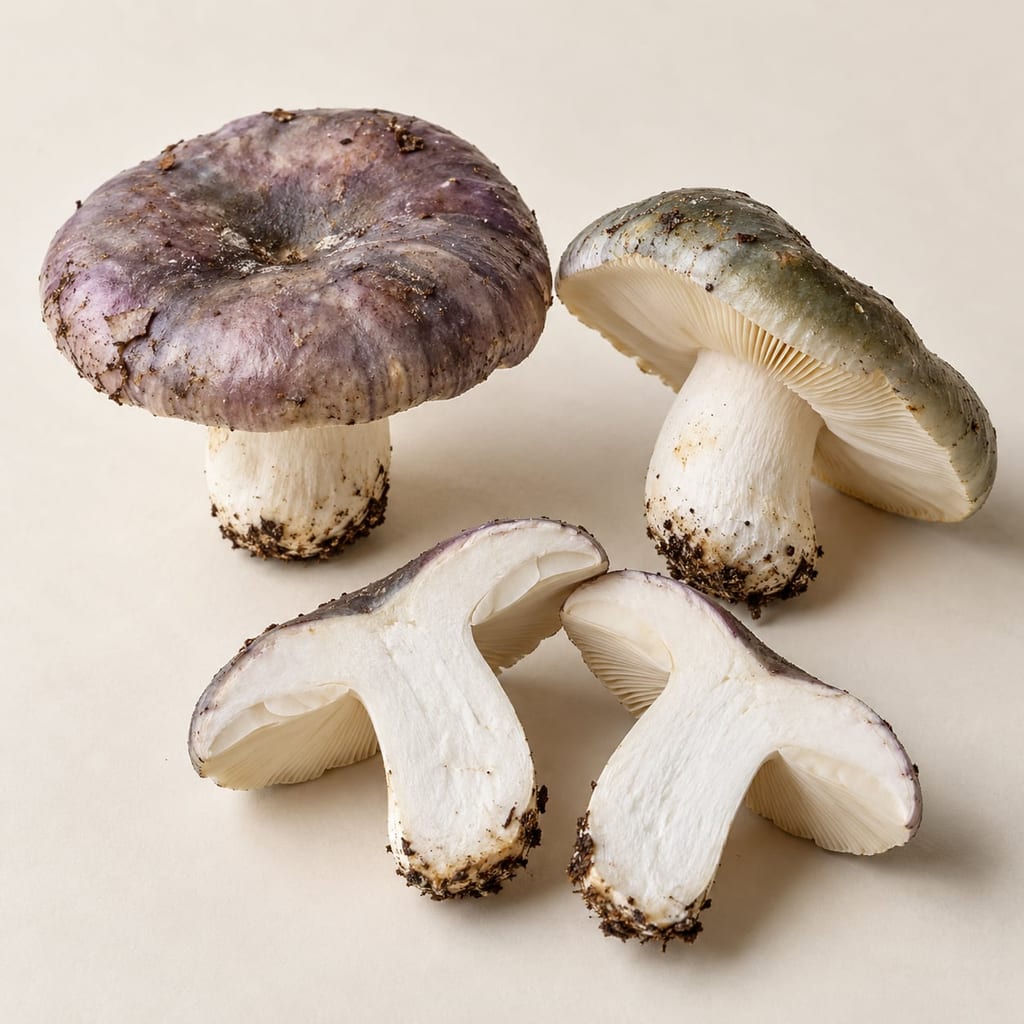
The charcoal burner, Russula cyanoxantha, is a wild brittlegill of European beech and mixed woods, eaten cooked; its greenish-to-brown colour is too variable to identify it by colour alone.
What it is
Russula cyanoxantha is a brittlegill, a wild mushroom of the genus Russula, which forms mycorrhizal partnerships with trees. Its accepted name is Russula cyanoxantha (Schaeff.) Fr., and the species has sixteen synonyms in the Wikipedia treatment, among them Agaricus cyanoxanthus and Russula variata. In English it is most often called the charcoal burner, and it is also known as the variegated russula.
The cap is 4 to 18 centimetres across, convex at first and later flattened. Its colour runs from greenish to bright brown and varies a great deal, which is why the species is so easily misjudged on colour alone.
Sources for this section
Habitat and distribution
The charcoal burner is found mostly in Europe, most commonly in beech forests and in other deciduous or mixed woods. The reference treatment notes that North American specimens may not be the true European species, and it reports North American records between July and October in the east and October to January further west.
The catalogue records the species as wild, with no cultivation, and lists it as a popular cooked brittlegill in Europe.
Culinary use
The charcoal burner is treated as an edible mushroom, and the Wikipedia treatment, citing Phillips (2010), rates it as choice. Its flesh is softer than that of many other edible russulas, with a mild, nutty taste. It suits many preparations, and the reference notes that the caps are often infested with maggots, which should be checked before cooking.
The sources reviewed do not give a single recipe or a preservation method for this species, so this page gives none.
Sources for this section
Look-alikes and identification
The reference treatment names several russulas that are easily confused with the charcoal burner: Russula grisea with a bluish-grey cap and light cream gills, R. olivacea with yellow spores, R. aeruginea with greenish cap and forked gills, R. variata with frequently forked gills, and R. versicolor with yellowish, unforked gills. The catalogue warns that a simple colour-based identification is not a safe method.
This page does not give an identification key and does not decide whether a specimen is the charcoal burner.
How to recognise a brittlegill
A mushroom is a brittlegill, a Russula, only when several features line up. The cap is usually brightly coloured. The gills are brittle: they snap when you try to bend them, and the flesh breaks cleanly like chalk instead of tearing into fibres. The stem carries no ring and no cup or sack at its base, and there are no veil remnants on the cap. The gills are attached to the stem, and a spore print is white, cream or dark yellow.
Two checks separate Russula from its look-alikes. Break a gill or cut the flesh: a brittlegill gives no milky juice, while a milkcap (Lactarius or Lactifluus) weeps latex. Then look at the stem. A ring on the stem, a cup or a sack or bulb with torn remnants at its base, or flesh that tears in fibres points away from Russula and towards Amanita, a genus that includes the deadly death cap and many other poisonous species. A mushroom with a ring or a cup at the base is not a Russula, whatever colour its cap is.
Recognising the genus is much easier than naming the species. Cap colour varies widely inside one species, so experts rely on the colour of the spore print, the taste, colour changes in the flesh, how far the cap skin peels, chemical tests and the microscope. A collector who is sure of the genus but not of the species should treat the species as unidentified.
Sources for this section
The taste test, and what it cannot tell you
Foragers have long sorted brittlegills by taste. Break off a small piece of cap flesh or gill, chew it for several seconds and spit it out without swallowing; the burn of an acrid species can take half a minute to build. Brittlegills that taste mild are the traditional edibles. Those that taste hot, peppery or acrid, and many bitter ones, are left alone because they irritate the stomach and bowel and can cause vomiting and diarrhoea.
The method works only inside the genus. Use it once the mushroom is positively a Russula, never to decide whether an unknown mushroom is safe: the deadliest mushrooms do not taste unpleasant, and a mild taste says nothing about an Amanita, a Cortinarius or any other family. Within Russula it is a screen for rejecting species, not proof of safety. Some mild species are poor eating, rare species are poorly documented, and a few brittlegills have been linked with poisoning. Cook what you eat, start with a small portion, and identify to species where you can. This record is not a field guide.
Sources for this section
Regulation and sale
Spain regulates the sale of mushrooms for food under Real Decreto 30/2009 of 16 January 2009. The decree lists Russula cyanoxantha and Russula virescens among the wild species that may be sold fresh, and it lists Russula emetica among the species that may not be sold in any form. Article 3.3 bans the sale of any species recognised or suspected as toxic.
The decree governs commercial sale in Spain only. It does not establish that a wild specimen is safe for any particular person to eat, and it does not replace identification by a competent person.
Places
Europe
Documented use · Region evidenceMostly European distribution; no locality is given.
Community
No community contributions have been published for this entry yet.
Share what you made
Sign in to contribute. Published comments and photos are free to read.
Sources
WikipediaTaxonomy · Food use · Identification · Geography
Russula cyanoxanthaAccepted name and authority; sixteen synonyms; common name charcoal burner; beech and mixed woods; cap 4 to 18 cm; colour variability; edible, rated choice, citing Phillips (2010); look-alikes; maggot infestation.
Cited in: What it is; Habitat and distribution; Culinary use; Look-alikes and identification
Boletin Oficial del Estado (Spain)Regulation · Safety
Real Decreto 30/2009, de 16 de enero, por el que se establecen las condiciones sanitarias para la comercializacion de setas para uso alimentarioDecree dated 16 January 2009, published 23 January 2009; Russula cyanoxantha in Part A (wild species that may be sold fresh); Russula emetica in Part D (may not be sold); Article 3.3 bans toxic species.
Cited in: Habitat and distribution; Look-alikes and identification; Regulation and sale
WikipediaIdentification · Food use
RussulaBrittle attached gills, no latex, no ring or volva; Lactarius weeps latex; taste (mild, bitter, acrid) as a diagnostic character; acrid species are toxic and mild species such as R. cyanoxantha and R. vesca are eaten; the genus is mostly free of deadly species.
Cited in: How to recognise a brittlegill; The taste test, and what it cannot tell you