
Mushrooms
Dark cep
Dark cep, Boletus aereus, is a prized wild bolete of Mediterranean and western European oak woodland, sold fresh or dried as a porcini-type mushroom.
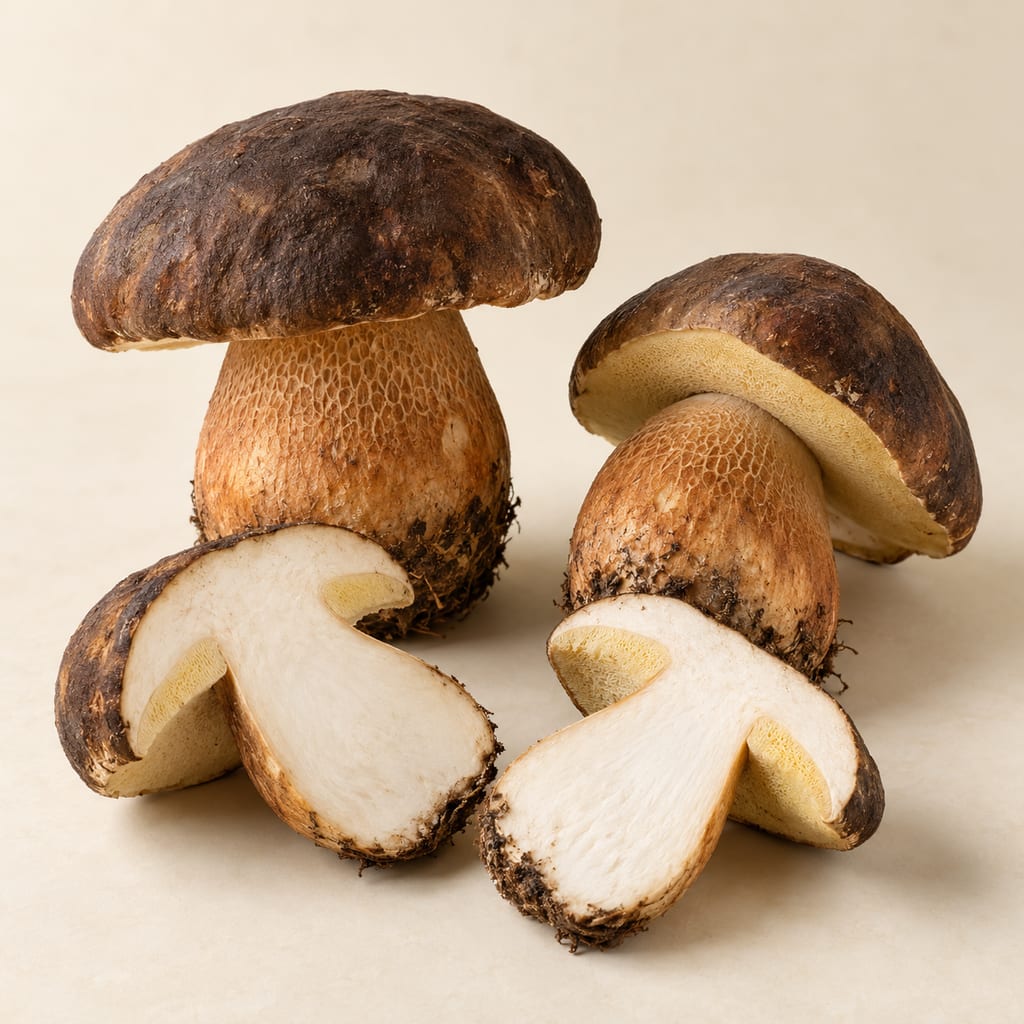
What it is
Dark cep is the common name the catalogue and field guides give to Boletus aereus, a bolete in the porcini group. It is also called bronze bolete and queen bolete. Its cap is dark and its flesh is firm, and it is described as cep-like, with a flesh firmer than that of Boletus edulis.
Several species are sold under the porcini and cep trade names, and the catalogue notes that these names cover several species. A dried or fresh porcini-type mushroom is not identified as this species unless the collection is named.
Where it grows and is eaten
The species is ectomycorrhizal and grows with broadleaf trees, especially beech and oak. One source identifies cork oak as a key host. It fruits above ground in summer and autumn, and in France one source gives a season from July to October.
It is widely eaten in Spain, France, Italy and Greece, and is generally consumed across the Mediterranean. British guides describe it as rare in Britain.
Sources for this section
Flavour and use
Sources describe the flavour differently. One describes an earthy smell and a pleasant mild taste, and another calls it strong, like a penny bun. Both agree it is a prized edible bolete, and it is eaten fresh and dried.
Sources for this section
Identification and look-alikes
Boletus edulis has a pale stem with a white reticulum. Tylopilus felleus is bitter and has pinkish pores. The bay bolete, Imleria badia, is a look-alike, but its pores do not turn blue when bruised.
Boletes are identified from several features together, so appearance alone is not enough to separate a dark cep from its look-alikes. The catalogue asks that taxonomy be checked and that porcini names are not read as one species.
Notes and gaps
The sources read for this page do not give a toxicity assessment, a preparation method or storage advice for this species. They also do not settle the flavour disagreement, and those points are left open.
Sources for this section
The European porcini compared
Boletus aereus is one of four porcini that DNA work in Europe separates clearly, with B. edulis, B. reticulatus and B. pinophilus. The forms inside the penny bun group, including a birch form, B. betulicola, and a pine-heath species, B. pinetorum, which Finnish authors keep apart, are not separated by DNA. Fechtner's bolete, once listed with the porcini, was moved to Butyriboletus after molecular data placed it far from the penny bun.
In short, from the sources. B. aereus has a dark, slightly velvety bronze-brown cap that may turn greyish, violet or purple-brown with copper or olive patches, pores that start whitish and turn yellowish to greenish and may darken to wine colour when bruised, a stem white at the top and brown to reddish below with a net of similar colour, white flesh with a hazelnut-like smell, and grows under oak, beech and chestnut in hot summer spells. B. reticulatus, the closest look-alike, has a paler, often cracked cap and a paler stem with a whitish net that often reaches the base. B. edulis appears later in cooler weather, mostly under spruce, with a paler, sticky cap and a sharper white net. B. pinophilus grows under conifers, mostly Scots pine, with a reddish-brown cap.
The bitter bolete, Tylopilus felleus, is the classic confusion. Its pores are white when young and turn pink with age, and its stem carries a coarse dark brown net on a lighter ground. Its flesh is intensely bitter, cooking makes this worse, and sensitivity to the bitterness varies between people, so tasting is not a safe test. Red- and orange-pored boletes are a different hazard. Satan's bolete, Rubroboletus satanas, has yellow to orange pores that turn red and blue at a touch, a stem running from yellow to carmine at the base, and is described as moderately poisonous, especially raw. The bitter beech bolete, Caloboletus calopus, has a pink-red lower stem, pores that bruise blue and flesh that stays bitter after cooking.
This record is not a field guide. Identification has to be certain, from the whole mushroom and several features together, and checked by an experienced local identifier before anything is eaten. Smell, taste or colour change alone never establish safety.
Places
Mediterranean and western Europe
Traditional use · Region evidenceRecorded as widely eaten in Spain, France, Italy and Greece; the catalogue gives the region as Mediterranean and western Europe.
Community
No community contributions have been published for this entry yet.
Share what you made
Sign in to contribute. Published comments and photos are free to read.
Sources
Wild Food UKIdentification · Food use
Bronze bolete (Boletus aereus) guideCommon names dark cep, bronze bolete and queen bolete; cep-like edible; flavour described differently by different sources; rarer in Britain
Cited in: What it is; Where it grows and is eaten; Flavour and use; Identification and look-alikes; Notes and gaps
First NatureIdentification
Boletus aereus Bull. ex Fr. - Bronze BoleteEctomycorrhizal association with oak and other broadleaf trees; fruiting in summer and autumn
Cited in: Where it grows and is eaten
Boletin Oficial del EstadoReference
Supplied catalogue source for Boletus aereus (Spanish regulatory record)Catalogue source for the food-market record; the catalogue notes porcini trade names cover several species
Cited in: What it is; Identification and look-alikes
WikipediaIdentification
Boletus aereusCap, pores, stem, flesh smell, hosts and season of B. aereus; how it differs from B. reticulatus, B. edulis and B. pinophilus
Cited in: The European porcini compared
Karstenia 49, Finnish Mycological SocietyTaxonomy · Identification
A new boletoid fungus, Boletus pinetorum, in the Boletus section Boletus from FennoscandiaFour European lineages separated by DNA; taxa inside the B. edulis group not separated; Finnish descriptions of B. edulis, B. pinophilus, B. reticulatus, B. betulicola and B. pinetorum
Cited in: The European porcini compared
WikipediaIdentification
Boletus reticulatusCap, stem, hosts and season of B. reticulatus
Cited in: The European porcini compared
WikipediaIdentification
Boletus pinophilusCap skin, stem network and hosts of B. pinophilus
Cited in: The European porcini compared
WikipediaTaxonomy
Butyriboletus fechtneri (Boletus fechtneri)Fechtner's bolete moved from Boletus to Butyriboletus after molecular data placed it in the Regius clade, distant from the B. edulis core clade
Cited in: The European porcini compared
WikipediaIdentification · Safety
Tylopilus felleusPores white then pink; coarse dark net on lighter stem; intensely bitter flesh, worse on cooking; sensitivity to the bitterness varies between people
Cited in: The European porcini compared
WikipediaIdentification · Safety
Rubroboletus satanasSatan's bolete: pore, stem and flesh colours, bluing, moderate poisoning with gastrointestinal symptoms
Cited in: The European porcini compared
WikipediaIdentification · Safety
Caloboletus calopusBitter bolete: pink-red lower stem, pores that bruise blue, intensely bitter flesh not removed by cooking; red stem distinguishes it from B. edulis
Cited in: The European porcini compared