
Substrates
Fish trim
Fish trim is a variable food-processing material, from fillet offcuts to recovered flesh. Species, source tissues, bone and skin content, and handling history determine what a particular lot contains.
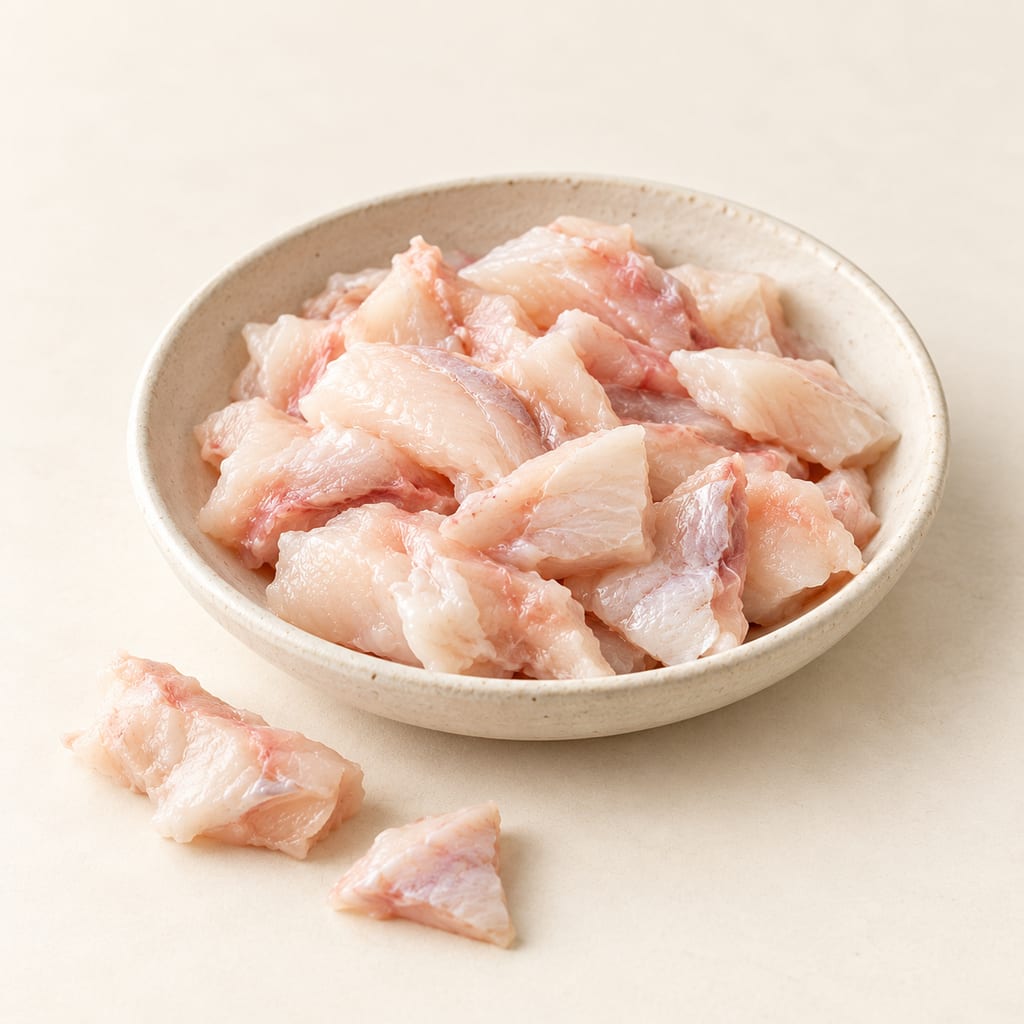
An offcut needs a description
Fish trim is material left when fish is cut and shaped for another product. It can include edible fillet offcuts, but the name does not define one species, anatomical cut or composition. A piece removed from a fillet edge is different from flesh recovered from a backbone. Skin, bone, connective tissue and fat depend on what the processor includes.
The linked koji-garum record names fish trim without identifying its species or cut. The underlying source offers meat or fish trim among several possible protein materials. It does not establish whether the fish material is loose flesh, minced, skin-on, bony or a mixture. A precise picture of one kind of trim would therefore be an example, not an identification of that recipe's ingredient.
By-product is a broader term. In fish-processing literature it can cover heads, viscera, skins, bones, fins and other materials alongside trimmings. That list should not become the assumed contents of a bag labelled fish trim. Edible flesh recovered during food processing also differs from material that has entered a feed or disposal stream.
Recovering value after the fillet
A fillet leaves other parts of the fish behind. The value recovered from those parts depends on the market, the processing plant and the route to the consumer. Alberto Ramírez's 2007 FAO report on salmon by-products describes how distance and transport costs influence where fish is cut and what remains at the processing site. The geography of an offcut is therefore partly a geography of trade and logistics.
The report stresses a practical division: material intended for food needs to continue through a food-quality handling system. Once it follows a downgraded route, its possible uses change. Protein and fat may still be present, but chemical composition alone does not make every processing remainder suitable for human consumption.
FAO's 2022 fisheries report places this in a wider industry. By-products can become direct food products, fishmeal, fish oil or other ingredients. Historically, some were discarded or diverted into feed manufacture. Better collection and processing can recover more value, but the report also identifies rapid deterioration and logistical difficulties. Describing a use as waste reduction does not remove the need to know what the raw material is.
Sources for this section
Offcuts and mechanically recovered mince
Fillet trimming and mechanical flesh recovery produce different forms. A bone separator can recover flesh remaining on frames or other suitable raw material. In the FAO description, fish passes between a moving belt and a perforated drum. Flesh is pressed through the holes, while much of the skin and bone remains outside. The result is a coarse mince rather than an intact fillet edge.
The machine's settings change the product. More pressure can increase recovery while also increasing fragmentation and the amount of unwanted skin or bone material passing through. Mechanical separation therefore does not guarantee a bone-free ingredient. It is a controlled processing operation with a yield-and-quality trade-off.
Mincing also disrupts tissue and changes texture, appearance and keeping quality. The FAO note describes uses in fish cakes, portions and other formed products. Those examples show why recovered flesh can remain useful food material. They do not make mince interchangeable with every loose offcut, or turn old raw material into fresh material by changing its shape.
Sources for this section
Why species and body part matter
Fish composition varies with species, individual condition, season and feeding history. Fat is particularly variable, and its distribution within the body is uneven. A lean whitefish fillet and a fatty belly portion should not be treated as one material simply because both could enter a trim stream. Without a species and cut description, the name supplies no reliable fat or moisture percentage.
Fish muscle contains contractile proteins and a surrounding connective structure. Actin and myosin help produce movement in the living animal; collagen contributes to connective tissue. Their organisation matters after harvest because it helps determine how flesh holds together. A recipe's weight of trim does not describe the balance between muscle, connective tissue, skin and bone.
A comparison of farmed Atlantic salmon and cod makes this specific. The researchers found different tissue environments around their pin bones. Salmon pin bones were associated with muscle and fat, while cod attachments were associated with muscle and connective tissue. These are findings for the two studied species. They explain why a general instruction to remove bones cannot assume identical tissue behaviour in every fish.
The tissue around a pin bone
A pin bone is held by more than a simple string of collagen. The attachment contains an extracellular matrix, a network outside the cells that gives tissue structure. In the salmon-and-cod study, its components included collagen, elastin and proteins carrying carbohydrate chains. The arrangement of those materials helped explain differences in the strength and breakdown of the attachments.
The researchers examined freshly obtained material and material stored on ice, using microscopy and molecular analyses. Changes occurred close to the bones rather than uniformly throughout the surrounding flesh. Different attachment structures meant that loosening and removal needed to be understood by species. The study did not propose one waiting period that would make all fish easy to debone.
Enzymes participate in the turnover and breakdown of this matrix. Proteases cut proteins, but their access to the tissue and the organisation of the protein network affect the result. The study discusses collagen-associated molecules that can help organise or protect fibres, as well as differences between cod and salmon. Protein quantity alone consequently cannot explain how readily a piece of connective tissue will break down.
These findings are useful when thinking about a mixed trim supply. Two lots containing similar-looking flesh can have different amounts and kinds of connective material. They are less useful as a prediction of a sauce's processing time. The study examined pin-bone attachments during storage, not unknown fish trim in a salted koji mixture.
Changes after harvest are not all fermentation
Fish tissue continues to change after the animal dies. Endogenous enzymes, meaning enzymes already present in the tissue, can contribute to protein breakdown and softening. A review of post-mortem muscle degradation explains how this process depends on the surrounding conditions. It is distinct from growth of an added fermentation culture.
That distinction prevents two errors. Softening does not prove that a desired fermentation has started, and an enzyme acting in fish tissue is not automatically an enzyme supplied by koji. Microbial growth, native enzyme activity and physical disruption during cutting or mincing can occur alongside one another while causing different changes.
The useful question is which material and mechanism a source actually examined. A storage study of a named species can explain one route to texture change. It cannot establish the organisms, enzyme activities or safety outcome of an unspecified garum batch. The absence of a visible change is equally unable to demonstrate that hazards are controlled.
Sources for this section
Fish protein and added koji enzymes
In the linked preparation, fish trim supplies protein material while rice koji supplies an additional enzyme source. Proteases can cut large proteins into smaller peptides, and further enzymatic action can release free amino acids. This helps explain the intended transformation towards a liquid seasoning. It is a different role from merely chopping the fish into smaller pieces.
Different proteases do different jobs. Endoproteases cut bonds within protein chains, producing shorter fragments, while exoproteases act at chain ends and can release smaller units. Their combined action helps explain why protein breakdown is a sequence of changes rather than a single step. The mixture can contain remaining proteins, peptides of different sizes and free amino acids at the same time. Measuring one of those groups would not describe the whole mixture, and observing a thinner slurry would not reveal every reaction that had occurred.
Research on koji and moromi provides evidence for protease activity and the production of peptides and free amino acids in a soy-and-wheat system. That is useful general enzyme science, with a clear boundary: the amounts and outcomes measured in that system do not describe fish trim. Species, tissues, salt, water and processing conditions all belong to the actual preparation being assessed.
The Modernist source presents its method as a warm, enzyme-assisted garum. Its own discussion does not make an unvalidated warm-hold process safe for every animal-protein material. Liquefaction and savoury flavour describe changes in the food; they are not evidence that the process has controlled botulism or other hazards. Those questions require support for the particular method and raw material.
Keeping food material in the food chain
Fish handling begins before an offcut reaches the kitchen. Time, temperature, clean equipment and the separation of suitable food material from waste all affect its condition. Codex guidance emphasises prompt chilling and monitoring during processing. A cold delivery at the end cannot by itself reconstruct the material's earlier handling history.
Trimming and inspection have their own purposes. Removing unwanted tissue and checking for bones or parasites are separate from microbial controls. Codex addresses filleting, skinning, trimming and candling as processing operations, with hazards depending on the product and species. None should be assumed complete merely because the material has been sold under a convenient trim label.
A useful specification therefore records species, source cut, whether skin and bones remain, whether the material is minced, and its fresh or frozen history. The linked recipe provides none of those details. There is no supported universal storage duration for that unknown mixture, and a familiar fish smell cannot establish its safety.
Histamine and microbial hazards need different explanations
In susceptible fish, handling failures can lead to histamine formation. FDA names tuna and mahi-mahi as examples and explains that enzymes produced by bacteria act after the fish dies. Once formed, histamine is not removed by washing, freezing or heating. This is why later processing cannot be assumed to repair earlier temperature abuse.
The hazard is species-related. With the trim's species unknown, it is not possible to assign the same histamine susceptibility to every possible lot or to dismiss the issue. Species identification and handling information support a hazard assessment; the generic word fish does not resolve it.
Microbial hazards are a separate matter. Food Standards Scotland's smoked-fish guidance identifies Clostridium botulinum, which can grow without oxygen, as a concern in raw and fermented fish, alongside other relevant pathogens. That guidance is not a validation of the linked garum. It explains why absence of obvious spoilage, a closed container or a desired aroma cannot substitute for supported process controls.
Fish identity remains important at the table
Fish is a food allergen, and an irregular cut or a liquid seasoning still needs an accurate ingredient description. FDA identifies fish among the major food allergens in the United States. A broad trim label should not obscure the species information needed to understand the actual material or the food made from it.
Fish-processing by-products can enter many foods, from cakes and soups to sauces and other prepared products. The appropriate use depends on the material and how it has been handled. Recovering an edible offcut can make good use of a fish, but it does not make heads, guts, frames, mince and clean fillet trimmings interchangeable. The ingredient's value lies in a known, suitable food material, not simply in using whatever remains.
Sources for this section
Allergens
Fish; species unspecified.
Places
Unknown
Documented preparation · Place not establishedThe linked garum source does not identify the fish species, catch/farm origin, processing place or trim composition. Named research examples do not supply that identity.
Community
No community contributions have been published for this entry yet.
Share what you made
Sign in to contribute. Published comments and photos are free to read.
Sources
Modernist Food | FermentedIdentity · Processing
Quick Garum (Koji-Driven)The garum source lists meat or fish trim as a possible protein material with rice koji. Fish species, cut and handling condition are unspecified; liquefaction is not safety validation.
Cited in: An offcut needs a description; Fish protein and added koji enzymes
FAO/WHO Codex Alimentarius CommissionIdentity · Processing
Code of Practice for Fish and Fishery Products, second editionSection 4.1 addresses time and temperature, while§8.1.6 covers filleting, skinning, trimming and candling. These processing controls are not a home garum method.
Cited in: An offcut needs a description; Keeping food material in the food chain
FAO Fisheries Circular1027Identity · Processing
Salmon by-product proteinsThe report distinguishes by-product tissues, food-quality handling and transport logistics in the 2007 salmon industry. It does not describe a current unknown trim lot.
Cited in: An offcut needs a description; Recovering value after the fillet
FAO, The State of World Fisheries and Aquaculture2022Identity · Processing
Utilization and processing of fisheries and aquaculture productionBy-product utilisation sections distinguish food products, fishmeal, oil and other uses, with historical disposal and handling constraints.
Cited in: Recovering value after the fillet; Keeping food material in the food chain; Fish identity remains important at the table
FAO, Torry Advisory NoteIdentity · Processing
Minced FishThe note explains mechanical flesh recovery, separator settings, fragments, tissue disruption, quality and uses. Mechanical recovery does not guarantee bone-free material.
Cited in: Offcuts and mechanically recovered mince
FAO Fisheries Technical Paper348Identity · Processing
Quality and quality changes in fresh fish:4.Chemical CompositionSections 4.1–4.3 describe species, season and feeding effects, fat distribution and protein distinctions. No single composition applies to unspecified trim.
Cited in: Why species and body part matter
Fish Physiology and BiochemistryIdentity · Processing
The role of extracellular matrix components in pin bone attachments during storage—a comparison between farmed Atlantic salmon (Salmo salar) and cod (Gadus morhua L.)The study compares salmon and cod pin-bone attachments and their extracellular tissues during ice storage. Species-specific results do not predict garum processing.
Cited in: Why species and body part matter; The tissue around a pin bone; Changes after harvest are not all fermentation
Food Science and Biotechnology32(8):1005–1018Identity · Processing
Degradation and evaluation of myofibril proteins induced by endogenous protease in aquatic products during storage:a reviewThe abstract describes endogenous protease contributions to post-mortem fish-muscle softening and condition-dependent changes.
Cited in: Changes after harvest are not all fermentation
Journal of Food Science and Technology56:2888–2898Identity · Processing
Desired soy sauce characteristics and autolysis of Aspergillus oryzae induced by low temperature conditions during initial moromi fermentationEnzyme-function passages explain endo- and exoproteases and peptide/amino-acid formation in soy-and-wheat moromi. They supply general enzyme science rather than a fish endpoint.
Cited in: Fish protein and added koji enzymes
U.S. Food and Drug AdministrationIdentity · Processing
FDA Issues Final Compliance Policy Guide for Scombrotoxin (Histamine)-forming Fish and Fishery ProductsThe guidance identifies susceptible fish and bacterial-enzyme histamine formation; washing, freezing or heating does not remove histamine once formed.
Cited in: Histamine and microbial hazards need different explanations
Food Standards ScotlandIdentity · Processing
Microbiological hazards in fishSmoked-fish business guidance describes anaerobic Clostridium botulinum and other microbial hazards relevant to fish, including raw and fermented forms. It does not validate garum.
Cited in: Histamine and microbial hazards need different explanations
U.S. Food and Drug AdministrationIdentity · Processing
Food AllergiesThe guidance identifies fish among major U.S. food allergens. A liquid seasoning or hydrolysed form still needs accurate ingredient information.
Cited in: Fish identity remains important at the table