
Mushrooms
Macrocybe lobayensis
Macrocybe lobayensis is a large, floury-tasting wild mushroom of West African savanna and crop land, described by the EFTA species account as very common and highly valued there.
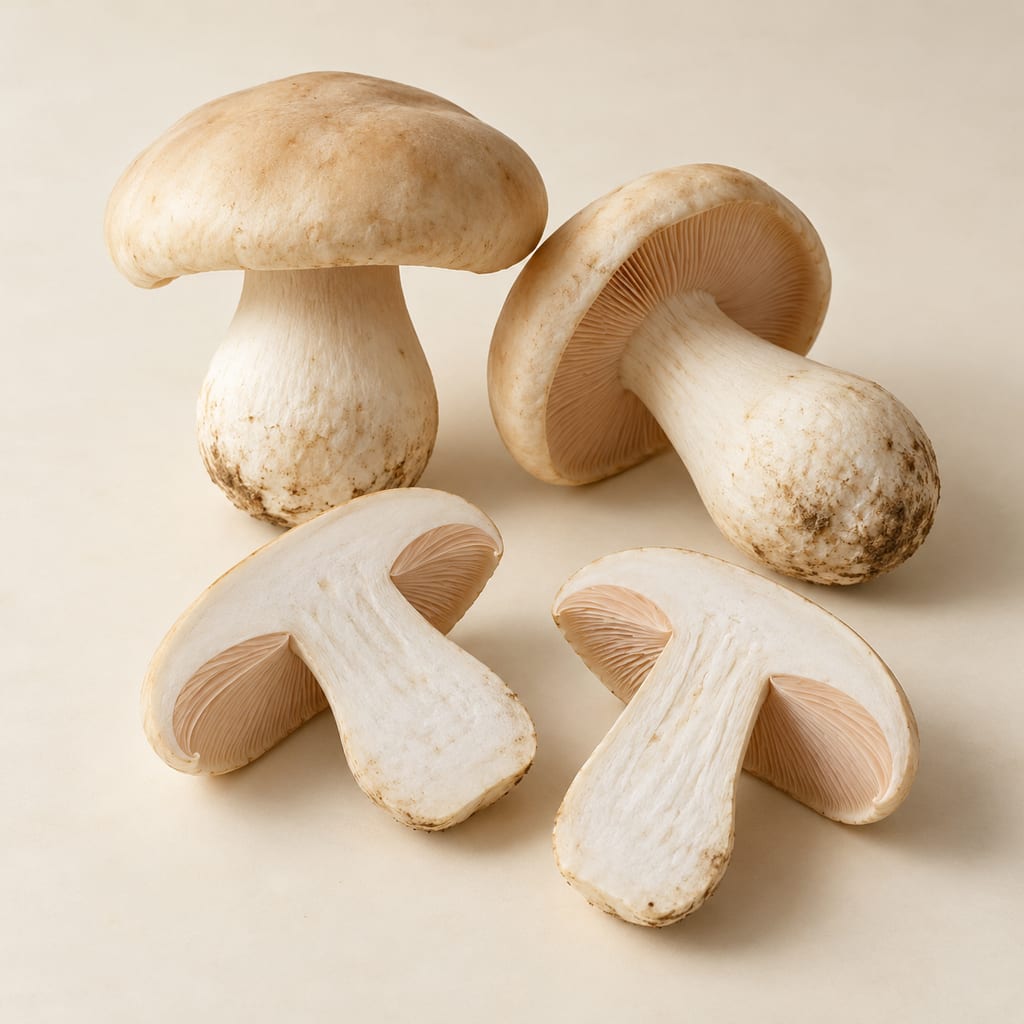
A floury mushroom of the African savanna
Macrocybe lobayensis has a thick, white, unchanging flesh, a weak odour and a floury taste. The EFTA species account says it is easily recognisable by its swollen base and floury taste. It grows on the ground as a saprotroph, which means it feeds on dead organic matter. The species is recorded in open forest, secondary forest, savanna and plantations, and it is often associated with crop residues.
The account calls it very common and highly valued in West African savannas, and it is described there as highly valued as food.
Sources for this section
Name and classification
Heim described the species in 1970 as Tricholoma lobayense. Pegler and Lodge transferred it to the genus Macrocybe in Mycologia in 1998, and the EFTA account gives the name as Macrocybe lobayensis, with the authority (R. Heim) Pegler & Lodge. The EFTA species account gives no common name, so the name giant African mushroom in the catalogue is not confirmed by that source and this page uses the scientific name as its title.
The catalogue lists the species under the synonyms Tricholoma lobayense and Tricholoma lobayensis. Those names are kept as aliases on the item.
Sources for this section
Where it grows
The EFTA account lists the species from South Africa, Benin, Burkina Faso, the Democratic Republic of the Congo, Côte d'Ivoire, Ghana, Niger, Nigeria, Senegal and Togo. It is found on the ground in open forest, secondary forest, savanna and plantations. The account links it with crop waste, which places it on farmland as well as in wild woodland and grassland.
Sources for this section
Eating and preparation
The EFTA account describes the species as highly valued as food, but it gives no preparation method, no cooking method and no market information. The sources read do not record how it is cooked, stored or sold in West Africa.
The flavour is described as floury and the odour as weak. Those are descriptive traits, and they do not show that the mushroom is safe to eat in any given state. The account gives no safety warning, and this page does not add one from outside sources.
Sources for this section
Open questions
The sources read give no food tradition for individual countries, no preparation method, no lookalike species and no safety review. A search found a 2024 review of Macrocybe that reports cultivation methods for several species, including M. lobayensis; the review was not opened for this page, and cultivation is therefore not described here.
The next research question is what West African cooking traditions use this mushroom, under which local names, and whether any specialist has reviewed its identification and handling.
Sources for this section
Places
West Africa
Documented use · Region evidenceRegion-level. The EFTA page calls the species very common and highly valued in West African savannas. It does not name a food tradition for any single country.
Central and southern Africa
Documented use · Region evidenceRegion-level occurrence. The EFTA page lists these countries as part of the range; it does not record food use in them.
Community
No community contributions have been published for this entry yet.
Share what you made
Sign in to contribute. Published comments and photos are free to read.
Sources
EFTA (Edible Fungi of Tropical Africa)Identity · History · Method
Macrocybe lobayensisPegler and Lodge, Mycologia 90(3): 498 (1998); Tricholoma lobayense R. Heim, Revue Mycologique 34(4): 346 (1970 [1969]).
Distribution: South Africa, Benin, Burkina Faso, DR Congo, Cote d'Ivoire, Ghana, Niger, Nigeria, Senegal, Togo.
Saprotrophic in open forest, secondary forest, savanna, plantations; often associated with crop wastes.
Very common and highly valued in West African savannas; floury taste, weak odour; swollen base.
Cited in: A floury mushroom of the African savanna; Name and classification; Where it grows; Eating and preparation; Open questions