
Cultures
Ginger bug
Ginger bug is a liquid starter of ginger and sugar kept going by feeding and used to start ginger beer and other drinks; the name does not fix one microbial community.
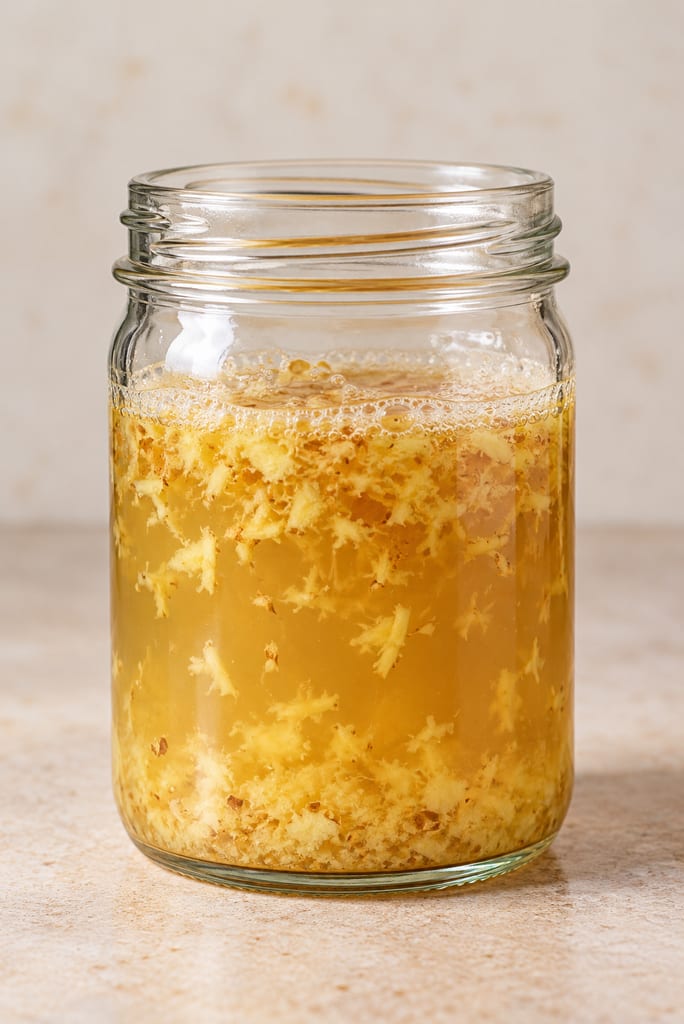
A liquid starter, not one culture
A ginger bug is a jar of water, ginger and sugar left to ferment and then fed and reused as a starter for drinks. People use the name for a liquid they keep going by back-slopping, which means carrying a part of one batch into the next. The name does not identify a fixed microbial community or lineage, and two jars with the same name can hold different organisms.
Two other things are easy to confuse with it. The ginger beer plant is a retained culture, a mixed community of lactobacilli and yeasts that Science in School likens to kefir and traces to a 1892 description by H. M. Ward; the only safe commercial source the article names in Europe is the German DSMZ collection, which sells it as strain DSMZ No. 2484. The other is a ginger drink made directly with baker's or ale yeast, with no bug at all. That article gives a one-litre recipe of this kind, with 150 g ginger, a lemon, 140 g sugar, cream of tartar and 4 g dried yeast, and the drink name ginger beer alone does not show which route was used.
What the studies describe
A 2024 Food Chemistry paper on ginger beer made by back-slopping treats the activation of the ginger bug as a stage of its own, before the later fermentation of the drink, and follows the volatile compounds, microbial communities, metabolites and sensory character across both. A separate 2024 study of home-brewed ginger beer compares two recipes with culture-dependent and culture-independent methods and reports differences in alcohol and in microbial results between them.
Only abstracts of these two papers were read here. They show that recipe and stage change what is in the jar. They do not give a universal list of species, an endpoint for activation, or any safety conclusion, and neither describes every ginger bug.
Household methods
An LCBO recipe and a German kefir-drink seller's guide each describe a liquid ginger starter and a later ginger-beer batch as separate stages, and the seller also describes reusing the liquid. These pages give their own instructions. They do not share a lineage, a standard feeding schedule or any independent validation, and this page does not reproduce their directions.
Sources for this section
Handling and limits
Ginger drinks that are fermenting in a closed bottle make gas. The Science in School article, which describes a baker's-yeast ginger beer and not a bug, tells readers to use plastic PET bottles and never glass, to refrigerate the finished drink and to drink it within six days. It reports that the British Excise Regulations of 1855 limited ginger beer to 2 per cent alcohol and that most was far weaker.
None of the sources reviewed sets general limits for activating a bug, for the alcohol it can lead to, for pressure, for storage or for recovery after a failed jar. Bubbles, smell, taste and appearance do not show that a ferment is safe.
Sources for this section
History and place
Science in School dates ginger beer itself to England in the mid-1700s, when strong earthenware bottles with a Bristol glaze let it travel, and says more than 3,000 producers were making it in the United Kingdom in 1935. That history concerns the drink and the plant. No dated source reviewed describes ginger bug by name, so its origin, region and season stay open.
Sources for this section
Places
Unknown
Relationship not established · Place not establishedNo reviewed source ties ginger bug as a named starter to a place; the dated history found concerns English ginger beer.
Community
No community contributions have been published for this entry yet.
Share what you made
Sign in to contribute. Published comments and photos are free to read.
Sources
Science in School / European Molecular Biology LaboratoryHistory · Method · Safety
Ginger beer: a traditional fermented low-alcohol drinkGinger beer plant as a mixed lactobacilli and yeast culture first described in 1892; DSMZ strain 2484
Baker's-yeast ginger beer recipe, PET bottles, refrigerate and drink within six days
1855 excise limit of 2 per cent alcohol; English origin in the mid-1700s
Cited in: A liquid starter, not one culture; Handling and limits; History and place
Food Chemistry / ElsevierMicrobiology
Ginger beer derived from back-slopping: Volatile compounds, microbial communities on activation and fermentation, metabolites and sensory characteristicsActivation of the ginger bug treated as its own stage before ginger beer fermentation; abstract-level reading
Cited in: A liquid starter, not one culture; What the studies describe
Journal of Food Hygiene and Safety / Korean Society of Food Hygiene and SafetyMicrobiology
Microbial Characterization of Home-Brewed Ginger Beer Using Culture-Dependent and Independent MethodsTwo home-brew recipes compared, with differences in alcohol and microbial results; abstract-level reading
Cited in: What the studies describe
LCBO Food & DrinkMethod
Fermented Ginger BeerA liquid starter and a later ginger-beer batch as separate stages
Cited in: Household methods
Natural-Kefir-DrinksMethod
Ginger Bug selbst machen – ein einfaches RezeptA seller's own ginger-bug method and reuse of the liquid
Cited in: Household methods