
Mushrooms
Golden oyster
The golden oyster, Pleurotus citrinopileatus, is a yellow oyster mushroom first described in East Asia and now widely cultivated on sawdust and corn cob substrates.
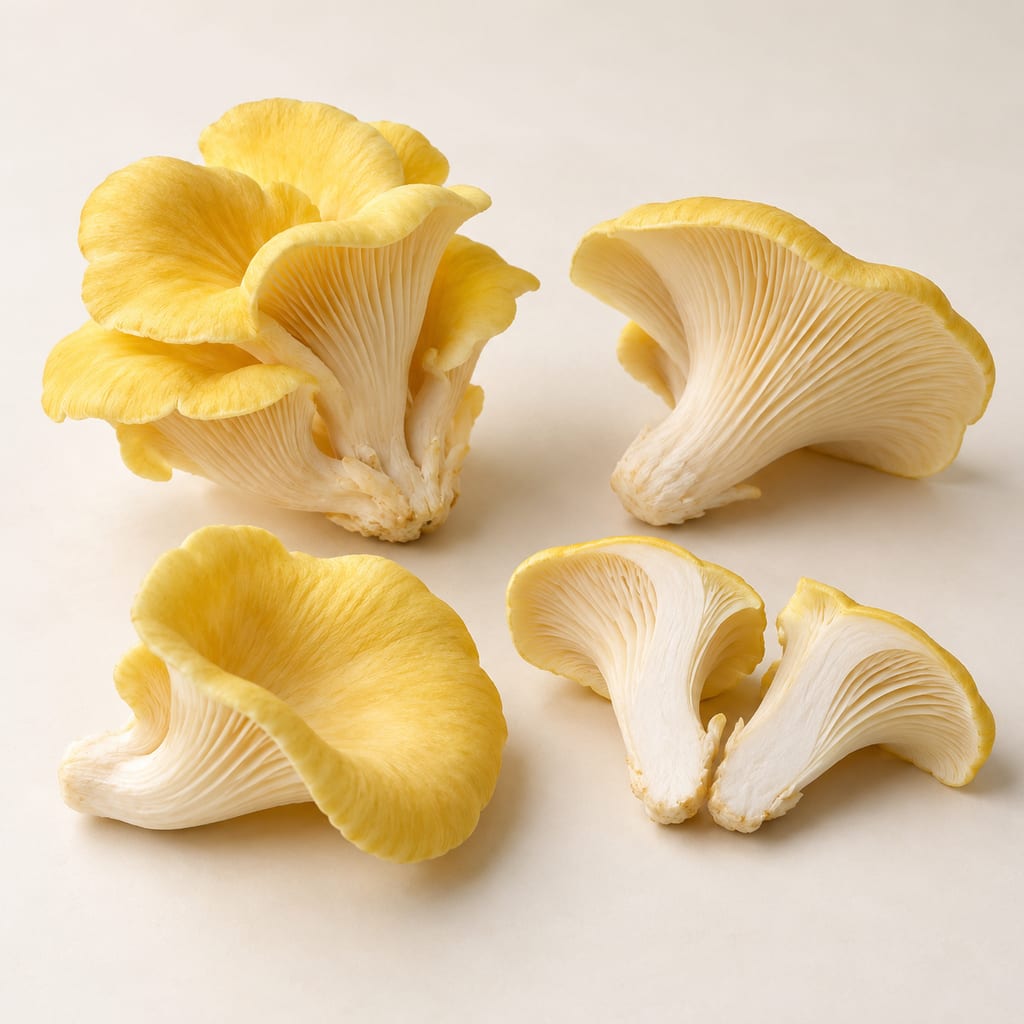
What it is
Pleurotus citrinopileatus is an oyster mushroom with yellow, clustered fruiting bodies. It is a wood-decomposing fungus. The catalogue distinguishes it from Pleurotus cornucopiae, which it is often confused with, and it is treated as a separate cultivation species.
Its natural origins are not settled. Michael Kuo's MushroomExpert entry says it was first described in eastern Asia and may originate there. Other sites give eastern Russia, northern China and Japan as its native range, but the sources read are general and commercial, not primary taxonomic studies.
Sources for this section
Cultivation and spread
The golden oyster is grown commercially mainly in India, China, Korea and Japan. A review describes it as easy to grow on substrates such as sawdust or ground corn cobs and as tolerant of high cultivation temperatures. It has been introduced to Egypt from China, and Kuo reports that it has escaped from cultivation and begun to naturalise in eastern North America.
The catalogue lists the cultivation context as widely cultivated. Establishment outside its native range is treated by the catalogue as a separate ecological question.
Food use
The catalogue records the golden oyster as a yellow clustered mushroom used cooked. The sources read describe its culinary use only in general terms. Preparation beyond cooking was not established for this species in the sources read.
Because this is a cultivated food, the main safety question is the source and handling of the crop rather than wild identification. Storage and shelf life were not established in the sources read.
Sources for this section
Places
East Asia
Historical attestation · Region evidenceNative range is not settled: sources variously point to eastern Russia, northern China and Japan, and the catalogue places the species in East Asia.
India, China, Korea and Japan
Modern adaptation · Country evidenceCommercial cultivation at scale, per a review cited by the source.
Community
No community contributions have been published for this entry yet.
Share what you made
Sign in to contribute. Published comments and photos are free to read.
Sources
MushroomExpert (Michael Kuo)Identity · Origin
Pleurotus citrinopileatusFirst described in eastern Asia; origin unclear; escaped and naturalised in eastern North America
Cited in: What it is; Cultivation and spread
World CropsCultivation
Golden oyster mushroomCommercial cultivation in India, China, Korea and Japan; grown on sawdust or corn cobs
Cited in: What it is; Cultivation and spread
Journal of Agricultural Research (Egypt)Cultivation
Cultivation possibility of golden oyster mushroom (Pleurotus citrinopileatus) under Egyptian conditionsIntroduced to Egypt from China
Cited in: Cultivation and spread
DiVA PortalCatalogue · Food
Nordic edible fungi report (supplied catalogue source)Catalogue: yellow clustered mushrooms used cooked; widely cultivated; separate from P. cornucopiae
Cited in: Food use