
Spices and aromatics
Guayusa leaves
Kew accepts Ilex guayusa. A qualitative study documents leaf-infusion and chakra accounts from a bounded group of Kichwa producers connected to Napo; its variable reports are not a standardized beverage method or measured crop guide.
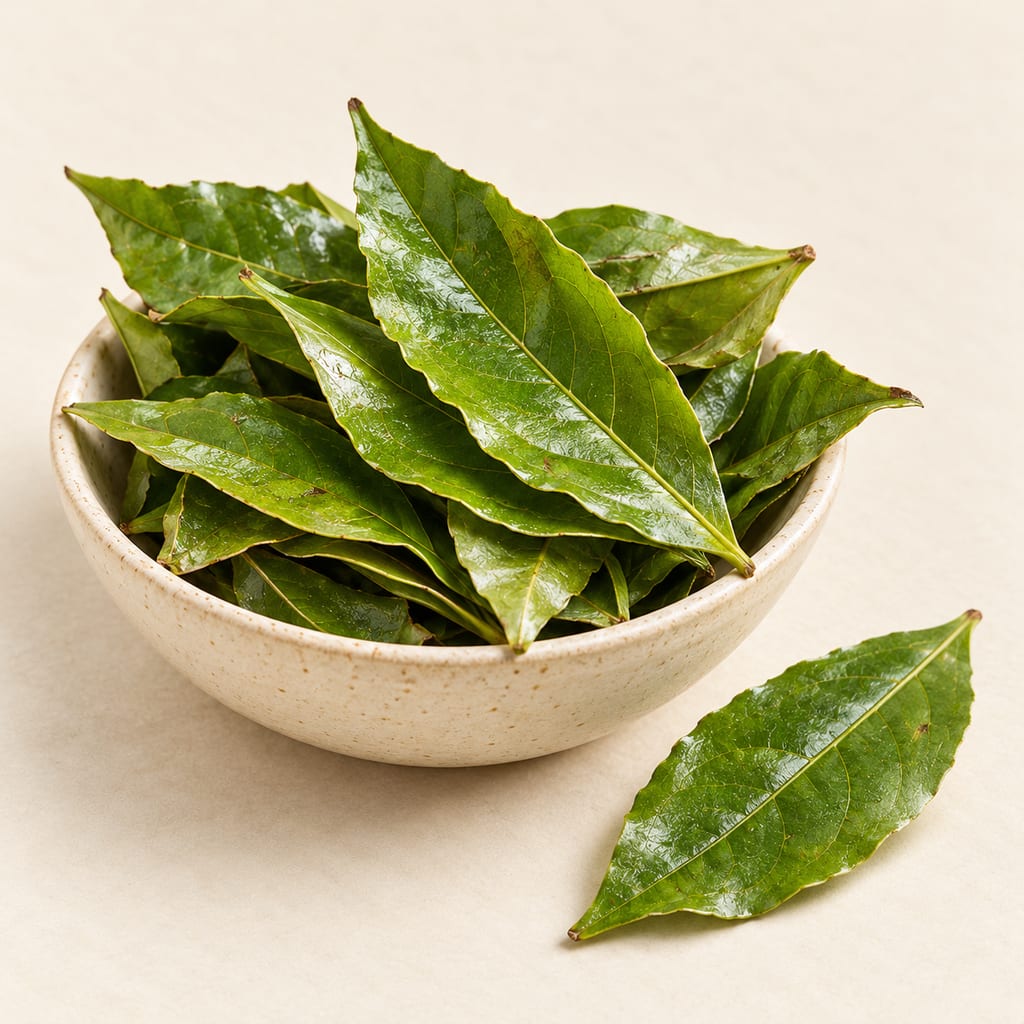
Name and scope
Kew accepts Ilex guayusa Loes. in Aquifoliaceae and lists Bolivia, Colombia, Ecuador, Peru and Venezuela in its native range. It lists Ilex utilis Moldenke as a heterotypic synonym. These names do not identify an unvouchered market or gathered plant. The PLOS study records Waisa, Waysa and Wayusa as forms used by participants; it does not provide a specimen voucher for the interview material.
A bounded Napo-linked study
The 2026 study interviewed 18 producers selected for direct guayusa-growing involvement: 11 men and 7 women. Fourteen lived in Napo; four lived in Pastaza but worked in Napo. Five field trips between September 2022 and September 2023 visited Rukullacta, La Serena, Jatun Yaku, Tamia Urku and Flor del Bosque in Napo; three interviews took place in Quito. The authors describe this as qualitative research, not a statistically representative sample.
The Napo government page describes value-chain support for the Ruku Kawsay association within the Pueblo Kichwa de Rukullakta in Archidona. It also names production communities and cantons in Napo. The page links a management plan, but that linked document was not accessible for this review, so no plan details or production figures are reported.
Reported food and social use
Participants describe guayusa leaves prepared as an infusion in family, morning, guest and ritual settings. Guayusa upina is described as a time for the family to drink, interpret dreams and plan the day. The paper records both fresh and dried leaves and tender and mature leaves; household choices and taste descriptions vary.
The reported plant part is the leaf. The study describes drying and boiling accounts, not a defined microbial starter or a fermented guayusa product.
Cultivation reports, not a crop prescription
The paper places its producer accounts in Napo, including a broad middle- and lower-zone altitude context of 300–1,200 m; that is regional background, not a measured climate-response range. Participants report obtaining shoots from a mother plant and commonly using selected cuttings. One account describes planting a 35 cm branch at any time of year. Soil preferences are described informally as “black” versus “yellow” soil, and accounts disagree about shade. These are reported practices rather than measured soil, light or propagation trials.
Reported first-harvest times range from four to five months to three years. One participant reports harvesting a plant every four months and collecting up to three sacks of leaves, averaging 25 kg per sack. The study does not standardize plant age, sack contents, moisture or market grade, so these accounts are not yield targets or a general harvest calendar.
Brewing accounts and their limits
One participant account describes a cup of leaves placed in a pot of boiling water; the article reports boiling times of 10, 20 or 30 minutes from different participants. It does not give a common leaf mass, water volume, serving yield or validated storage endpoint. This variation is descriptive evidence, not a standardized or safety-validated recipe.
The paper also records accounts of infusions held warm overnight or through the day. Those are ethnographic descriptions and are not presented here as household instructions. Participant statements about children's use, pregnancy, energy or health do not establish safety or clinical effects.
A naming ambiguity in the equipment account
In its brewing paragraph, the paper calls a dedicated guayusa pot “waysamanga or tulpa.” Elsewhere it describes lighting the tulpa, and its Figure 2 caption identifies the pictured firepit as “tulpa.” The article does not resolve whether the word refers to separate objects or uses one term in different ways. A pilche is named as a drinking cup. These accounts do not specify equipment dimensions or a reproducible process.
What remains unknown
The inspected sources do not establish measured climate, frost, heat, water, drainage or soil requirements, a productive container or greenhouse method, or comparable crop yields. The provincial page supplies regional context rather than a growing protocol; its linked plan was not read. No conclusion about safety for children or pregnancy, clinical benefit, pesticide residues, or a complete household beverage process follows from these sources.
Sources for this section
- Socio-cultural components related to the cropping, harvesting, and consumption of guayusa (Ilex guayusa Loes) in Amazonian Kichwa communities →
- Ilex guayusa Loes. | Plants of the World Online →
- Guayusa: Producción y comercialización guayusa →
- Plan de Manejo Integral: Guayusa / Ruku Kawsay (linked PDF; content not inspected) →
Research gaps
The interview study is a purposive, Napo-linked qualitative sample; it does not establish nationwide practice or a specimen identity for other material.
The linked Napo management plan was not retrieved, and the participant-level interview data are not public.
Variable leaf amounts, water volumes, timings and storage accounts do not define one reproducible or validated household method.
No measured crop climate, frost, irrigation, container, greenhouse, yield or regrowth protocol was established in the reviewed sources.
Participant reports about children, pregnancy and perceived effects are not clinical or food-safety evidence.
Sources for this section
- Socio-cultural components related to the cropping, harvesting, and consumption of guayusa (Ilex guayusa Loes) in Amazonian Kichwa communities →
- Ilex guayusa Loes. | Plants of the World Online →
- Guayusa: Producción y comercialización guayusa →
- Plan de Manejo Integral: Guayusa / Ruku Kawsay (linked PDF; content not inspected) →
Research status
The underlying plant account received a partial source review. Its review scope is described in the original plant article.
Sources for this section
Places
Unknown
Relationship not established · Place not establishedThe available research does not establish a single origin for this ingredient.
Community
No community contributions have been published for this entry yet.
Share what you made
Sign in to contribute. Published comments and photos are free to read.
Sources
Alejandra Espinosa Andrade and Wilson Vásquez-Castillo, PLOS ONE 21(6), e0349762 (2026)Ingredient research
Socio-cultural components related to the cropping, harvesting, and consumption of guayusa (Ilex guayusa Loes) in Amazonian Kichwa communitiesCited in: Name and scope; A bounded Napo-linked study; Reported food and social use; Cultivation reports, not a crop prescription; Brewing accounts and their limits; A naming ambiguity in the equipment account; What remains unknown; Research gaps
Royal Botanic Gardens, KewIngredient research
Ilex guayusa Loes. | Plants of the World OnlineCited in: Name and scope; What remains unknown; Research gaps
Gobierno Autónomo Descentralizado Provincial de Napo, InfoNapoIngredient research
Guayusa: Producción y comercialización guayusaCited in: A bounded Napo-linked study; What remains unknown; Research gaps
Gobierno Autónomo Descentralizado Provincial de Napo linkIngredient research
Plan de Manejo Integral: Guayusa / Ruku Kawsay (linked PDF; content not inspected)Cited in: A bounded Napo-linked study; What remains unknown; Research gaps
FermenteaResearch provenance
Guayusa in Kichwa community accounts and Ecuador sources: original plant researchCited in: Research status