
Spices and aromatics
Hibiscus (roselle/bissap) calyx
A source-linked account of roselle's leafy and calyx uses, with Kew's updated name treatment and region-specific growing observations kept visible.
Name and plant parts
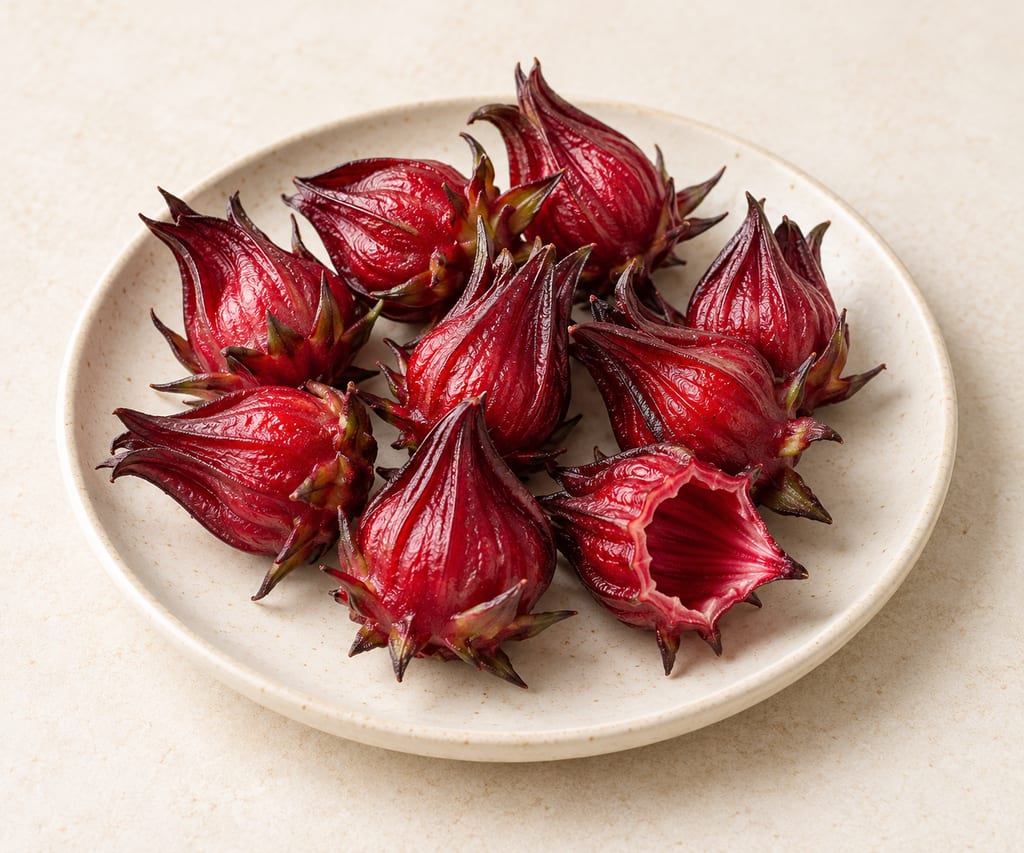
Hibiscus sabdariffa is the familiar name used by the inspected horticultural and food sources. Kew now accepts Sabdariffa gossypiifolia and lists H. sabdariffa as its synonym. These names refer to the same species in that treatment. Roselle and sorrel are common names used in different source contexts. The red or green fleshy calyx surrounds the seed capsule; it is formed from sepals, not petals. Leaves and calyces are distinct food parts.
Food uses in regional sources
NParks describes fresh or dried calyces immersed in hot water for a sweetened drink and calyx use in jams. It also records young shoots in salads, soups, and other vegetable dishes. PROSEA reports young leaves eaten raw or cooked and calyces used for beverages, jams and jellies in several tropical regions. These sources describe different parts and food contexts; they do not provide one complete household formula. The recorded uses are descriptive and do not establish an edible identity for an unknown Hibiscus.
Sources for this section
Flowering and calyx development
UF/IFAS describes roselle as photoperiod-sensitive, with flowering as days shorten; its Florida guide reports flowering about three to four months after planting and commonly in August or September there. The fleshy calyx expands after flowering around the seed capsule. UF/IFAS says harvest size is reached around two weeks after flowering, while NParks gives about 35 days after flower opening. These are source-specific observations with different calendars and should not be combined into a universal harvest date. UF/IFAS also notes that the calyx becomes more fibrous as seeds mature.
Sources for this section
Growing in the open or in containers
The Singapore NParks profile describes roselle grown in beds or containers with at least six hours of sun. It recommends well-drained, moisture-retentive, organic-rich, slightly acidic soil at pH 5–6.5 and lists seed or stem cuttings as propagation methods. It reports moderate water preference, pruning for branching, and flowering 45–60 days from planting seed. These details come from a Singapore gardening profile and are not a general climate prescription. The page gives no pot volume, container depth, greenhouse schedule or cold-protection design.
Sources for this section
Cultivation limits and health claims
NParks lists root-knot nematodes, whiteflies, two-spotted mites, bacterial leaf diseases, and stem or root rot among its cultivation issues; its linked chemical suggestions are not reproduced here as household advice. UF/IFAS describes a taproot and regular watering until establishment. The reviewed sources do not define universal frost, heat or humidity thresholds, an irrigation quantity, or a protected-crop protocol. No medicinal or clinical benefit is claimed.
Sources for this section
Research gaps
No local cultivar, specimen, or name-to-market-product identity check was made.
No complete, attributed household batch with quantities, yield and storage instructions was reopened; beverage descriptions remain preparation context only.
Source-specific calyx harvest intervals differ; no universal harvest date or maturity test is established.
The Singapore profile does not specify container dimensions, while the reviewed sources do not establish frost, heat, humidity or greenhouse limits.
No food-safety, drying, cooling, preservation or shelf-life process was validated.
Research status
The underlying plant account received a partial source review. Its review scope is described in the original plant article.
Sources for this section
Places
Unknown
Relationship not established · Place not establishedThe available research does not establish a single origin for this ingredient.
Community
No community contributions have been published for this entry yet.
Share what you made
Sign in to contribute. Published comments and photos are free to read.
Sources
Royal Botanic Gardens, Kew, Plants of the World OnlineIngredient research
Sabdariffa gossypiifolia (Mill.) M.M.Hanes & R.L.BarrettCited in: Name and plant parts; Research gaps
University of Florida IFAS ExtensionIngredient research
Hibiscus sabdariffa BotanyCited in: Name and plant parts; Flowering and calyx development; Cultivation limits and health claims; Research gaps
National Parks Board Singapore, Flora and Fauna WebIngredient research
Hibiscus sabdariffa L.Cited in: Name and plant parts; Food uses in regional sources; Flowering and calyx development; Growing in the open or in containers; Cultivation limits and health claims; Research gaps
Plant Resources of South-East Asia (PROSEA)Ingredient research
Hibiscus sabdariffa L.Cited in: Food uses in regional sources; Research gaps
FermenteaResearch provenance
Roselle (Hibiscus sabdariffa): original plant researchCited in: Research status