
Mushrooms
Agaricus arvensis
Agaricus arvensis, the horse mushroom, is a large white field mushroom of manured pasture. European sources describe it as a prized edible, and its toxic yellow-staining lookalike must be ruled out first.
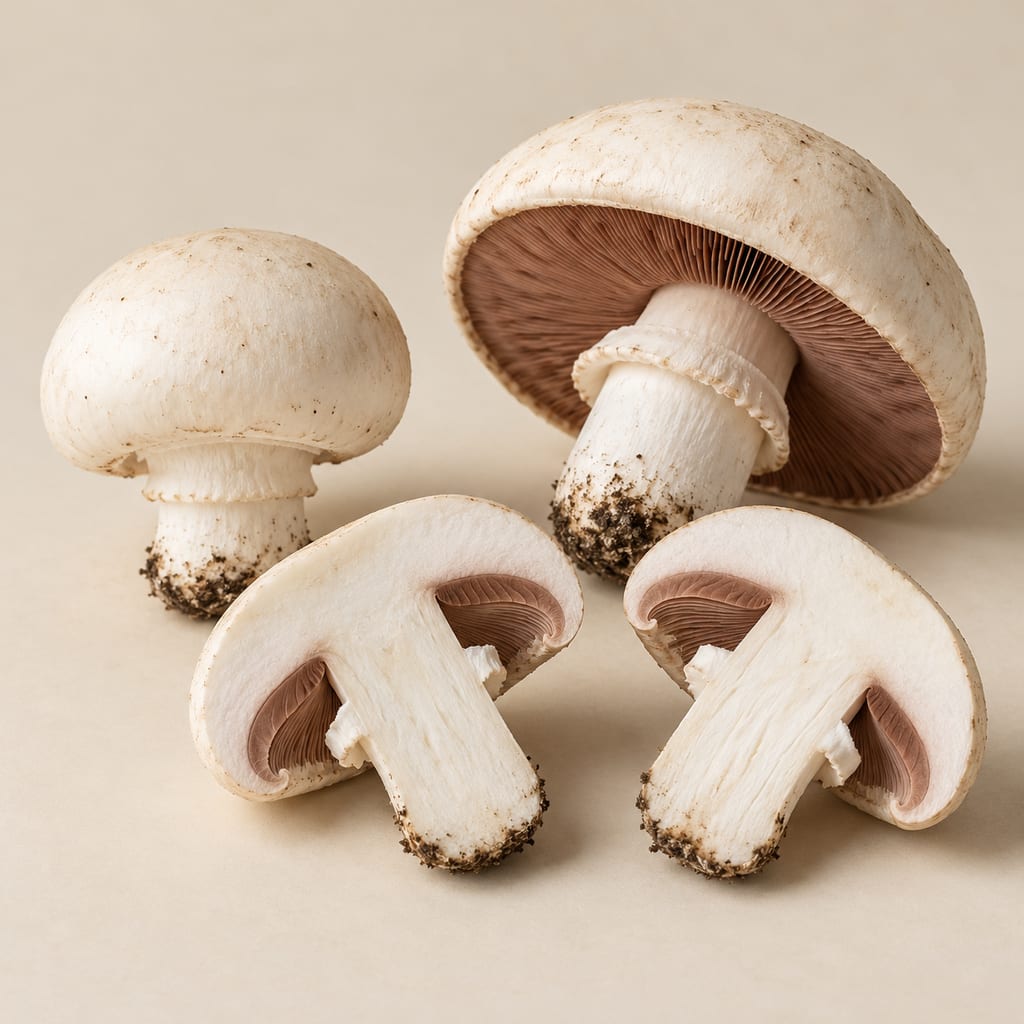
A large white mushroom of the field
Agaricus arvensis has a white cap 7 to 20 cm across, which is smooth and dry and stains yellow where it is bruised, especially when young. The gills start pale pink and darken to chocolate brown. The stem is 5 to 12 cm long, and a large spreading ring is white above, with a cogwheel pattern on its underside. The spore print is dark brown or purple-brown, and the spores are smooth and ellipsoidal, measuring 6 to 9 by 4 to 6 micrometres.
The flesh gives off a strong smell of almond or aniseed, which the sources attribute to benzaldehyde. The stem base does not turn bright yellow when cut, which separates it from the poisonous yellow stainer.
Sources for this section
Name and early description
Jacob Christian Schaeffer described the species, and the epithet arvensis refers to its field habitat. The English name horse mushroom comes from its frequent appearance in manured pasture near stables, though one source notes that horses are not needed for it to grow. The sources give two dates for the first description, 1762 from Bavaria and 1774, and this page does not resolve the difference.
In Australia the species is called the almond mushroom, and in New Zealand the snowball mushroom.
Sources for this section
Where it grows and when
It grows in manured meadows, beside bridle paths and in permanent pasture, and it forms fairy rings. It feeds on decaying organic matter and often grows near nettles. In Britain it is recorded from May to October, and the First Nature page gives a fruiting season of August to November, usually a week or two after the field mushroom. The sources also list records from Iran, South Africa, Japan, Russia, New Zealand, Australia, the United States and Canada.
The catalogue records the supply as regional cultivation. The sources read describe it as a wild mushroom and do not describe commercial cultivation, so this page does not repeat the cultivation claim.
Sources for this section
Cooking and use
The First Nature page calls the horse mushroom a good edible species and suggests using it where a recipe calls for large portobello mushrooms. It works well in risotto, omelettes, soups and sauces. The First Nature page describes its taste as not distinctive.
The sources read give no traditional preparation, no regional recipe and no preservation method. Those are the gaps to fill before this page describes a method.
Sources for this section
Heavy metals and how often to eat it
The First Nature page reports that the species tends to accumulate heavy metals such as copper and cadmium. It presents these as reports rather than measured results. Wikipedia makes the general point that Agaricus species bioaccumulate heavy metals when they grow in contaminated soil. Both sources advise against gathering roadside specimens for eating.
First Nature advises that, if eaten, the horse mushroom is best treated as an occasional food rather than a regular one.
Sources for this section
Identification and lookalikes
The yellow stainer, Agaricus xanthodermus, is the poisonous lookalike that matters most. Its stem base turns chrome yellow when cut, and it smells of ink or iodine. It can cause serious stomach upsets. Agaricus urinascens is very similar but does not turn bright yellow when cut, and its spores are larger, typically 11 by 6 micrometres.
Young horse mushrooms can be confused with Parasola species, because their gills stay white for a long time. The sources also warn that white-gilled Amanita species, such as the destroying angel Amanita virosa and Amanita verna, can be mistaken for an Agaricus. Where the gills are white, the identification must be checked before eating. The First Nature page states the rule: never munch on a hunch.
Sources for this section
Open questions
The sources read do not give a traditional preparation, a food-preservation method, or evidence of commercial cultivation. The next research question is whether the catalogue's cultivation record for Europe is supported by a grower or market source.
Sources for this section
Places
Britain and Ireland
Documented use · Region evidenceRegion-level. The species is described as fairly frequent here; the sources do not date the food use in this area.
Europe
Documented use · Region evidenceRegion-level. Described as occurring in most of mainland Europe; the species is described as a choice edible in the sources read.
Community
No community contributions have been published for this entry yet.
Share what you made
Sign in to contribute. Published comments and photos are free to read.
Sources
WikipediaIdentity · History · Safety
Agaricus arvensisSchaeffer 1774 authority; cap 7-20 cm; odour benzaldehyde; Britain May to October; choice edible; heavy metal bioaccumulation; yellow stainer and Amanita lookalikes.
Wikipedia is a lead; the species facts were checked against the First Nature page.
Cited in: A large white mushroom of the field; Name and early description; Where it grows and when; Cooking and use; Heavy metals and how often to eat it; Identification and lookalikes
First NatureIdentity · Method · Safety · History
Agaricus arvensis Schaeff. - Horse MushroomCap 8-20 cm; stem double ring; spores 6-9 x 4-6 micrometres; August to November; good edible species; copper and cadmium reports; yellow stainer and Amanita virosa warnings; portobello, risotto, omelette, soups and sauces.
Cited in: A large white mushroom of the field; Name and early description; Where it grows and when; Cooking and use; Heavy metals and how often to eat it; Identification and lookalikes; Open questions