
Substrates
Aibika greens
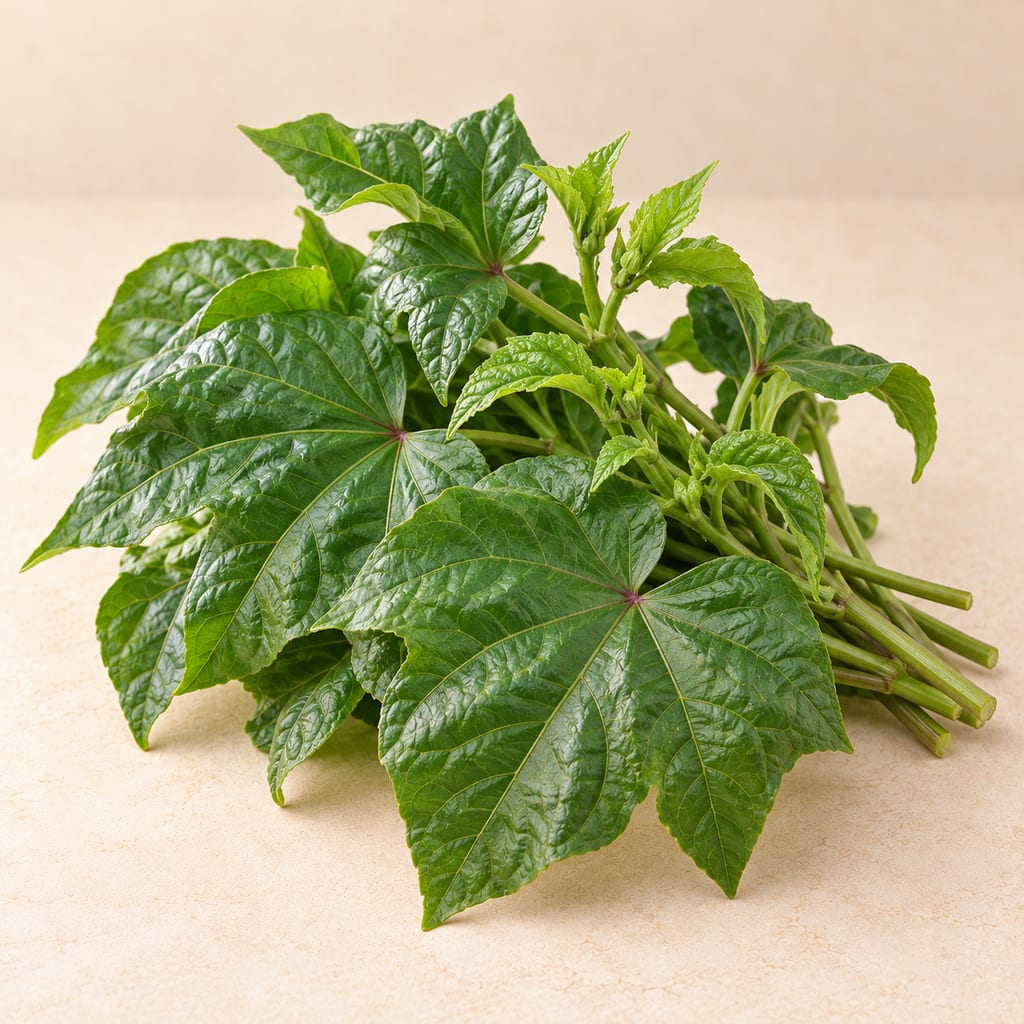
Papua New Guinea sources describe aibika leaves and shoot tips as cooked greens. Crop forms vary, and the reports do not identify a single cultivar or provide a complete recipe.
Name and crop scope
Kew accepts Abelmoschus manihot (L.) Medik., lists Hibiscus manihot L. as a homotypic synonym, and includes New Guinea in the species’ native distribution. Kew also accepts three infraspecific names. PROSEA treats aibika narrowly as a crop concept and discusses a prickly related form separately; that older handbook treatment does not replace Kew’s current accepted infraspecific list. PROSEA also lists the English name “sunset hibiscus”; that common name is not a specimen identification. PNG sources use “aibika” for the crop, but do not map each garden plant or accession to a cultivar or accepted infraspecific name. No specimen is identified here.
Papua New Guinea food reports
The 1993 article describes leaves and shoot tips as food and lists several reported preparations: boiled in coconut cream, steamed, fried, baked in an earth oven with hot stones (mumu or umu), and cooked in coconut cream with hot stones (aigir). PROSEA likewise describes young leaves and stem tips as a cooked vegetable. French describes a mucilaginous cooked texture and reports that frying or steaming with little water changes it. These are separate source-reported practices, not one combined method. None of the sources gives a measured household batch with quantities, yield, ordered stages, endpoint and storage.
Growing reports and their settings
PROSEA says the tropical crop is most often grown from lowlands to about 1,200 m, with slower growth at higher elevations. It reports well-distributed rainfall of at least 1,200 mm per year for good production, sensitivity to waterlogging, and a preference for well-drained loams at pH 5.5–7, while noting growth across a wider soil range. These are regional handbook descriptions, not universal thresholds. The 1993 paper says it was commonly cultivated in PNG lowlands and also at higher sites below 2,000 m. French’s 2006 account says that above about 1,650 m insects appeared to consume growth faster than it grew; this is an observation, not a measured failure limit.
PROSEA describes seed and cutting propagation; its PNG account gives stem cuttings 40–50 cm long, planted about half their length at 25–100 cm spacing in rows 1 m apart, preferably as the main rains begin. The 1993 paper separately describes mature cuttings 30–40 cm long at 1 × 1 m in unreplicated 10 m² germplasm plots at Laloki, replanted annually. These differ by source and setting and are not household instructions. No productive container trial or heated or unheated greenhouse protocol was found.
Germplasm counts and dates
The original paper is in volume 36, number 1 (1993), pages 60–69. Its publisher’s migrated article page separately displays ‘Published 03-11-2025’; the date format and reason for the difference are not explained, so the printed issue date is used here. The paper’s abstract and text report 112 accessions, but its Table 1 entries add to 110. No explanation for the difference is given. A 2026 Melanesian study genotyped 227 accessions across four Pacific settings, including 47 provided by NARI; it cites a 2024 NARI inventory of 63 accessions in research centres. The 1993 collection count, later cited inventory and 2026 study sample describe different dates and scopes and are not reconciled by the inspected sources.
Limits
No source supplies a complete household recipe, validated cooking endpoint, storage duration, safe serving threshold, current accession-to-cultivar map, or household container or greenhouse results. The 1993 accession table is a germplasm account, not a national consumption census. No medical, nutritional, infant-feeding or food-safety conclusion is made.
Research gaps
A complete source-specific cooking batch with quantities, yield, ordered steps and storage was not found.
The 1993 paper reports 112 accessions while its Table 1 entries sum to 110; the source does not explain the discrepancy.
The 1993 printed issue date differs from the migrated publisher page’s ‘Published 03-11-2025’ field; the original reason/date is not established.
The 2024 NARI inventory count cited by the 2026 study is not reconciled with either the 1993 table or the 2026 genotyping sample.
No cultivar-specific identity, frost threshold, household container or greenhouse protocol, current local conservation status or harvesting permission was established.
Sources for this section
- Abelmoschus manihot (L.) Medik. →
- Aibika (Abelmoschus manihot) Germplasm in Papua New Guinea →
- Aibika (Abelmoschus manihot) Germplasm in Papua New Guinea →
- Abelmoschus manihot (L.) Medikus, PROSEA Handbook 8: Vegetables →
- Food Crops of Papua New Guinea: An introduction to the crops, their importance and distribution in Papua New Guinea →
- Genetic diversity and morphological variation of aibika [Abelmoschus manihot (L.) Medik.] in Melanesia →
Research status
The underlying plant account received a partial source review. Its review scope is described in the original plant article.
Sources for this section
Places
Unknown
Relationship not established · Place not establishedThe available research does not establish a single origin for this ingredient.
Community
No community contributions have been published for this entry yet.
Share what you made
Sign in to contribute. Published comments and photos are free to read.
Sources
Royal Botanic Gardens, Kew, Plants of the World OnlineIngredient research
Abelmoschus manihot (L.) Medik.Cited in: Name and crop scope; Research gaps
John W. Sowei and Paul Osilis; The Papua New Guinea Journal of Agriculture, Forestry and Fisheries, 36(1) (1993), pp. 60–69Ingredient research
Aibika (Abelmoschus manihot) Germplasm in Papua New GuineaCited in: Name and crop scope; Papua New Guinea food reports; Growing reports and their settings; Germplasm counts and dates; Limits; Research gaps
The Papua New Guinea Journal of Agriculture, Forestry and Fisheries, article metadata pageIngredient research
Aibika (Abelmoschus manihot) Germplasm in Papua New GuineaCited in: Germplasm counts and dates; Research gaps
A.M. Gurnah; J.S. Siemonsma and K. Piluek (eds.), PROSEA FoundationIngredient research
Abelmoschus manihot (L.) Medikus, PROSEA Handbook 8: VegetablesCited in: Name and crop scope; Papua New Guinea food reports; Growing reports and their settings; Limits; Research gaps
Bruce R. French; ECHO Community, 2006Ingredient research
Food Crops of Papua New Guinea: An introduction to the crops, their importance and distribution in Papua New GuineaCited in: Papua New Guinea food reports; Growing reports and their settings; Research gaps
Floriane Lawac et al.; Genetic Resources and Crop Evolution 73, article 158 (2026)Ingredient research
Genetic diversity and morphological variation of aibika [Abelmoschus manihot (L.) Medik.] in MelanesiaCited in: Germplasm counts and dates; Limits; Research gaps
FermenteaResearch provenance
Aibika (Abelmoschus manihot): original plant researchCited in: Research status