
Substrates
Jambu leaves
Jambu is a Brazilian leafy crop described in Pará food traditions; botanical authorities and Brazilian profiles differ on its origin, while cultivation evidence is specific to Embrapa guidance and a small set of Pará experiments.
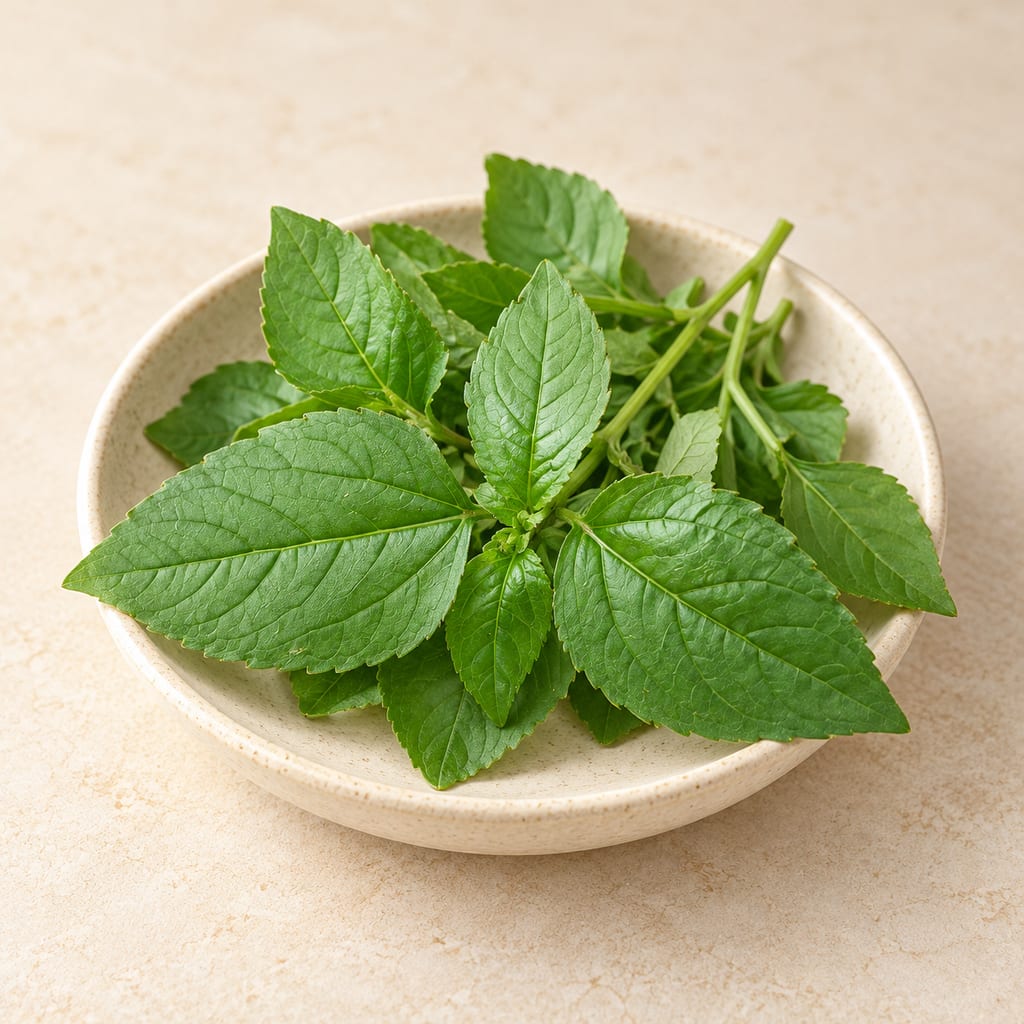
Accepted name and regional names
Kew accepts Acmella oleracea (L.) R.K.Jansen and lists Spilanthes oleracea L. as a synonym. Embrapa's 2017 jambu leaflet uses the older Spilanthes combination for the same named subject; this article keeps one stable species record. Embrapa and the UFSC Horto Didático page list jambu and regional names including agrião-do-Pará, agrião-do-norte and agrião-do-Brasil. A shared food name alone does not identify a specimen.
Sources for this section
Geography and food context
The sources disagree on origin. Kew describes the taxon's native range as a cultigen from southeastern Brazil. Embrapa's 2017 leaflet calls jambu native to Amazonia, while UFSC labels its origin exótica without explaining the geographic reference used for that label. Those statements are retained as separate source classifications; this record does not resolve them by inference.
Embrapa documents jambu in Pará cuisine and names tacacá, pato no tucupi and maniçoba, including increased consumption around the Círio de Nazaré festivities. The IPHAN heritage record describes the Ofício de Tacacazeira as a regional practice of preparing and selling tacacá, primarily carried by women, and names jambu among its ingredients alongside cassava products, dried shrimp and seasonings. Its stated geographic coverage includes Acre, Amapá, Amazonas, Pará, Rondônia, Roraima and Tocantins. This is evidence about a named cultural practice, not plant origin or a uniform recipe for all communities.
Sources for this section
Food parts and preparation reports
Embrapa describes leaves as food, particularly cooked in fish caldeiradas and in named Pará dishes. Its leaflet includes a fish caldeirada with jambu but does not quantify every seasoning or provide a yield, elapsed cooking time or measured fish endpoint; this article does not reproduce directions. UFSC lists leaves and flowers as consumed in natura, while Embrapa emphasizes cooked leaves in its dishes. These are different source descriptions, not a safety comparison or recommendation.
Embrapa describes a tingling or numbing sensation associated with the small yellow flower heads. That is a sensory description, not an identification test, medical effect or basis for a dose. This article makes no medicinal claim and does not recommend an oil or concentrate.
Sources for this section
Embrapa cultivation guidance
The source pages describe the life cycle differently: Embrapa calls jambu a perennial herb, while UFSC's identification section calls it an annual herb. They do not reconcile those descriptions. Embrapa says the plant develops in hot, humid conditions above 25 °C and that dry conditions and temperatures below 18 °C harm growth. It recommends light, well-drained soil with organic matter. Those are source statements, not a controlled global climate envelope. The leaflet gives year-round cultivation for hot, humid regions and August–February sowing for tropical areas with mild or cool winters, so its calendar is explicitly regional.
Embrapa describes seed and stem-cutting propagation. It says cuttings dehydrate quickly, recommends shaded containers for raising seedlings before transplanting to beds, and gives 20–25 cm between plants. Its harvest timing is about 45 days after transplanting cuttings or 80 days after sowing. The leaflet reports two to three bunches per square metre every two to four weeks, with each bunch around 250 g; those production figures are not guarantees for another site or cultivar.
Sources for this section
Field and protected-growing evidence
A 2016 field trial at the Federal Rural University of Amazonia's experimental farm in Igarapé-Açu, Pará, used cultivar Jamburana. The paper reports average daily air temperature of 27.8 °C and relative humidity of 71.1% during that trial, with observed ranges of 21.3–33.9 °C and 41–93%. These are measurements from one location, cultivar and season, not species tolerance thresholds or home targets.
A separate 2019 Belém greenhouse study tested hydroponic nutrient-solution strengths using sterilized ground silica in 2 L pots and maintained solution pH within 5.5–6.5. Those values describe a controlled research system. They are not household recommendations or a comparison of heated and unheated greenhouses. The inspected sources give no mature-pot production guide, greenhouse setpoints, universal pH, or photoperiod requirement.
Storage and open questions
Embrapa reports that leaves in plastic bags in the lower part of a refrigerator can remain in good condition for up to seven days. This is a source-reported quality observation, not a validated safety limit. The sources do not resolve the difference between Embrapa's cooked-food emphasis and UFSC's raw-use listing, provide a measured cooking endpoint, or establish local collection permissions.
Sources for this section
Research gaps
Kew's cultigen range, Embrapa's Amazonia statement and UFSC's unexplained exótica label are different origin classifications; the reviewed sources do not resolve them.
The official IPHAN page was not directly retrievable in this review; its indexed record supports only a partial source reading. The cited record concerns tacacazeira cultural practice, not a plant-origin determination.
Embrapa and UFSC describe different preparation forms; neither source provides an independent food-safety assessment or measured household endpoint.
Embrapa gives regional growing advice; light intensity, photoperiod, universal soil pH, mature container production and home greenhouse controls remain unknown.
The 2016 field trial and 2019 greenhouse experiment are location- and method-specific research, not general production instructions. Embrapa's seven-day storage statement is not a validated safety limit.
Sources for this section
Research status
The underlying plant account received a partial source review. Its review scope is described in the original plant article.
Sources for this section
Places
Unknown
Relationship not established · Place not establishedThe available research does not establish a single origin for this ingredient.
Community
No community contributions have been published for this entry yet.
Share what you made
Sign in to contribute. Published comments and photos are free to read.
Sources
Plants of the World Online, Royal Botanic Gardens, KewIngredient research
Acmella oleracea (L.) R.K.JansenCited in: Accepted name and regional names; Geography and food context; Research gaps
Embrapa Hortaliças; Neide Botrel, Nuno Rodrigo Madeira, Raphael Augusto de Castro e Melo, and Geovani Bernardo AmaroIngredient research
Hortaliças tradicionais: jambuCited in: Accepted name and regional names; Geography and food context; Food parts and preparation reports; Embrapa cultivation guidance; Storage and open questions; Research gaps
Horto Didático, Universidade Federal de Santa CatarinaIngredient research
JambuCited in: Accepted name and regional names; Geography and food context; Food parts and preparation reports; Storage and open questions; Research gaps
Instituto do Patrimônio Histórico e Artístico NacionalIngredient research
Ofício de TacacazeiraCited in: Geography and food context; Research gaps
Engenharia Agrícola; William L. C. de Aviz et al.Ingredient research
Productivity of irrigated jambu under soil-water stresses and nitrogen dosesCited in: Field and protected-growing evidence; Research gaps
Horticultura Brasileira; Italo M. G. Sampaio et al.Ingredient research
Productive and physiological responses of jambu (Acmella oleracea) under nutrient concentrations in nutrient solutionCited in: Field and protected-growing evidence; Research gaps
FermenteaResearch provenance
Jambu (Acmella oleracea): original plant researchCited in: Research status