
Spices and aromatics
Garlic mustard leaves
Alliaria petiolata is a European and Eurasian mustard with UK spring food-use descriptions and RHS garden guidance. The available sources do not establish a complete recipe, a safe quantity, or a general permission to forage.
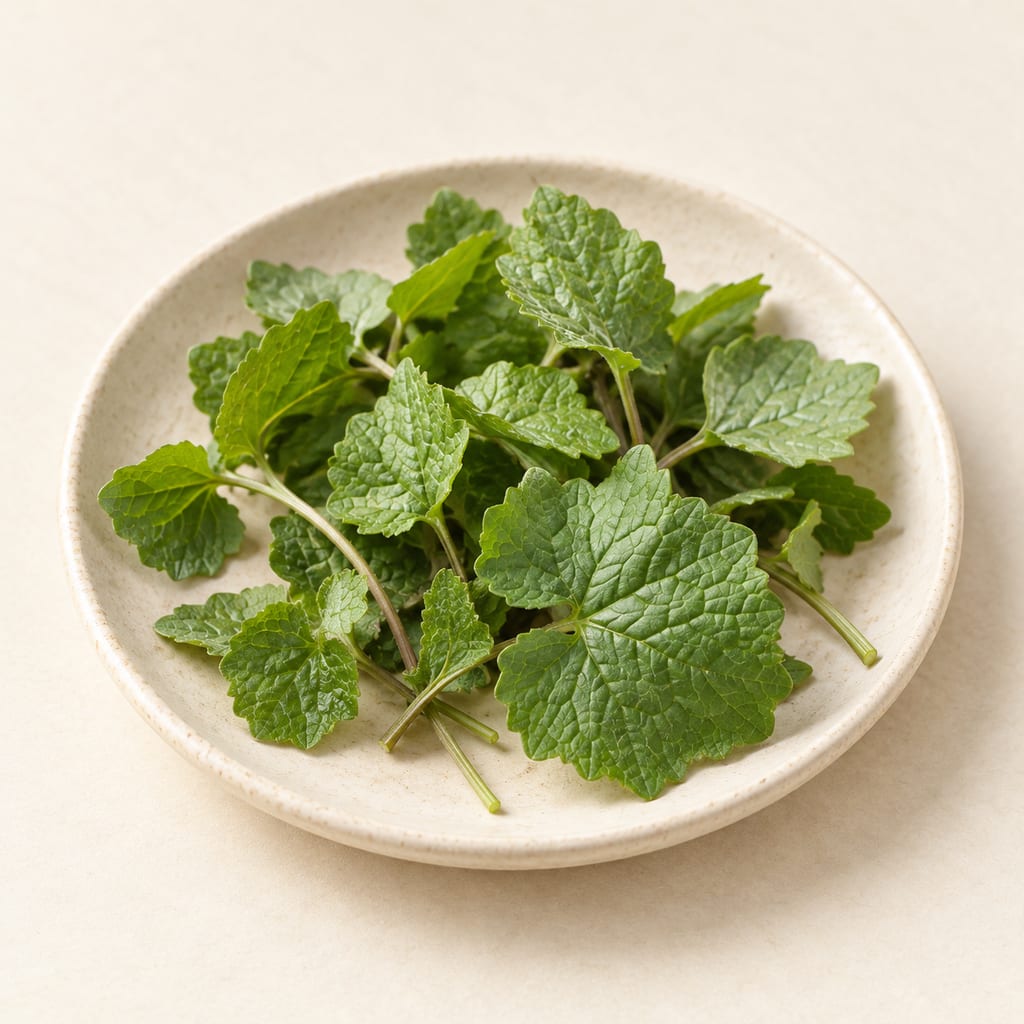
The plant behind the name
Kew accepts Alliaria petiolata (M.Bieb.) Cavara & Grande, a member of the mustard family. Its recorded native range extends from Europe through Central Asia to northern Myanmar and north-western Africa. British names include garlic mustard, Jack-by-the-hedge, hedge garlic and sauce-alone; the RHS also records the Welsh name garlleg y berth. Despite the familiar name and garlicky smell of crushed leaves, this is not an Allium species, and smell alone does not identify it.
Kew Grow Wild describes it as a familiar spring plant of UK hedgerows and woodland edges. In that UK context, the page calls it abundant and says concern about over-harvesting would arise if foraging increased substantially. Minnesota Extension instead identifies it as introduced, invasive and a restricted noxious weed in Minnesota, and says planting or propagating it in Minnesota landscapes is illegal. These regional accounts do not establish status or rules elsewhere.
Food uses reported in the UK
Kew Grow Wild describes young leaves in salads, pesto, sandwiches and sauces, flowers scattered over salads, seeds used whole or ground, and the horseradish-scented root as a historical condiment. It says young leaves are best before flowering and gives February to May as the UK picking season. Its account also connects the name sauce-alone with a 17th-century British condiment served with salted fish and roast lamb. These are source-reported uses and history, not a complete recipe or an endorsement to gather from a particular place.
Sources for this section
What the garden profile supports
The RHS profile lists full or partial shade and chalk, loam or sand, with acid, alkaline or neutral soil categories and moist but well-drained conditions. It assigns UK hardiness H6 in the RHS scheme, whose stated band is −20 to −15°C; this is a scheme category, not a measured survival cutoff for an individual plant. The RHS recommends sowing seed when ripe and says autumn sowing in place is best because seed needs a long chilling period to break dormancy, without specifying a duration, depth or germination temperature.
The RHS presents the plant in a wildlife-garden setting rather than as a quantified food crop. It notes possible caterpillar damage. Kew Grow Wild describes first-year rosettes remaining green through winter, faster second-year growth from April and pods by June in the UK. Those seasonal observations do not establish a harvest yield or schedule elsewhere.
Sources for this section
Limits of the available evidence
The inspected food account supplies no measured quantities, yield, ordered preparation, cooking endpoint or storage period. The sources do not establish a safe amount, a field-identification key, or permission to collect on public or private land. Minnesota Extension’s planting prohibition and restricted-noxious classification are source-reported for Minnesota; their underlying legal text was not independently inspected and they do not determine status elsewhere. The RHS categories are not a potting mix or commercial growing protocol; no productive container or greenhouse method, numeric heat or humidity limit, or other jurisdiction’s collection rule was verified.
Sources for this section
Research gaps
No complete source-specific recipe with quantities, yield, ordered steps, endpoint and storage was verified.
No quantified food-safety limit or preparation-specific safety assessment was established; no amount is inferred from the food-use descriptions.
No field-identification guide or local land-access and collection-permission assessment was completed.
No numeric heat, humidity or survival threshold, productive container regime, or greenhouse growing protocol was found.
Invasive and legal status is jurisdiction-specific. Minnesota Extension reports a restricted-noxious classification and landscape planting prohibition in Minnesota; no non-Minnesota jurisdiction law or site-specific collection permission was checked.
Research status
The underlying plant account received a partial source review. Its review scope is described in the original plant article.
Sources for this section
Places
Unknown
Relationship not established · Place not establishedThe available research does not establish a single origin for this ingredient.
Community
No community contributions have been published for this entry yet.
Share what you made
Sign in to contribute. Published comments and photos are free to read.
Sources
Royal Botanic Gardens, KewIngredient research
Alliaria petiolata (M.Bieb.) Cavara & Grande | Plants of the World OnlineCited in: The plant behind the name; Research gaps
Royal Horticultural SocietyIngredient research
Alliaria petiolata | RHS Plant ProfileCited in: The plant behind the name; What the garden profile supports; Limits of the available evidence; Research gaps
Grow Wild, Royal Botanic Gardens, KewIngredient research
Garlic mustardCited in: The plant behind the name; Food uses reported in the UK; What the garden profile supports; Limits of the available evidence; Research gaps
University of Minnesota ExtensionIngredient research
Garlic mustardCited in: The plant behind the name; Limits of the available evidence; Research gaps
FermenteaResearch provenance
Garlic mustard: a spring woodland-edge edible: original plant researchCited in: Research status