
Substrates
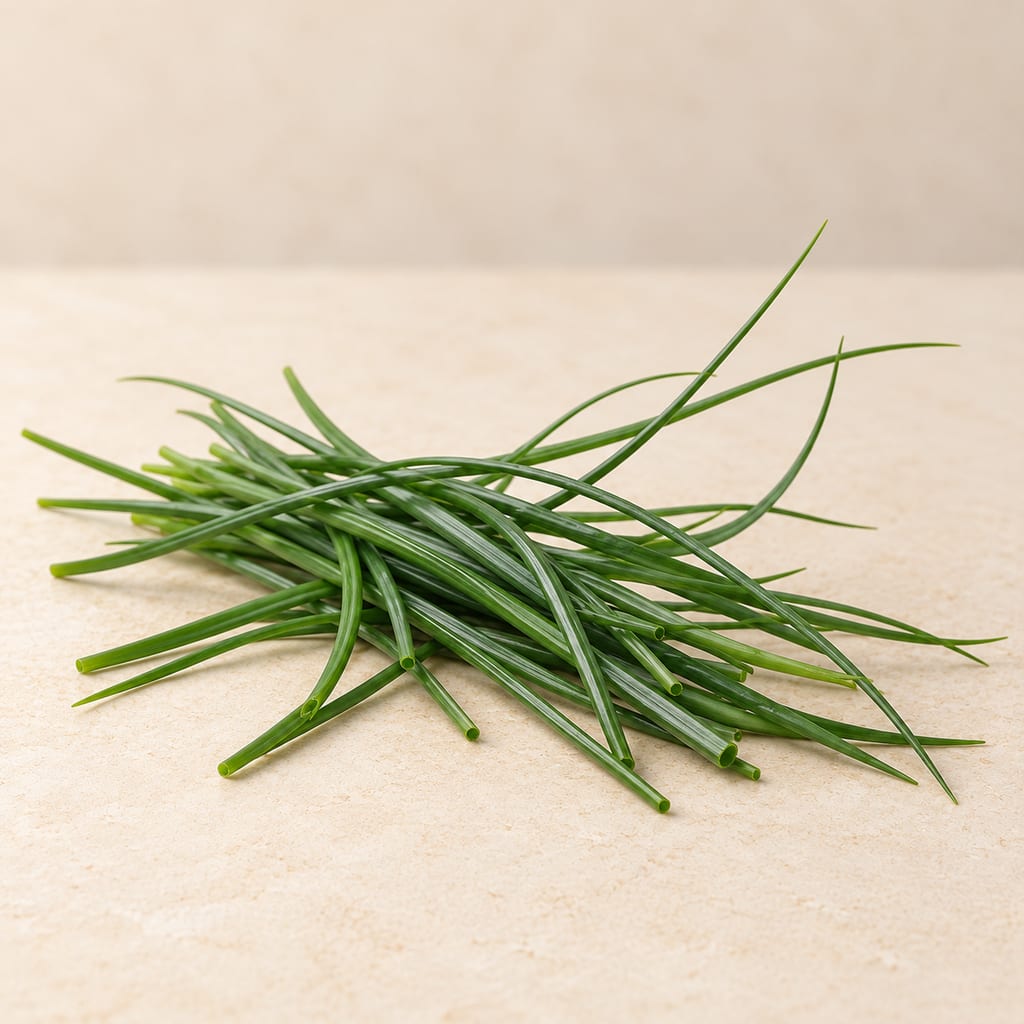
Crow garlic leaves
Allium vineale is a widespread European allium with hollow leaves and bulbil-bearing flowerheads. A White Carpathian ethnobotany study records a narrow, source-specific leaf-use tradition; it does not provide a complete recipe or gathering guidance.
Identity and names
Kew accepts Allium vineale L. and describes a bulbous geophyte native across Europe and the Mediterranean to northern Iran. The RHS profile uses crow garlic, crow onion, false garlic and stag’s garlic among its English names. Those labels are not a substitute for the botanical name: several common names overlap across alliums.
RHS describes hollow, tubular, chive-like leaves and June flowerheads that usually contain many green-to-purple bulbils with few flowers. This distinguishes its profile from RHS’s account of three-cornered leek, which has a triangular flowering stem and white flowers with green midveins. These are source descriptions, not a complete identification key; smell alone cannot identify a gathered plant.
A White Carpathian food account
A 2017 ethnobotany study based on interviews in the White Carpathians of the Czech Republic lists Allium vineale with voucher PAW0025 and the local name Planá pažitka. Its table reports leaves eaten raw on bread or added to soups and scrambled eggs. The discussion says the plant is occasionally gathered in Moravské Kopanice. This describes reported practice in that region, not a general Czech name or a validated preparation.
The paper supplies no amounts, sequence, yield, cooking duration, storage interval or gathering-site guidance for these uses. It does not say the bulb or bulbils are eaten, so the “garlic” common name is not evidence for those parts. The examples are food contexts only, not executable recipes or safety advice.
Growing and seasonal context
The RHS profile assigns H5 in its UK hardiness scheme; the RHS scheme places H5 in the −15 to −10°C band, which is a category description rather than an experimental species-specific frost cutoff. Its profile lists full sun, chalk, clay, loam or sand, moist but well-drained conditions, and acid, alkaline or neutral pH categories. These are garden descriptors, not measured crop optima. North Carolina Extension describes fall emergence and foliage dieback after early-summer flowering in its regional setting; RHS places flowerheads in June in UK conditions. Neither gives a transferable leaf-harvest calendar.
RHS and North Carolina Extension describe spread by bulbils; North Carolina also notes seed and underground offsets. VicFlora records the species as introduced and naturalised in Victoria, including pasture and grassland habitat. Agriculture Victoria’s 2017 schedule assigns different weed categories by catchment; its current pages define distinct duties for those categories. The records do not establish a universal garden recommendation, crop yield, container protocol or current legal determination for a particular property.
Limits of this account
The White Carpathian survey is the inspected food-use source here. It does not establish food practice in every region where the species grows, identify gathered specimens, or validate site cleanliness or safety. The reviewed growing sources describe garden or weed contexts rather than a food-crop system.
Research gaps
No complete household method with measured ingredients, ordered steps, yield and storage guidance was verified for the named leaf uses.
No source establishes gathering permissions, site contamination controls or a safe identification method; common names and odor are insufficient for identification.
The growing evidence is regional garden, extension and flora material; no productive yield trial, home-container design, greenhouse regime or universal climate limits were established.
Victoria’s cited species schedule consolidates a 2017 Gazette and assigns catchment-specific categories; current legal obligations for a location were not determined.
Sources for this section
- Allium vineale L. | Plants of the World Online →
- Allium vineale | RHS Plant Profile →
- Traditional Plant Knowledge in the White Carpathians: Ethnobotany of Wild Food Plants and Crop Wild Relatives in the Czech Republic →
- Allium vineale | North Carolina Extension Plant Toolbox →
- Allium vineale | VicFlora →
- Victorian noxious weeds list by scientific name (2017 Gazette consolidation) →
- Invasive plant classifications →
- Wild garlic and crow garlic →
Research status
The underlying plant account received a partial source review. Its review scope is described in the original plant article.
Sources for this section
Places
Unknown
Relationship not established · Place not establishedThe available research does not establish a single origin for this ingredient.
Community
No community contributions have been published for this entry yet.
Share what you made
Sign in to contribute. Published comments and photos are free to read.
Sources
Royal Botanic Gardens, KewIngredient research
Allium vineale L. | Plants of the World OnlineCited in: Identity and names; Research gaps
Royal Horticultural SocietyIngredient research
Allium vineale | RHS Plant ProfileCited in: Identity and names; Growing and seasonal context; Research gaps
Pawera et al., Human EcologyIngredient research
Traditional Plant Knowledge in the White Carpathians: Ethnobotany of Wild Food Plants and Crop Wild Relatives in the Czech RepublicCited in: A White Carpathian food account; Limits of this account; Research gaps
North Carolina State University ExtensionIngredient research
Allium vineale | North Carolina Extension Plant ToolboxCited in: Growing and seasonal context; Limits of this account; Research gaps
Royal Botanic Gardens VictoriaIngredient research
Allium vineale | VicFloraCited in: Growing and seasonal context; Limits of this account; Research gaps
Agriculture VictoriaIngredient research
Victorian noxious weeds list by scientific name (2017 Gazette consolidation)Cited in: Growing and seasonal context; Research gaps
Agriculture VictoriaIngredient research
Invasive plant classificationsCited in: Growing and seasonal context; Research gaps
Royal Horticultural Society AdviceIngredient research
Wild garlic and crow garlicCited in: Identity and names; Research gaps
FermenteaResearch provenance
Crow garlic: a Czech food record and regional growing context: original plant researchCited in: Research status